
Arjola Trimi: I am not my pathology, but much more: woman, mother and athlete
The multiple champion recalls illness, rebirth and that 'well-being comes from structures, from the possibilities offered to everyone to live to the fullest'

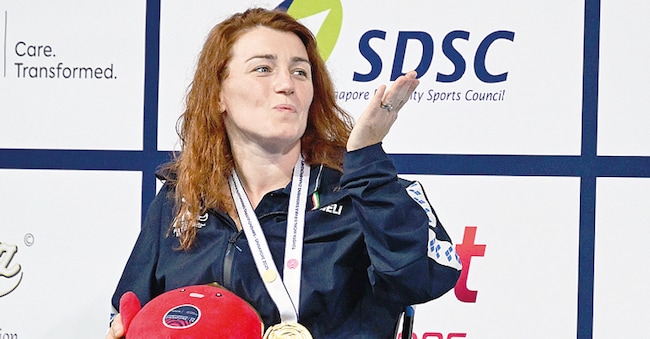
If you have a son called Dipendra - Sanskrit for 'lord of light' - you cannot but be light. Arjola Trimi, a Paralympic swimmer with some fifty medals between World Championships, Games and European Championships, is clear and enveloping light, with her eyes so calm sea and her thoughts so forever. In Singapore, she won gold in the 200 freestyle, category S2, getting the better of Teresa Perales in the last 25 metres. "I kept a constant rhythm, while my opponent dropped so far at the bottom," she recalls on this afternoon, on the terrace of the Sole 24 Ore headquarters, between mountains and light. It seems easy, but it is not so, especially because Arjola had been away from competitions for four years: "The gold in Singapore is the result of a lot of hard work and training, often carried out on days when the body screams from pain, but you can't wait for the perfect set-up, and the most beautiful memory is the award ceremony: i was on the podium, with the medal around my neck, and I blew a kiss to my husband Cristiano and my son Dipendra, who were in the stands (as the photo taken by Augusto Bizzi shows, ndr): my joy is theirs and I wanted Dipendra to see that the sacrifices of his mother and everyone had been realised in that gold".
Arjola, born in Tirana in 1987, arrived in Italy when she was two: 'Mum and dad are engineers, they had a job that rewarded them but they left Albania because the climate was turbulent. They arrived in Lombardy and started again in a cleaning company. They were identified for what they did and not for what they were. The same feeling I have as a person with a disability: people identify you by what you have. I have a pathology and, in their eyes, I am my pathology. But I am so much more, the pathology is a part of me. We are all people and everyone is everything in power. Disability takes away possibilities, it is up to us to find different ways to live fully anyway, that is, to do what we want and express the talent that beats within us'. And Arjola found it in the water: "It is my comfort zone where I am free to be myself at my best. And water was the environment in which to start again when the disease came along: "I was 12 years old, after a bad fall at basketball and many operations one morning I could no longer feel my leg, and then the other one and my right arm. Within a couple of years I was no longer myself. Only after a long time was the pathology identified: degenerative spastic tetraparesis. But, if you don't understand, you don't process'. The rebirth, long and accompanied by a special family, started with wheelchair basketball: 'I was much more than my illness: having awareness changes your perspective. Spasticity took over and Arjola found herself dealing with excruciating, unrelenting pain, but 'in the water I found myself. If you have talent, and I am like a floating cork, you have to cultivate it, it's a responsibility. Sport is sincere and leaves no alibi: you work, you toil, you reap'. As happened to her, starting with Polha Varese, a club that is world-class in giving sports opportunities to athletes with disabilities. We should clone the Polha, its president Daniela Colonna-Preti, its technicians and its volunteers, and instead we are in our own Italy: 'Many steps forward have been made - is Arjola's analysis - but the concept of disability must be incorporated deep down: it affects us all closely, especially in an increasingly elderly country, and people's wellbeing passes through the structures, the possibilities offered to live life to the fullest'. Facts count, not perceptions. As 8-year-old Dipendra teaches us when asked what he thinks about his mother in a wheelchair: 'that I can sit on her lap and be happy'. We learn to look at the world through Dipendra's eyes.


