Space

Artemis II, record for maximum distance from Earth reached

The Artemis II crew is scheduled to dock off the coast of San Diego at approximately 20:07 local time on Friday, 10 April.

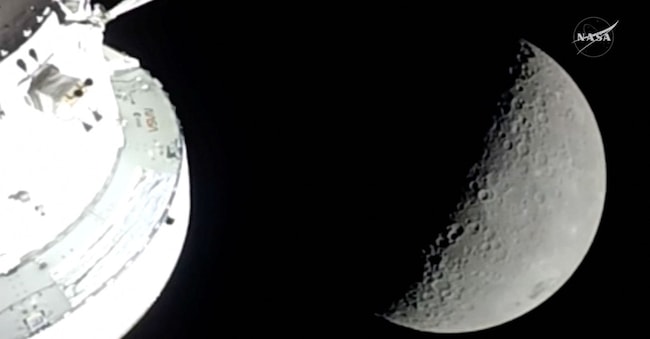
Una vista della Luna mentre la navicella Orion della missione Artemis II si avvicina per raggiungere il punto più lontano dalla Terra, in questa immagine tratta da un video in diretta trasmesso il 6 aprile 2026. NASA/Foto fornita tramite REUTERS    QUESTA IMMAGINE È STATA FORNITA DA UNA TERZA PARTE. via REUTERS

3' min read

Translated by AI
Versione italiana

3' min read

Translated by AI
Versione italiana

The four astronauts aboard the US Space Agency's Artemis II space mission have made history. On Monday, 6 April, at 7:02 p.m. (EDT), the four astronauts on board the Artemis II mission reached a distance of 252,756 miles, or about 406,000 kilometres, from Earth, according to NASA.

They broke the record for the distance ever travelled by man, previously set by Apollo 13 in 1970.

Loading...

The new record was reached at 1.56 a.m. on Monday, 6 April (EDT)*.

This achievement means that the crew of Artemis II was 4,111 miles further from Earth than the Apollo 13 mission achieved in 1970.

At 3.20 a.m. Italian time, the lunar ground observations are completed and at 8.25 a.m. (Italian time) Orion will leave the sphere of influence of the Moon's gravity: this will be the beginning of the journey back to Earth.

The Artemis II crew is scheduled to dock off the coast of San Diego at approximately 20:07 local time on Friday, 10 April.

* (Eastern Daylight Time) indicates daylight saving time on the east coast of North America (UTC-4).
Adopted between March and November, it is 4 hours behind Coordinated Universal Time (UTC-4) and 6 hours behind Italia (CET/CEST).

Artemis II, the crew and the tests

On the Orion shuttle, astronauts Reid Wiseman, Victor Glover, Christina Koch and Jeremy Hansen achieved a record-breaking distance of 4,111 miles over that achieved by the Apollo 13 mission in 1970.

The astronauts have asked permission to name two lunar craters.
They proposed Integrity, the name of their capsule, and Carroll, in honour of Commander Reid Wiseman's wife, who passed away in 2020.

 
"Hello, Artemis II, this is Apollo astronaut Jim Lovell. Welcome to what used to be my area," was the message that woke up astronauts, recorded by the Apolollo 8 pilot in 2025, shortly before his death. "It is a historic day and I know how busy you will be, but don't forget to enjoy the view".

The astronauts also performed a new test of the custom-made pressurised suits called Ocss (Orion Crew Survival System), which can guarantee survival for up to six days. They are essential both during the dynamic phases of the flight, e.g. during launch and re-entry, and in the event of cabin depressurisation and after ditching. The astronauts wore them to test both their tightness and freedom of movement, e.g. to sit on the shuttle seat and to eat and drink.

The day continued with preparations for observing the lunar surface, which took them about seven hours. There were 35 points to be studied and photographed, including the sites where the Apollo 12 and Apollo 14 missions grounded.

There is also the Eastern Sea, a crater with a diameter of over 900 kilometres that lies at the boundary between the visible and the hidden side of the Moon and that will be fully illuminated at the time of Orion's passage.

On the hidden side of the Moon there was the expected communication blackout with the NASA control centre in Texas, which resumed about 40 minutes later. "As we fired up the engines heading for the Moon, I said we were not leaving Earth, and we were," said astronaut Christina Koch when contact with Earth was re-established. "We will explore, we will build spacecraft. We will return. We will build scientific bases... We will be inspirational, but we will always choose Earth."

The astronauts observed, in particular, the Hertzsprung crater, with a diameter of about 600 kilometres. It is at this time that Orion is expected to make its maximum approach to the lunar surface, at 6,550 kilometres.

A little later they witnessed an eclipse as the Moon eclipsed the Sun.

Copyright reserved ©
Loading...

Brand connect

Loading...

Newsletter

Notizie e approfondimenti sugli avvenimenti politici, economici e finanziari.

Iscriviti