World Economic Outlook

Tariff war, IMF cuts global growth estimates below 3%. For the US, one point less

In 2025, world GDP will stand at 2.8%, returning to 3% in 2026, with a downward correction of 0.8% over the two-year period. For the US, growth will be 1.8%, almost one point lower than the January forecast and the 2024 figure. Mexico in recession. Downward correction of 0.6% for China and 0.2% for the Eurozone. For Italy, we go from a GDP growth of 0.7% in 2024 to 0.4% in 2025, with a cut in the estimate of 0.3%.
by Gianluca Di Donfrancesco

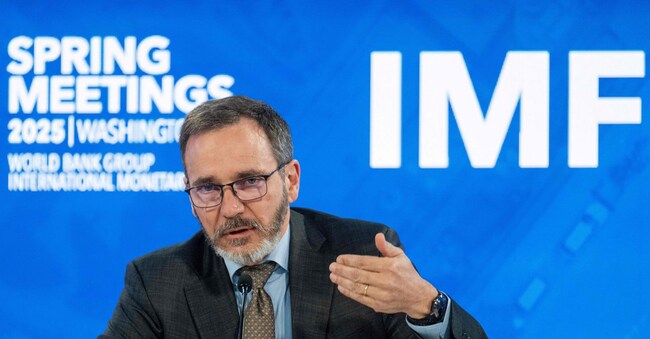
Il capoeconomista dell’Fmi, Pierre-Olivier Gourinchas (AFP)

6' min read

6' min read

The tariff war unleashed by Donald Trump throws global growth below 3%: according to the forecasts just released by the International Monetary Fund, GDP will stop at 2.8% in 2025 and 3% in 2026, a significant slowdown from 3.3% in 2024 and a sharp downward revision from previous estimates, which still pointed to 3.3%. A cumulative correction of 0.8% over the two-year period from an already mediocre pace, which now falls even further below the historical average (2000-19) of 3.7%. In the recent past, except for recessionary episodes, world growth has twice stopped below 3%: in 2008 and 2019. For Italy, we go from a GDP growth of 0.7 % in 2024 to 0.4 % in 2025, with estimates cut by 0.3 %.

In the update of its World Economic Outlook, the Fund emphasises the difficulty in coming up with consistent scenarios, given the volatility of the US tariffs, threatened, announced, suspended and sometimes increased. An uncertainty factor that amplifies the negative shock. The Fund specifies that in the 'reference scenario', its calculations are built on information available as of 4 April 2025. The partial 90-day halt and exemptions on a series of US duties are therefore not taken into account, nor the escalation with China, factors that affect individual countries, but which would not change the global situation much, given the level of the clash between the two largest economies, emphasises the IMF's chief economist, Pierre-Olivier Gourinchas.

Loading...

LE STIME DELL’FMI

Loading...

U.S. loses one point of GDP

Almost all countries face a slowdown in growth compared to 2024 and a cut in forecasts for 2025. Among those losing the most would be the United States: compared to last year's robust 2.4 per cent, GDP growth would stop at 1.8 per cent this year, almost a point lower than the January forecast. 'Duties weigh in at 0.4%,' Gourinchas explains. At the beginning of the year, consumer, business and investor expectations were positive, but were quickly deteriorated by the political uncertainty that manifested itself even before the announcements on duties. Tariffs are also expected to weigh on 2026, with growth stuck at 1.7%. Based on current policies, the US national debt continues to rise, rising from 121% of GDP in 2024 to 130% in 2030.

Mexico is even heading towards recession, with GDP contracting by 0.3% in 2025, compared to 1.5% in 2024 and a downward correction of 1.7% compared to January estimates.

For Canada, the downward correction is worth 0.6 points of growth and stops GDP forecast for 2025 at 1.4%. The countries most connected and most dependent on the United States are among the hardest hit by protectionism.

The Impact on China

.

China, based on the baseline scenario, would lose 0.6 points of GDP, with 2025 growth stuck at 4%, down from 5% in 2024, when the economy was driven largely by foreign demand. The support measures under study by the regime could help absorb some of the blow from Trump's tariffs. Chinese inflation is also slowing (to 0.8%).

Spain is a story in itself

.

The correction for the Eurozone is more moderate: growth forecast for 2025 loses 0.2 % to 0.8 %. In 2026 there should be a moderate recovery to 1.2%, driven by real wage growth and a boost in German public spending, after the changes to the debt constraint passed in March, which should have a positive impact on France, Italy and Spain.

Italy sees its already low recovery expectations for 2025 (0.4%, with a downward correction of 0.3%) downgraded. Growth will also be below 1% in 2026 (0.8%). Public debt is seen rising from 135.3% of GDP in 2024 to 137.3% this year and to 138.5% in 2026. The deficit drops to 3.3% this year and below 3% in 2026.

Germany will continue to ride the edge of recession, with zero growth forecast in 2025 (-0.3% difference from January).

As is now customary, Spain is a story in itself: 2025 growth slows down from 3.2% in 2024, but stands at a robust 2.5%, which is even better than the January forecast (+0.2%). A rare case in this outlook.

Rates and inflation

.

In the reference scenario, the one taking into account only the measures announced until 4 April, the IMF expects the Federal Reserve and the European Central Bank to continue lowering rates, but at different rates. In the US, the rate is expected to fall to 4 per cent at the end of 2025 and reach the long-term equilibrium point at 2.9 per cent only at the end of 2028. In the Eurozone, rates are expected to fall to 2% by mid-year (from 2.25% decided on 17 April).

Strong upward revisions for US inflation, which the IMF expects to be 3% in 2025, one point higher than the January forecast. For the Eurozone, on the other hand, the forecast is unchanged: inflation is expected to be 2.1 % in 2025 and 1.9 % in 2026.

Braking trade

.

Tariffs, reiterate the IMF economists, are a negative shock for the country that imposes them, as resources are reallocated towards the production of uncompetitive goods, with a loss of aggregate productivity, lower activity and production costs, and higher prices. In the medium term, by reducing competition, tariffs increase the market power of domestic producers, reduce incentives for innovation and create rents.

For trading partners, tariffs are a negative external demand shock, driving away foreign customers, although some countries might benefit from the redirection of trade flows.

In the quest for maximum efficiency, global supply chains have reached a degree of complexity that multiplies the distorting effects of tariffs. Most traded goods are intermediate inputs that cross borders several times before being assembled into final products. The difficulties, the IMF report points out, "could propagate up and down the global input-output chain, with high multiplier effects, just as during the Covid pandemic," Gourinchas explains. On this basis, the Fund has revised its projection for global trade (goods and services) growth downwards to 1.7 per cent, a downward adjustment of 1.5 percentage points this year.

Uncertainty about trade policy is also an important factor. The initial reaction of many companies will be to pause and reduce investments and cut back on purchases. Banks will re-evaluate their offer of credit to businesses.

The effect on the dollar

.

The effect of tariffs on exchange rates is not simple. The US could see its currency rise, as in previous episodes. This reflects the reduced demand for foreign currency as import demand falls, but also the likelihood that the affected countries may loosen their monetary policy. However, increased policy uncertainty, weaker growth prospects and an adjustment in global demand for dollar-denominated assets may weigh on the exchange rate, as seen immediately after the recent announcements. In the medium term, the dollar could depreciate in real terms if tariffs result in lower productivity in the US.

What is the reference scenario

.

The IMF's baseline scenario takes into account the announcements on tariffs until 4 April. On 1 February, Trump's executive orders imposed tariffs on Canada, China and Mexico. An additional 10% tariff on all imports from China went into effect on 4 February, and a 10% tariff was imposed on 4 March.China responded with tariffs of 10-15% on imports of certain US agricultural products, energy commodities, and farm equipment, effective 1 February, and on other agricultural products, effective 10 March.US tariffs of 25% on all imports of non-energy goods from Canada (10% for energy) and 25% on all imports from Mexico went into effect on 4 March, with the exemption of goods that comply with the US-Mexico-Canada (Usmca) agreement.Canada announced counter tariffs of 25% on about 40% of imports from the US. The US also extended steel and aluminium tariffs, as of 12 March, removing all exemptions from the 25% tariff on steel and increasing the tariff on aluminium from 10 to 25%. On 26 March, the US announced a 25% tariff on all cars and parts. The measure is effective from 3 April for cars, while the one for components was postponed to 3 May.On 2 April, the US Fairness and Reciprocity Plan was introduced, which imposes a 10% minimum tariff on all countries other than Canada and Mexico, and duties of up to 50% for about 60 states. The universal 10% minimum tariff has been in effect since 5 April and the other tariffs are set to take effect on 9 April. Exemptions were enacted for key goods, such as pharmaceuticals, semiconductors, energy, and certain minerals.Canada's countermeasures, announced on 3 April, consist of 25% duties on fully assembled, non-U.S.-compliant vehicles imported from the United States. On 4 April, China announced tariffs of 34%, corresponding to the increased US duties on imports from China announced for 10 April.

The pre-2 April scenario

In an alternative scenario, built on the situation before 2 April (i.e. with tariffs announced between 1 February and 12 March against Canada and Mexico, the first wave against China, retaliation by Canada and China, and tariffs on steel and aluminium). Global growth would have been 3.2% for both 2025 and 2026, basically in line with the January forecast.


Copyright reserved ©
Loading...

Brand connect

Loading...

Newsletter

Notizie e approfondimenti sugli avvenimenti politici, economici e finanziari.

Iscriviti