
Tariff war, IMF prepares to cut global growth estimates
Director General Kristalina Georgieva warns: there will be 'significant reductions, but not a recession'. "Uncertainty has a cost and the longer it goes on, the higher it goes". Internal and external macroeconomic imbalances need to be addressed: 'Foreign deficits and surpluses can create fertile ground for trade tensions'

3' min read
3' min read
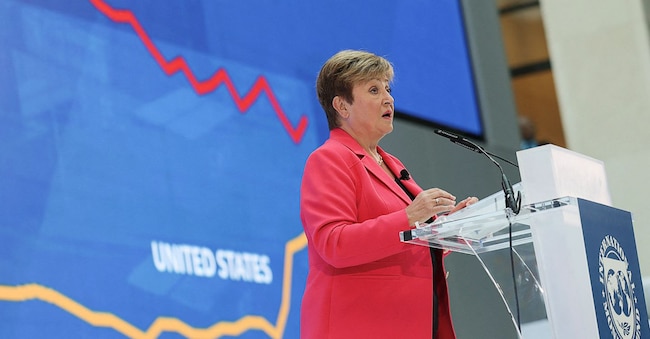
The International Monetary Fund is preparing to cut global growth estimates and to raise inflation estimates for some countries, as the Ocse and practically all national economic institutes have already done, along with the research departments of banks and corporations: this is the price of the tariff war triggered by Donald Trump. An alarm that has just been raised also by Federal Reserve and European Central Bank. Estimates, statistics and forecasts from the IMF will come next week, when the update of its World Economic Outlook will be published. In the meantime, the managing director, Kristalina Georgieva, anticipates that the new projections will reflect 'significant downturns, but not a recession'.
The scenario
.In January, the Monetary Fund had set the expected increase in world GDP at 3.3% in both 2025 and 2026, after 3.2% in 2024. An already 'sluggish' pace and, moreover, exposed to the Trump unknown, which in recent months is proving to be as deleterious as feared. So much so that in March, the OECD had already cut its estimates for world GDP to 3.1% in 2025, 0.2% less than indicated in December. In 2026, growth would stop at 3%, 0.3% less.
On 16 April, the WTO warned that the tariff war will freeze global trade, which could see a drop of between 0.2 per cent and 1.5 per cent this year, depending on how high the tariff wall Trump intends to erect around the US.
The cost of uncertainty
.Estimating the impact that protectionism will have on the world economy and on individual countries is not easy, in a framework continually redefined by the erratic nature that dominates the White House, between announcements, rethinks and relaunches, linked more to personal idiosyncrasies and power plays than to economic logic, from which the decisions on tariffs seem to be completely divorced.
Some firm points are there, however. In her customary speech anticipating the topics of the IMF meetings scheduled for next week in Washington, Georgieva emphasises, for example, that 'uncertainty alone has a cost'. This is seen every day in the markets. From finance to the real economy, 'in a world of bilateral tariffs, which can move up or down, planning becomes difficult. The result? Ships at sea not knowing in which port to set sail; investment decisions postponed; volatility; precautionary savings. The longer the uncertainty, the higher the cost'.


