Current Affairs

Artificial intelligence and employment: the UIL calls for the redistribution of profits and a reduction in working hours whilst maintaining the same pay

Speaking at the national conference, leader Bombardieri proposed the redistribution of the benefits arising from the increase in productivity generated by AI, and that public incentives and industrial policies should be directed solely towards those businesses that use it to create high-quality jobs,

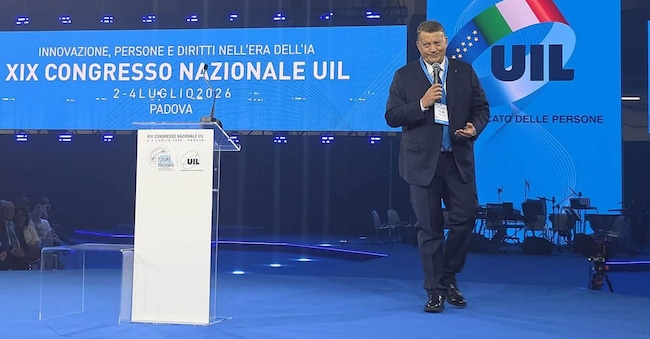
Pierpaolo Bombardieri  Imagoeconomica

4' min read

Translated by AI
Versione italiana

4' min read

Translated by AI
Versione italiana

The increase in productivity generated by the use of artificial intelligence must translate into ‘higher wages, more training, better working conditions and a reduction in working hours for the same pay’. Because if ‘machines produce more, workers should work less and live better’: this is the principle put forward by the UIL, which has placed the issue of artificial intelligence at the heart of its 19th National Congress, with the aim of establishing rules and safeguards that support innovation without leaving workers behind.

Ten proposals: human oversight of automated decisions and the redistribution of benefits

The trade union led by Pierpaolo Bombardieri will present to the Government and the social partners a document setting out ten proposals, ranging from prior information and impact assessments of algorithms, to human oversight of automated decisions; from the right to an explanation and to challenge decisions, to the certification of algorithmic sustainability; and from ongoing training on AI during working hours to the establishment of a National Transition Fund.

Loading...

The proposals include the redistribution of the benefits arising from the increase in productivity generated by AI, the protection of jobs, the creation of national leaders in the technology sector, the protection of the national data heritage, and a review of the rules on redundancies linked to automation and digitalisation. The UIL also calls for public incentives and industrial policies to support only those companies that use AI to create high-quality jobs, improve services and skills, and respect people’s rights.

Particular attention is being paid to the risks of surveillance, algorithmic discrimination and loss of autonomy in the workplace. Hence the call for algorithmic transparency, limits on digital monitoring and greater collective bargaining.

According to the UIL, artificial intelligence can promote growth, innovation and well-being, but only through clear rules, investment, the involvement of trade unions and a public strategy capable of managing the transition, ensuring that the market is not the sole arbiter of change.

Confirmation that the 5% tax relief on contractual pay rises will continue in 2027–2028

In the Budget Bill, Bombardieri claimed that among the ‘positive outcomes’ was the allocation of two billion for labour market measures and for the tax exemption of contractual pay rises. ‘We have been criticised, and in some cases mocked, but the INPS has set the record straight: the funds we requested and which were allocated by the Government have benefited 3,800,000 people. For us, this is a significant achievement – for those communities, for those workers earning less than 35,000 euros gross per year, for the many part-time workers, for the working poor, and for the contracts that have been renewed.” Prime Minister Giorgia Meloni responded positively to the UIL leader’s request for confirmation of the 5 per cent tax relief on pay rises in contracts due for renewal in 2027 and 2028, committing to extend the measure in the forthcoming Budget Bill.

Tax incentives for mergers


Bombardieri put forward a proposal to the employers’ organisations, suggesting that we jointly call on the Government to introduce a 10-year tax cut for companies that merge and expand into new markets, thereby facilitating generational succession and promoting internationalisation, which ‘is, for us, the real solution, rather than competing with China over who has the lowest wages’. Speaking at the UIL congress, the Prime Minister also expressed her willingness to ‘discuss together a preferential tax regime that encourages mergers and generational succession’ with regard to this proposal.

Labour representation: a new agreement with businesses is needed, which must then be implemented by the government

Bombardieri regards the Labour Decree as a ‘victory’, as well as the Government’s decision to define a living wage as the total remuneration set out in the most representative collective agreements, and its decision not to exercise its delegated powers, given that discussions are currently underway between the social partners. ‘I organised two general strikes against the Meloni government,’ emphasised the UIL leader. ‘The government has stated that a living wage is that set out in the collective agreements signed by CGIL, CISL and UIL. This has never happened under any previous government.’

On the issue of representation, the challenge for Bombardieri is to ‘rewrite the rules of industrial relations and map out the future of Italian confederal trade unionism for the coming years. We are working towards signing a new inter-confederal agreement on this matter. To businesses I say: let’s get on with it. We believe the time has come for the ‘erga omnes’ application of collective agreements and that we must begin discussing the implementation of Article 39 of the Constitution – perhaps after reaching the inter-confederal agreement and asking the Government to transpose it into law and support it.”

Election day also marks the election of trade union representatives

On the subject of trade union democracy, Bombardieri has put forward a proposal for an ‘election day’ that would allow all workers – men and women alike – to vote for their representatives on the same day every three or four years.Let us embrace this principle and consider how and where to vote: let us give everyone an additional tool for democracy. “In elections held in the workplace, 80 per cent of those eligible to vote do so, and 70 per cent vote for the lists put forward by the CGIL, CISL and UIL,” he pointed out.

Copyright reserved ©
Loading...

Brand connect

Loading...

Newsletter

Notizie e approfondimenti sugli avvenimenti politici, economici e finanziari.

Iscriviti