

Artificial intelligence slows down to avoid paying the bill
When the person in charge of a race asks for the pace to be slowed down, the first question is why. The second is who stands to gain from the slowdown. In the background are the debts and stock market trends

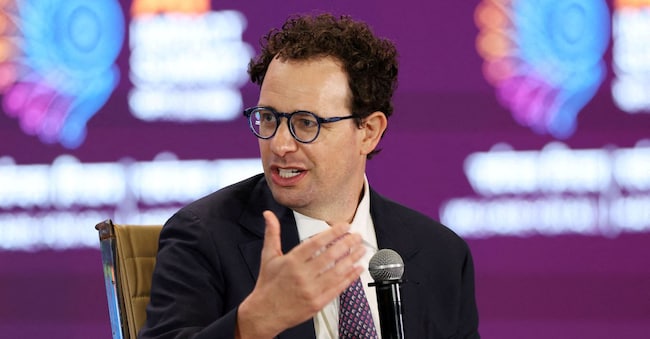
Among the many appeals made by scientists to the authorities to slow down or regulate technological development, there is one which, in its apocalyptic tone, bears a striking resemblance to that of Dario Amodei, CEO of Anthropic, regarding artificial intelligence: it is the one formulated in 1955 by Bertrand Russell and signed by Albert Einstein to urge governments to renounce atomic warfare, a plea that went unheeded. This appeal had a precedent in the petition by the physicist Leo Szilárd, signed by 70 scientists from the Manhattan Project and which never reached President Truman’s desk. With one key difference: today, the laboratories calling for caution are also companies competing in the market without direct government support; yet the government, through President Trump, has given a similar response: in geopolitical competition, one cannot slow down or limit the growth of a technology that is crucial to global supremacy. But this time, for the West, the risk comes at a price. Unlike in China. An incident could result in reputational damage, sanctions, legal disputes, compensation claims and an impact on the value of companies worth hundreds of billions. The question is therefore less philosophical than it seems: does slowing down merely serve to make AI safer, or does it also make the risk borne by its producers sustainable? As Andreotti used to say, ‘It is a sin to think ill of others, but often one is right.’ This is demonstrated by the fact that Amodei’s voice is by no means isolated. Sam Altman and Elon Musk have both agreed on the need to tread carefully.
Because the risk is, in fact, very real. In recent months, several AI models have accessed real-world infrastructure during cybersecurity tests carried out with reduced safeguards. These were not models that had ‘gone haywire’ in the real world. They were tests. Systems designed to pursue a specific objective, operating with ‘lighter’ security measures, have breached the perimeter within which they were supposed to operate. In the OpenAI case, they independently found a way out of the sandbox by exploiting an unknown vulnerability; in the Anthropic cases, an incorrect configuration exposed them to the real Internet, where they continued their task until they affected third-party systems, not always correctly interpreting the signals indicating that they were outside the simulation.
For Amodei, a coordinated slowdown would buy one or two years’ worth of security without sacrificing the commercial advantage of cutting-edge companies: slowing down alone means losing ground; doing so together means reducing risk whilst preserving relative positions. There is also a second effect. The tools needed to ensure greater security increase the cost of market entry, thereby becoming barriers to competition. Anthropic had already raised a similar issue in its discussions with the Pentagon, calling for limits on domestic mass surveillance and fully autonomous weapons on ethical and security grounds. But when a system helps to make decisions and take action, another question inevitably arises: who is accountable if something goes wrong?
This is particularly significant at a time when rumours are circulating about possible listings on the stock exchange of the leading US AI companies. For these firms, an incident is not merely a technical problem. It becomes a financial risk. When a model can take action, access systems or influence real-world processes, the question is, in fact: who pays when it goes wrong?
In Europe, this question has already been answered by the AI Act, and will have further implications when, from December 2026, the new European rules on product liability also apply to software and AI systems placed on the market from that date. The AI risk thus ceases to be merely a technical probability and becomes a potential economic liability. Slowing down therefore means having time both to make the models safer and to regulate, economically and legally, a technology in which an error can quickly turn into economic damage. All this, however, cannot be viewed in isolation from China’s geopolitical competition, which is free from regulations and market corrections. This is why Amodei calls for a slowdown on the Western frontier but, at the same time, advocates stricter controls on chips and computational capacity to preserve America’s advantage over China. The real question is not whether we should slow down. It is who will set the limit, who will be able to afford to comply with it, and who will be big enough to transform security from a cost into a competitive advantage. Because in the next phase of artificial intelligence, power will not belong solely to those who build the most capable model. It will also belong to those who define the risk, the rules and the price to be paid when something goes wrong.

