Face to face

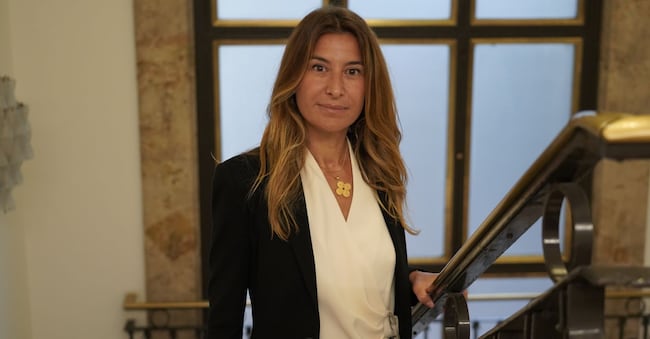
Paola Papanicolaou, from Olympics to finance an international career

The head of Intesa Sanpaolo's international banking division recounts her journey from childhood between two cultures to leading global realities

by Monica D'Ascenzo

6' min read

Translated by AI
Versione italiana

6' min read

Translated by AI
Versione italiana

Quando ti metterai in viaggio per Itaca

There is a thread that runs through the personal and professional story of Paola Papanicolaou, today head of Intesa Sanpaolo's international banking division: it is that of the encounter between different worlds. An interweaving that starts in the family, is consolidated in training and becomes a working method in a career built between Italia, Greece and international markets. A journey, like the metaphor in the poem by Constantinos Kavafis, which has value in itself, while always having the destination in mind. Because it is what we experience along the way that allows us to become what we will be.

Paola Papanicolaou, who carries those verses with her, treasures every encounter, every experience and even every mistake. The daughter of a Greek father, who came to Italia to study medicine, and an Italian mother studying to become a biologist, Papanicolaou soon moved with her family to Athens, where she spent her childhood. Her dual identity, Italian and Greek, was never experienced as a contradiction, but as an asset. "Even as a child, I spoke the two languages together and sometimes made up composite sentences by borrowing words from one and the other. I felt entitled to be both: Italian and Greek. From Greece I absorbed hospitality, sociability, respect for history; from Sicily, where my grandfather had a hotel, contact with different cultures'. It was also during those summers that a natural aptitude for languages was born: today he speaks five - Italian, Greek, English, French and German - and continues to study new ones. "I'm learning Serbian and Croatian: it's a gesture of attention towards colleagues, even just making a joke in their language changes relationships. I also read Cyrillic. I am constantly doing memory exercises to learn the words of other languages'.

Loading...

Training

Curiosity is the trait that marks his entire childhood: piano from the age of seven, dance, artistic gymnastics, competitive swimming. "I loved learning new things and I believe that learning never ends". A predisposition that also translates into method: full days and studying in the evening, after 10.30 p.m., with full responsibility for one's choices.

His decision to study in Italia stemmed from his desire to gain a more solid understanding of one of his two roots. Papanicolaou started university in Messina attending Economics and continued in Pisa, in the Banking Technique course. It was here that he met professors such as Roberto Caparvi, one of the first to introduce the subject of cash flow in the banking system, and where he developed an interest in the transformation of the financial sector: 'For my thesis I was asked to make predictions on the future of the banking system: an exercise that taught me to look ahead.

The academic experience is enriched by working as a volunteer assistant and participating in examination boards. "In that context you learn to read people, behaviour and attitudes beyond words. It's a skill that I use a lot today in interviews to better understand my interlocutor, beyond what he or she tells me". A sensitivity that goes hand in hand with admiration for those who manage to combine technical skills and human attention.

Working in major international events

Before his permanent entry into the banking world, Papanicolaou gained significant experience in the organisation of major events, from the Athens 2004 Olympics to the Turin 2006 Olympics. "In those contexts you learn to work with limited resources, time constraints and very different people, often volunteers. You have to involve them and get them to give their best, even knowing that they are not paid for the work they are doing and that they are there for the most diverse reasons'. A context that develops special time management and a strong result orientation. "I'm the kind of person who does everything to get to the goal within the deadline. And in those experiences I learnt a different perception of time than someone working in a less demanding context. Also because at such well-attended events there is an immediate response from the public, which serves as a litmus test of the work you have done".

The entrance to the bank

The transition to the banking sector took place in a context with still few women in positions of responsibility. At Monte dei Paschi di Siena, the manager took on increasing responsibilities, up to roles of responsibility even greater than the experience she had gained up to that point. 'I found myself managing the commercial management of Tuscany, Umbria and Marche: an important challenge. It was here that she developed a managerial style based on direct listening: in 2012 she visited most of the 365 branches.

"I was advised to go branch by branch: to get to know the bank and make myself known. I listened a lot and realised that there are many shades of perception of reality. You have to ask questions, this was a trump card to create a bond of empathy with a very strong union environment'. On the other hand, the bank was going through a complex period and the managers made a difference in involving people: 'There were objective difficulties and messages were being given to the network to do more. It was therefore necessary to tell the business plan and also explain why certain decisions were being taken'.

From that experience 'in the field' also arose a key message, which became the hallmark of his approach: 'Ours is a beautiful job, because we can help people and companies create a better future for themselves financially'. A message shared with the entire network, also through direct contact with thousands of employees. "The attachment of Mps employees to the bank in difficult times has been remarkable," the manager still acknowledges.

Relational Capital

Attention to the human dimension of work is one of the elements that Papanicolaou has found in Intesa Sanpaolo: 'In the new business plan, our CEO Carlo Messina once again emphasises how our people are our most important resource.

A relational capital that becomes even more central in the transition to the current international role. After a path full of diversified experiences in the Intesa Sanpaolo Group, with responsibilities in wealth management and in the area of technology, today he leads a complex reality: eleven banks in twelve countries between Central Europe, the Balkans, Egypt for a total of about 900 branches and 7.4 million customers.

"The biggest challenge is to find common goals in such different geographies. The answer is not standardisation, but a balance between standardisation and autonomy. "I am a great believer in teamwork: you have to identify a few shared principles and build on those, respecting local cultures. Our challenge, also with the support of the other Business Divisions in Italia, is to create many regional realities that are harmonised with each other. To do this, it is necessary to shorten the distances to Italia and, at the same time, try to understand and respect the different local cultures'.

Knowledge of languages and cultural dynamics becomes a competitive advantage in order to succeed: "In the branches, people often speak little English: when I arrive and use their language, there is surprise and the cultural distance is immediately shortened. An approach that is also reflected in governance: the major foreign banks participate in decision-making through a management board of the largest six, strengthening the sense of shared responsibility. The Intesa Sanpaolo group's strategic plan, just presented by CEO Carlo Mesina, also includes the rebranding of its international subsidiaries, which will start by the end of the year in Ukraine, Moldova and Hungary. "This plan envisages for the International Banking division an integrated development with all the group's activities in a stronger way than in the past".

Integration between cultures

And the contamination goes both ways. 'When I came to work in Italia I suffered a fundamental difference with Greece: in the Balkan countries expressing different opinions at meetings is normal; in Italia it can be perceived as a hostile act'. Differences that require mediation skills and adaptation. 'Respect is earned in the field. Even when on paper you may seem less prepared, you have margins to win the trust of the people you work with. I like to work to turn obstacles into partnerships".

The method remains the one built up over the years: structure, discipline, but also room for creativity. "We must industrialise processes, simplify and standardise them, but then leave freedom for the 'personal touch'". A synthesis between rigour and flexibility that reflects, after all, its history: a balance between different identities, held together by a curiosity that never runs out. Because as Kavafis writes in his poem: "Made wise by now, with all your experience on/You will have understood what Ithaca means".

Copyright reserved ©

Brand connect

Loading...

Newsletter

Notizie e approfondimenti sugli avvenimenti politici, economici e finanziari.

Iscriviti