
From Aster missiles to torpedoes: this is what the frigate Martinengo sent by Italia to defend Cyprus looks like
At least 160 Italian Navy personnel will reach the Cyprus area

Key points
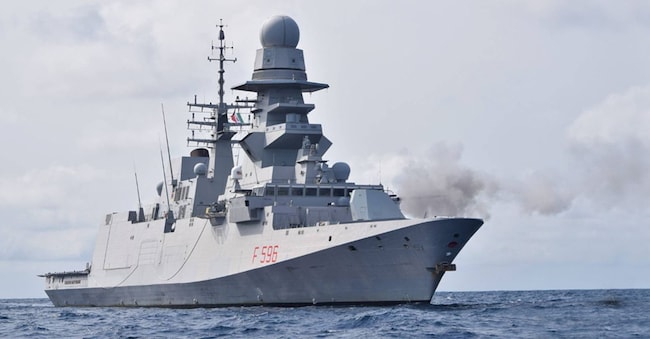
In the end, Italia decided. The missile frigate 'Federico Martinengo' is the Italian Navy ship designated for the defence of the Cyprus area, for the operation as part of an arrangement in coordination between Italia, Spain, France and the Netherlands. Last year the Martinengo concluded its engagement in the European mission Eunavfor Aspides in the Red Sea, returning to the naval base in Taranto after protecting merchant traffic from Houthi threats. At least 160 Italian Navy personnel are now reaching the Cyprus area.
The Italian Martinengo - one of Italy's most advanced naval defence assets - is equipped with anti-aircraft and anti-ship missiles, cannons and torpedoes. It can also accommodate helicopters and is equipped with sophisticated radar and sonar systems. It will be able to spot any drones or rockets up to a distance of about two hundred kilometres with its radar, while the Aster missiles, active within a radius of one hundred kilometres, could neutralise the threats.
In the last few hours there had been rumours that the frigate to be sent to Cyprus could be the 'Schergat', currently engaged in Operation Safe Mediterranean, but in the end the choice fell on the Martinengo.
Built in Fincantieri's Riva Trigoso shipyard, the Martinengo was delivered to the Navy on 24 April 2018. It is the seventh Italian Fremm unit. In fact, the Italian-French Fremm international cooperation programme envisaged for Italia the acquisition of 10 multi-mission frigates (4 of the 'General Purpose' type characterised by high flexibility in operational deployment and 6 of the anti-submarine type - characterised by greater capabilities in that particular form of operational deployment). Both versions have an excellent anti-aircraft and anti-ship defence capability, and can employ SH90/EH101 helicopters. Martinengo is the third in multi-role configuration after the 'Carlo Bergamini' and 'Luigi Rizzo', delivered to the Navy in 2013 (the former) and 2017 (the latter). Fremm frigates can reach a maximum speed of 27 knots and accommodate up to 200 people, including crew and personnel.
The features
It has a length (overall) of 144 metres, a maximum beam of 19.7 metres and a maximum height from the keel line of over 44 metres. The maximum draught is 8.7 metres, with a full load displacement of 6900 tonnes.

