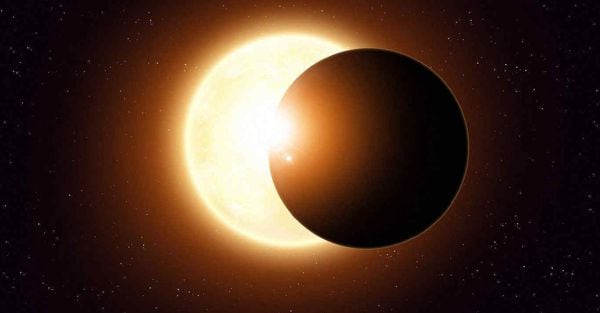
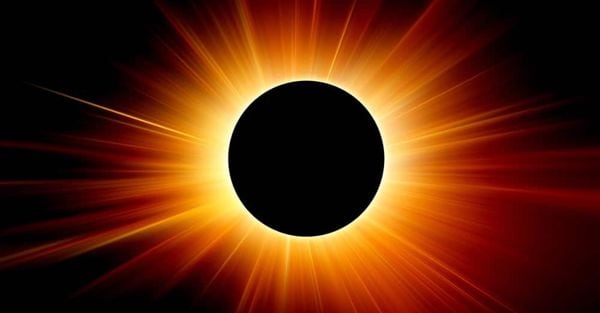
The solar eclipse at sunset is also visible from Italia
The sky treated us to one of nature’s most fascinating spectacles

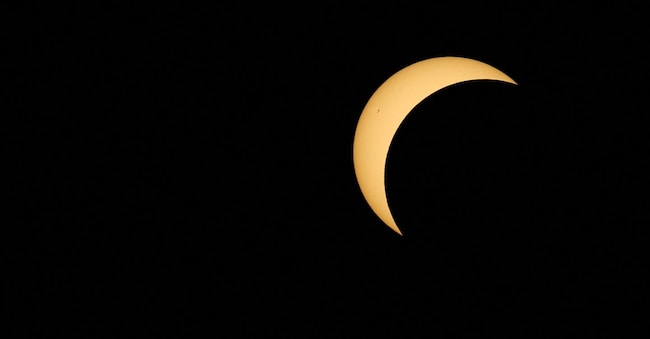
On 12 August 2026, the sky treated us to one of nature’s most fascinating spectacles: a solar eclipse that was also visible from Italia at sunset. An event that combines astronomical precision with visual wonder, still capable today of drawing millions of people to gaze towards the horizon.
A solar eclipse occurs when the Moon passes between the Earth and the Sun, obscuring the Sun’s disc. It is the result of an alignment between the three celestial bodies, which is only possible under specific conditions because the Moon’s orbit is tilted relative to that of the Earth. It is precisely this inclination that prevents a solar eclipse from occurring every month, making it a less frequent phenomenon, visible only from a specific area of the planet. The Sun’s diameter is about 400 times that of the Moon, whilst the Sun’s distance from the Earth is about 390–400 times that of the Moon; this is why the discs of the Sun and the Moon appear virtually identical in the sky – at about half a degree – and a total eclipse is possible.
Beyond the scientific explanation, an eclipse remains one of the most evocative phenomena observable with the naked eye (with the necessary protective equipment). The quality of daylight changes; it dims in an unusual way, shadows become sharper and the atmosphere takes on almost unreal hues. It is hardly surprising that eclipses have always captured the human imagination, inspiring both fear and wonder.
For centuries, in fact, they were viewed with fear, particularly in societies lacking the scientific tools to understand them: the sudden darkening of the Sun was interpreted as a divine sign or an omen of misfortune, or as the work of mythical creatures that ‘devoured’ the Sun. There was no shortage of rituals and noises designed to drive away the darkness. With the progress of astronomy, this aura of mystery has faded, but not the fascination. Some eclipses have gone down in history: the one in 585 BC, which, according to tradition, interrupted a battle between the Medes and the Lydians; the one in 1919 observed by Arthur Eddington, which helped to confirm Einstein’s general relativity; and, more recently, the great total eclipses that crossed the United States in 2017 and 2024, watched by millions of people.
The phenomenon unfolds gradually: the Moon begins to cover the Sun, marking the start of the partial phase, which can last for over an hour. It then reaches its peak, when the obscured portion is at its greatest, before slowly returning to normal. In Italia, the eclipse on 12 August will remain partial throughout, but in some areas the coverage will be very extensive.