Products

Asus bets on AI agents: the future of the PC passes through artificial intelligence

At Computex 2026, the Taiwanese giant celebrates 20 years of ROG, introduces the Zenni Claw assistant and raises the challenge of artificial intelligence embedded in devices

from our correspondent Luca Tremolada

6' min read

Translated by AI
Versione italiana

6' min read

Translated by AI
Versione italiana

TAIPEI -Playing at home always has an advantage. At Computex 2026, Asus arrives in this spirit. It is not just one of the big players at the Taipei technology fair. It is one of the brands that more than others tell the story of the evolution of the Asian hardware industry.

This year the stage has a special significance. ROG, Republic of Gamers, turns 20 years old. Two decades ago it was a brand for overclocking enthusiasts and extreme components. Today it has become an ecosystem ranging from notebooks to desktops, from peripherals to professional gaming technology. A birthday that Asus celebrates in the symbolic place of its growth: Taiwan. But the real message of Computex 2026 is not gaming. It is artificial intelligence.
Loading...

The Taiwanese company has built its presence around three pillars: bringing premium technologies to the most affordable segments of the market, celebrating 20 years of ROG, and launching the new Agentic AI platform. This is where the most interesting game is played. The idea is simple to tell but complex to realise. So far we have had chatbots that respond. Asus is instead aiming for digital agents that act. Specialised assistants for work, personal life and travel, capable of performing tasks and orchestrating services without requiring technical skills. No complicated prompts, no command lines. The stated goal is a 'click and play' experience, with built-in protection systems to avoid errors, data leaks or unwanted behaviour.

The message coming from Computex is clear. Asus, like other computer manufacturers, can no longer just sell computers. It must build an infrastructure in which hardware, advanced materials and artificial intelligence work together. Artificial intelligence thus becomes the red thread running through the entire product range presented in Taipei. That is why the most interesting novelty, however, is not the hardware.

What is Zenni Claw?

It is called Zenni Claw and is the new AI assistant developed by Asus. The Taiwanese group is trying a different route: three-step installation, simplified interface and ready-to-use skills. The idea is to create a kind of digital secretary capable of organising tasks, planning trips and managing daily activities. A similar choice is being made by other computing bigwigs, such as Lenovo, and others will soon follow, because with the high memory costs, prices will not tend to fall and more reasons to buy are needed.
The technical choice is significant. Zenni Claw uses hybrid logic: some operations are performed locally, others in the cloud. A bit like deciding whether to drive on an urban road or the motorway depending on the traffic. The system chooses the most efficient route between speed, cost and privacy.

And then there is the new hardware. What's new in the Zenbook 14 and Vivobook S

As usual, the new Zenbook 14 and Vivobook S were presented here at Computex on all platforms: Intel, AMD and Snapdragon. Up to 50 TOPS of processing power thanks to the new NPUs, the specialised AI processors. The goal is to perform many tasks locally that until yesterday required the cloud: transcriptions, document summaries, image generation, intelligent assistance and predictive functions.

The strategy follows an industry-wide trend. After years in which artificial intelligence lived in data centres, manufacturers are bringing some of the computational power directly back to the devices. This is an important change because it reduces response times, bandwidth consumption and privacy issues.

How do they look?

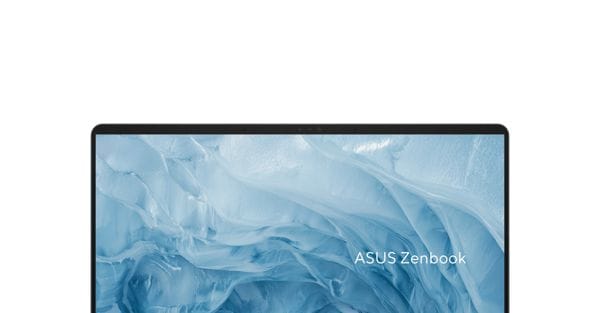
Of the chips we have already mentioned: the multi-platform strategy is confirmed with Qualcomm Snapdragon X, Intel Core Ultra and AMD Ryzen AI processors. The new Zenbook 14 weighs just 1.2 kilograms and promises over 21 hours of battery life. Numbers that tell a precise direction: the PC must accompany the user for an entire working day without depending on a power outlet.

The Vivobook line also relies on the same philosophy. Snapdragon processors, a battery life of more than 25 hours and OLED screens up to 16 inches. The idea is to turn the notebook into an always-on tool, capable of alternating study, work and entertainment without interruption.

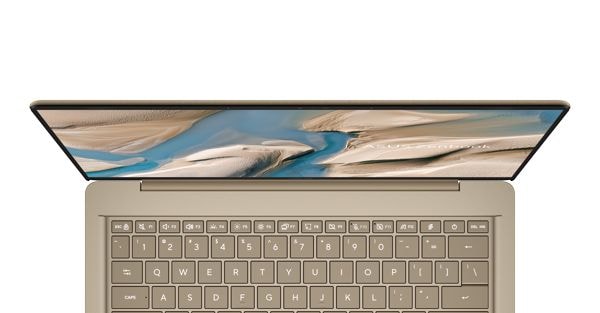
Ceraluminum, presented last year, will be used on the entire range in 2026, covering the entire frame for some models and just the lid for others. It is not a simple paint, but a material obtained by means of a plasma bath that manipulates the molecular structure of the metal, giving it unique properties of durability and reduced environmental impact. This process allows unprecedented colours to be obtained without the use of dyes, but by exploiting the different oxidation states of metals, such as the new blue-grey variants and a golden pink.

Specifications include up to 24 GB RAM, a 14-inch OLED screen with a screen-to-body ratio of 88 per cent, IR camera for facial unlocking and a smooth and stable 'easy lift' hinge. The claimed autonomy is exceptional: up to 26 hours of video playback in the AMD version and 21 hours in the Snapdragon version. A very important detail for longevity is the presence of an internal PCIe Gen 4 M.2 2280 SSD slot, which allows the user to upgrade the storage memory independently.

New for business, Asus redesigns the office computer

In the business segment, the new ExpertBooks arrive. The ExpertBook E5 Flip G2 reduces weight and thickness, introduces Wi-Fi 7, and promises 50 per cent longer battery life. It is not a traditional notebook, but a machine designed to move between office, classroom, video conferencing and field work. A computer that folds 360 degrees because work no longer has a fixed form.

Even more interesting is ExpertBook P5, which already looks to the post-quantum era by integrating Post Quantum Cryptography algorithms. A technology that tries to answer an increasingly concrete question: how to protect today the data that quantum computers could decrypt tomorrow.

Under the casing works the new generation of Intel Core 3 Series processors with a dedicated NPU capable of reaching 18 TOPS. During a demo at the Asus offices in Taipei, we are shown the advances in build quality. The I/O ports hold up to eight kilos of weight, the computer can hold more than a large glass of water on the keyboard, and can be picked up and lifted to the corner of the screen without bending.

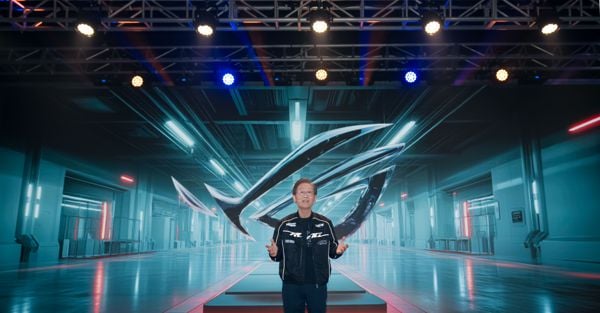
Il presidente storico di Asus Jonney Shih

Then there is the ROG world.

All of Rog's top brass were there to celebrate 20 years of this number one handle in the hearts of avid gamers. Here Asus continues to push the envelope on extreme hardware. The new Strix Scar 18 comes in at a total power of 320 watts, powered by a 450 watt charger and cooled by a giant vapor chamber. The Mini-LED screen introduces a new technology that drastically reduces blurring in moving images, one of the most critical aspects for competitive gaming.

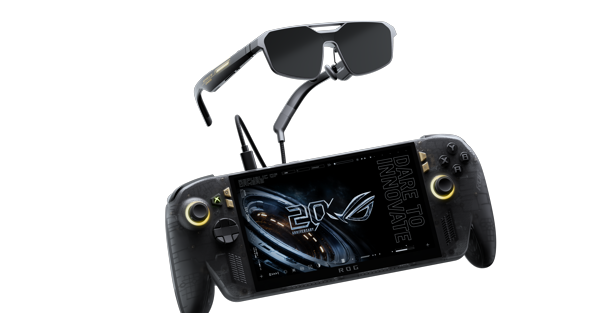
Asus and Microsoft on the occasion of their 20th anniversary have re-launched the challenge in the portable console market with the new ROG Xbox Ally X20, a celebratory version for the 20th anniversary of the Republic of Gamers brand that aims to bridge the gap between PC gaming and the Xbox world. The most obvious new feature is the arrival, for the first time on the Ally family, of a 7.4-inch OLED screen with 120Hz refresh rate and 1,400 nits peak brightness, designed to improve visual quality even in the most dynamic games. Under the transparent black casing with gold details works the new AMD Ryzen AI Z2 Extreme processor, flanked by 24 GB of memory and 1 TB of storage. The machine also introduces support for Microsoft's Auto SR technology, hitherto reserved for Copilot+ PCs, which uses artificial intelligence to increase the resolution and fluidity of games. Rounding out the package are the ROG XREAL R1 Edition 20 AR glasses, capable of simulating a 171-inch virtual screen, turning the console into an immersive portable gaming station.

And finally, the return of the tablet

There is also a surprise in the 2026 catalogue. Asus is returning to the tablet market with the ASUS Pad. A 12.2-inch OLED screen, 144 Hz refresh rate and a weight of just over 500 grams. Specifications that show how the boundary between notebook and tablet keeps getting thinner and thinner. It is no longer the secondary device of the decade. It is an AI terminal designed to consume content, take notes and collaborate with the smart app ecosystem. However, we do not know if it will also arrive in Italia.

Copyright reserved ©
  • Luca Tremolada

    Luca TremoladaGiornalista

    Luogo: Milano via Monte Rosa 91

    Lingue parlate: Inglese, Francese

    Argomenti: Tecnologia, scienza, finanza, startup, dati

    Premi: Premio Gabriele Lanfredini sull’informazione; Premio giornalistico State Street, categoria "Innovation"; DStars 2019, categoria journalism

Loading...

Brand connect

Loading...

Newsletter

Notizie e approfondimenti sugli avvenimenti politici, economici e finanziari.

Iscriviti