
Denmark beats the US at Ces 2026 with a 'smart' brick
For once, thanks to Denmark's Lego, Europe beat America at the Consumer Electronic Show, but only in jest. Here is what we understood about Smart Brick

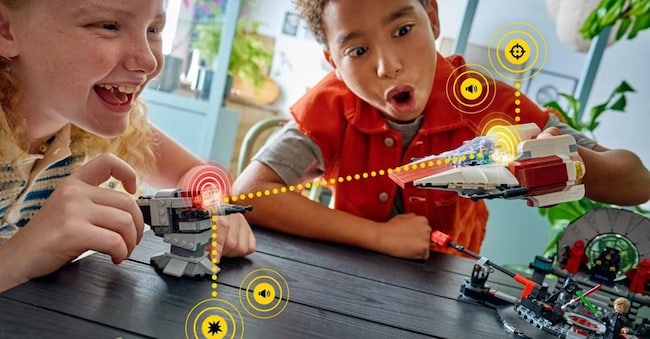
At Ces in Las Vegas, Denmark beat the US. In fact, it beat everyone. While tensions run high between Washington and Copenhagen over Greenland, the small European country that is home to the multinational toy company Lego took great satisfaction by appearing for the first time at the biggest consumer electronics fair with a product that proved to be the most interesting and innovative piece of technology this year. At Ces 2026, the most surprising object was neither an artificial intelligence chip nor a humanoid robot, but a brick. The new system is called Smart Play and at the heart of it all is a Smart Brick that, to look at it, looks like a normal Lego brick. Same shape, same joint, same philosophy. Inside, however, there is a concentration of technology: a microchip just a few millimetres big, movement sensors, accelerometers, light detectors, small LEDs, a speaker and a proprietary wireless network that allows the bricks to 'talk' to each other at close range. There is no Wi-Fi, no visible Bluetooth, no app to download. The technology is hidden, like an engine under the bonnet. The principle is elementary and ingenious. The brick senses what is happening around it and reacts. If you shake it, it activates. If you move it quickly, it changes sound. If you tilt it, it responds differently. If you bring it close to other bricks or a minifigure, it understands the context and changes its behaviour. It is a game that listens to hands, not voice commands. A kind of physical, rather than artificial intelligence. The real magic emerges when the storytelling comes in. In Star Wars-inspired sets, for example, you mount an X-Wing and the noise of the engines changes depending on how you fly it. Approach Luke and Darth Vader and a sound duel automatically starts. You don't press anything, you don't choose from a menu. You play, and the system follows you. It's as if the brick has learnt the rules of the game from watching millions of children over the last seventy years.The interesting thing is that LEGO has deliberately chosen not to turn this into a digital platform. No scores, no notifications, no progress bar. The child remains at the centre, with his stories, his mistakes, his imagination. The Smart Brick does not tell you what to do, but reacts to what you do. It is a subtle difference, but an enormous one. It is the technology that puts itself at the service of the game, not the other way around.From an industrial point of view, it is a heavy move. Lego returns to innovate the physical object in an era when almost everyone is chasing the screen. And it does so with a modular solution: the same smart brick can become a spaceship, animal, vehicle or character simply by changing the context. One chip, infinite stories. European efficiency, one might say.In the end, the feeling is clear. Smart Play is not a 'smart' toy in the American sense of the word, full of functions and low on magic. It is something more rare: technology that is surprising because it cannot be seen, and beautiful because it leaves room for imagination. In a world that increasingly speaks English with a Californian accent, this time the innovation comes from Billund. And yes, for once, Europe has beaten America, but just for fun.


