
An exhibition dedicated to Giovanni Spadolini at the Florence State Archives
A selection of works, documents, objects and volumes from the Fondazione Spadolini - Nuova Antologia and from public and private archive sources
by N.Co.
3' min read
Key points
3' min read
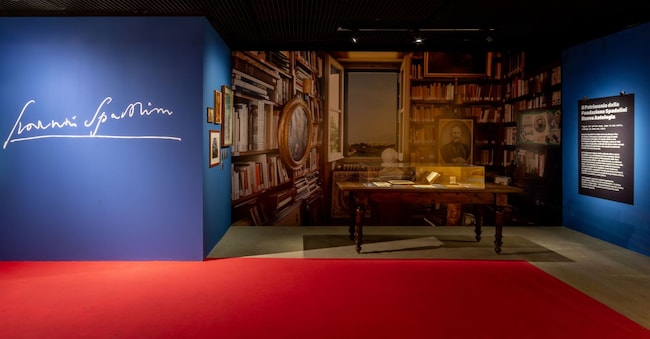
An exhibition at the Florence State Archives to commemorate Giovanni Spadolini on the centenary of his birth and the 50th anniversary of the establishment of the Ministry for Cultural and Environmental Heritage, now the Ministry of Culture. The exhibition 'Giovanni Spadolini and the Birth of the Ministry of Culture - The Man and the Legacy', organised by the General Directorate for Archives of the Ministry of Culture, will remain open until 12 October 2025 at the Florence State Archives. On display are a selection of works, documents, objects and volumes from the Fondazione Spadolini - Nuova Antologia and from public and private archive sources. The exhibition was inaugurated by the Minister of Culture Alessandro Giuli, Luigi La Rocca, Head of the Department for the Protection of the Cultural Heritage, Antonio Tarasco, Director General of Archives, Cosimo Ceccuti, President of the Fondazione Spadolini - Nuova Antologia and representatives of the cultural and protection institutions in Tuscany.
He was the first Minister of Culture in Italy
.The exhibition traces the contribution of Giovanni Spadolini - statesman and intellectual who was the first to hold the position of Minister of Cultural Heritage - to the political and cultural debate that led to the birth of the Ministry, emphasising his commitment to the protection of Italy's historical-artistic heritage and his ties with the world of culture, research and collecting. On display original materials, including the Appunti per una Dichiarazione dei beni culturali, from which the organisational idea of the new ministry took shape. The exhibition is curated by Paola d'Orsi, director of the State Archives of Florence, with the collaboration of Antonella Ranaldi, superintendent of Archaeology, Fine Arts and Landscape for the metropolitan city of Florence and the provinces of Pistoia and Prato, Elisabetta Sciarra, director of the National Central Library of Florence and Eugenia Valacchi, superintendent of archives and bibliography for Tuscany. The exhibition is also curated by the Ministry of Cultural Heritage, which is in charge of the new Ministry of Cultural Heritage.
Giuli, idea of culture with high perspective and open horizon
"Talking about Giovanni Spadolini means gathering around an idea of culture with a high perspective and an open horizon. A culture that does not fall into the traps of ideology, that is aware of its Risorgimento and liberal origins, that embraces History with its load of contradictions and sense of the tragic, and cares for different places, spaces, heritages. A secular, plural but unitary gaze,' says Culture Minister Alessandro Giuli.
Tarasco, Spadolini combined civic passion and intellectual rigour
"The exhibition dedicated to Giovanni Spadolini is a fitting tribute to the figure of a statesman who knew how to combine civil passion, intellectual rigour and political vision in the field of cultural protection. Spadolini not only founded the Ministry of Cultural and Environmental Heritage, from which the Ministry of Culture derives today, but also contributed to the transfer to it of archival matters, which for a century had been the exclusive competence of the Ministry of the Interior," says Antonio Tarasco, Director General of Archives. The initiative, built with archive materials and original testimonies, he adds, "also serves to reflect on the role of archives in our society as a place for building our historical awareness".
D'Orsi, a re-reading itinerary constructed with the rigour of the sources
"Fifty years after the foundation of the ministry, this exhibition does not attempt a commemorative balance, but proposes an itinerary of rereading, constructed with the rigour of the sources as well as the ambition of a living thought. It questions the origins in order to grasp, in the choices of that time, what can still inform our time and guide future strategies,' emphasises Paola D'Orsi, Director of the Florence State Archives.


