

'At the legislative level, Italy is in the vanguard and can lead other countries'
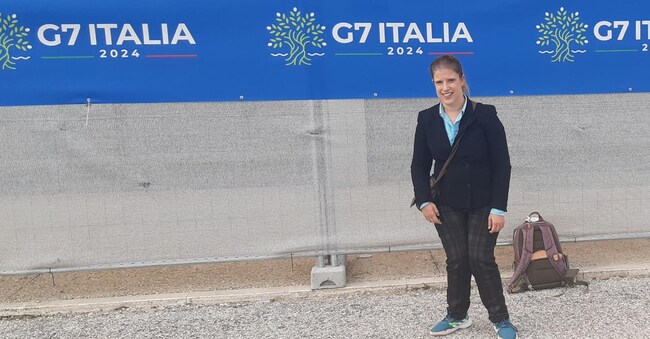
Laura Coccia, Cerebral Palsy representative in the European Union Association, at the G7 in Umbria

2' min read
Key points
2' min read
There are 800,000 Europeans with a cerebral palsy disability, two live births per thousand. A heterogeneous cohort for which, however, there is no unambiguous definition recognised at EU level and which therefore leads to a great variety of approaches between individual countries. To try to change this, a first step was the Manifesto for Celebrating Paralysis of Cerebral Palsy Europe, an association that brings together national entities throughout Europe. The text was submitted in May to the then European candidates to persuade them of the need for action.
These days, the discourse continues at the G7 in Assisi, where Laura Coccia, Brussels representative of Cerebral Palsy in the European Union Association (CP-ECA), brings the associations' demands. "We are trying to make the institutions aware of what cerebral palsy is because there is still no standard. What is considered 'celebral palsy' concerns brain damage that occurred during childbirth or in the days just afterwards due to causes, for example, related to severe prematurity. But no two cases are the same, each individual person has his or her own damage and each must be treated differently. The matter then becomes complicated in everyday reality because it is cloaked in social prejudices that we also find in everyday language. It is still thought that a brain-damaged person has an intellectual-relational disability. But that is not always the case. It doesn't have to be,' Coccia explains.
The Italian example
.At the legislative level, Italy has always been at the forefront in the world, according to Coccia, because 'it abolished special schools in the 1970s. I would not have obtained a doctorate, spoken five languages and done Erasmus if I had lived in a country where there were no inclusive schools. Like me many: we had the right to education. That is why I hope that in the draft text of the Solfagnano Charter there can be a way to emphasise the right to education. I expect that Italy itself can insist that for persons with disabilities this must be a universal right recognised without any shadow of a doubt'. Coccia underlines this because in Europe this is not yet the case for all countries. The context is not homogeneous and the speed at which policies are implemented is different, so much so that at a European level one person with a disability out of three is at risk of social exclusion and poverty, which is why interventions on the issue of independent living are necessary: 'We cannot forget that disability is one of the factors that can lead to the impoverishment of the family unit. Not because it is an element of risk in itself but it leads to family and social economic conditions that have a great impact".

