

In Otranto, the ‘Giornalisti del Mediterraneo’ festival tackles the new challenges facing the media
Among those honoured with the ‘Caravella del Mediterraneo’ award were Lucio Caracciolo, Iacopo Luzi, Armando Franza, Lucia Esposito, Alhassan Selmi, Claudio Antonelli and Leonardo Zellino. A special award for press freedom was presented to Shelly Kittleson. The topics covered included: disinformation, conflicts, press freedom, the safety of journalists and the digital revolution.
by 24Ore NextMed
 Aggiungi Il Sole 24 Ore
ai preferiti su Google
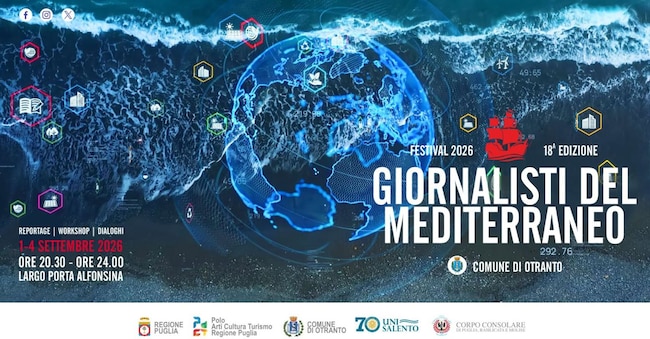
In an age of widespread disinformation, large-scale armed conflict and the advent of artificial intelligence, the Mediterranean Journalists’ Festival marks its 18th anniversary. This is a significant milestone, coming at a time that has been more challenging than ever for those who have made deciphering reality their profession: ‘The challenge, in fact, is to uphold the timeless principles of journalism – the pursuit of truth, even in often indecipherable circumstances – whilst remaining attuned to current events and the times,’ explains the Festival’s founder, Tommaso Forte. Without compromising the need to report unequivocal facts, nor the necessity of utilising modern means of communication, which enable us to reach unprecedented audiences of readers in real time.
So once again this year, the Festival – scheduled to take place in Otranto from 1 to 4 September – in the usual setting of Largo Porta Alfonsina, organised by Forte with Nicola Fragassi, Leda Cesari and Rosaria Bianco, in partnership with Otranto Town Council – has once again chosen to honour leading figures from Italian journalism and communications, and beyond.
The Festival can also count on the editorial partnership of leading national and international news organisations, which are media partners for the 2026 edition: ANSA, Vatican Radio, Vatican News, La Gazzetta del Mezzogiorno and MondoMediterraneo.eu, which will support the event by disseminating content, in-depth features and details of the main events on the programme.
On 4 September, the ‘Caravella del Mediterraneo’ Award will be presented to Lucio Caracciolo, founder and editor of the magazine ‘Limes’; to Iacopo Luzi, White House correspondent; to General Armando Franza, commander of the Puglia Air and Naval Unit; to journalist Lucia Esposito, who is under police protection due to her investigations into the Camorra; to the Palestinian journalist Alhassan Selmi; to Claudio Antonelli, deputy editor of “24Ore NextMed”; and to Leonardo Zellino, correspondent for Tg1. A special prize for press freedom was awarded to the American journalist Shelly Kittleson, a freelance journalist who was kidnapped last March in Baghdad. Among this year’s guests was also Vittorio Di Trapani, president of the National Federation of the Italian Press.
The Festival, a well-established event which, over the past eighteen years, has hosted more than 1,000 journalists, analysts, representatives of institutions and academics, has always served as a forum for discussion on current geopolitical developments in the Mediterranean basin and across Europe, as well as on the transformations taking place in the world of information, in light of the increasingly entrenched and pervasive presence of artificial intelligence in our lives, ‘a fact that exposes humanity to ever-new challenges’, explains Forte. But there will also be scope for discussing the safety of those working in the field, censorship and the growing attempts to delegitimise the media, with a focus on the economic and strategic dynamics of the region and the Blue Economy, and, of course, the ongoing conflicts in Eastern Europe and the Middle East, with ‘forays’ into the role of Catholic diplomacy in mediation and peace-building processes. In short, the 2026 edition will be a crucial one for anyone wishing to understand current and future scenarios, not only in the field of news. “Our small yet significant contribution to the need to engage with global issues involving major nations, the consequences of which affect the lives of each and every one of us, even in the smallest communities,” concludes the mayor of Otranto, Francesco Bruni. “All this from the perspective of a place – my city – which has always made ecumenism and dialogue between different peoples and cultures one of its core missions.”

