

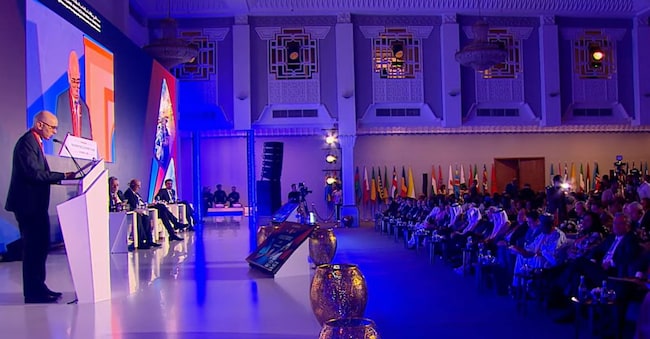
400 delegates gather at the PAM forum in Marrakesh to promote the integration of parliaments
The discussions were organised around four key priorities: international trade and economic integration, financial sustainability and public debt, technological innovation and artificial intelligence, and climate adaptation and food security. President Centemero said: “AI must become a driver of shared growth, not a source of new divisions.”

Key points
From the security of trade routes to artificial intelligence, from public debt to the energy transition, today’s major economic challenges share one characteristic: they transcend national borders. It was against this backdrop that Marrakech hosted the fourth edition of the PAM Economic Forum on 19 and 20 June, a meeting aimed at consolidating a common agenda between the Mediterranean, the Gulf and the African continent. Organised by the Parliamentary Assembly of the Mediterranean (PAM) together with the House of Councillors of the Kingdom of Morocco and, for the first time, in partnership with the Parliamentary Network of the World Bank and the International Monetary Fund, the Forum brought together over 400 participants, including parliamentarians, government representatives, international financial institutions, multilateral organisations, academics and the private sector. More than just an international conference, the Marrakesh Forum has, in recent years, become one of the main tools through which the PAM seeks to translate parliamentary cooperation into concrete economic initiatives. Parliamentarians, representatives of international financial institutions, businesses and the academic world sit around the same table, engaged in a dialogue that reflects the growing economic importance of the region linking the Mediterranean, the Gulf and Africa.
Interconnections
“The international landscape is characterised by growing uncertainty and complexity. Global challenges are increasingly interconnected and are testing the resilience of governments, economies and our societies.” With these words, Giulio Centemero, President of PAM, opened the proceedings of the fourth edition of the Marrakech Parliamentary Economic Forum, drawing attention to the increasingly systemic nature of contemporary economic challenges. To support this view, Centemero cited the recent crisis in the Strait of Hormuz as an example of the growing interdependence that characterises the global economy. “A localised disruption in a strategic corridor can have immediate effects on energy markets, trade logistics, investor confidence and food supply chains. This confirms that we live in a deeply interdependent system.” The central message of the 2026 edition was summarised in the slogan: “Different Shores. Common Purpose. One Shared Future”. An invitation to overcome geopolitical divisions and build a common vision between Europe, the Mediterranean, the Gulf and the African continent. According to the Assembly’s President, the differences between political and economic systems must not stand in the way of pursuing shared objectives. “The Mediterranean, the Gulf and the African continent are made up of different nations, economies and political systems. But the challenges we face know no borders. Nor should our ambition,” added Centemero.
Priorities
The Forum’s proceedings were organised around four key priorities: international trade and economic integration, financial sustainability and public debt, technological innovation and artificial intelligence, and climate adaptation and food security. The discussion also extended to the issue of technological sovereignty and the region’s ability to compete in high value-added sectors. With this in mind, the PAM has revived the idea of a Euro-Mediterranean and Gulf hub dedicated to artificial intelligence. “Artificial intelligence must become a driver of shared growth and not a source of new divisions,” said Centemero.
Trade
A special session was devoted to the African Continental Free Trade Area (AFCFTA) and the opportunities offered by greater integration of Euro-African value chains, with the aim of promoting investment, economic connectivity and regional resilience. This focus on strengthening ties between the two shores of the Mediterranean was also reflected at an institutional level. In fact, several strategic agreements were signed in Marrakesh, including a Memorandum of Understanding between the PAM and the Association of African Senates, aimed at consolidating parliamentary cooperation between Africa and the Euro-Mediterranean region. The agreement reached with ASCAME, the Association of Mediterranean Chambers of Commerce, is part of the same initiative, aimed at strengthening dialogue between legislative institutions and the private sector in support of regional economic integration. Beyond the agreements signed and the initiatives presented, what emerges above all from Marrakech is a clear political vision of regional integration. In a context marked by growing economic fragmentation and geopolitical uncertainty, PAM aims to strengthen forms of cooperation capable of connecting Europe, Africa and the Gulf around shared interests. This is a perspective that Centemero summarised in his closing remarks at the Forum: ‘The answer cannot be to retreat. It must be greater cooperation, accompanied by greater ambition.’

