
Attack in Libya: Zelensky corrects himself and apologises to Meloni
The Ukrainian president admits: European partners had not been warned. The prime minister confirms the aid, but asks the EU for guarantees regarding the new loan

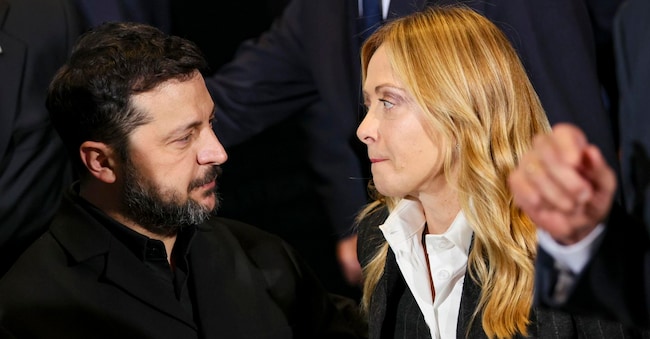
First, there was the BBC interview in which the President of Ukraine, Volodymyr Zelensky, speaking about the operation against two Russian warships in Libya, stated that Ukrainian forces ‘never attack’ without first coordinating with their partners. Then, in the face of the Italian Government’s strong irritation at this untrue statement, came the U-turn. And a phone call to apologise to Giorgia Meloni, which the Prime Minister mentioned at the start of her speech to the Noi Moderati assembly.
“Zelensky has clarified some earlier remarks that had given rise to a great deal of doubt,” says Meloni, “and he did so directly to me as well during a telephone call today. I think this was necessary because our position in support of the nation under attack remains unchanged, but this can never take precedence over the defence of Italia’s national interests.” During the same conversation, the Prime Minister reiterated directly to the Ukrainian leader the concerns she had expressed on Thursday in Brussels at the extraordinary European Council meeting regarding the operation carried out by Kyiv’s forces in the port of Benghazi and the risk of the conflict spreading to the Mediterranean.
Italia, as Deputy Prime Minister and Foreign Minister Antonio Tajani had immediately made clear, had been kept in the dark about the military operation in Libya. “Zelensky said something untrue,” Defence Minister Guido Crosetto reiterated from the podium at the party conference led by Maurizio Lupi shortly before the Prime Minister’s arrival. “I have spoken to the European Union, NATO, France, Germany and the United Kingdom, and none of these allies knew anything about it.”
In the end, even Zelensky admitted as much and explained to Meloni that ‘the operation was carried out without coordination with partners”, as stated in a note from Palazzo Chigi, which adds Zelensky’s commitment “to ensure full information-sharing and direct, constant communication”. The Ukrainian president confirmed all this on social media, adding the adjective ‘European’ when referring to the partners.
The incident is closed, the Government assures us. “Zelensky’s apology clarifies the situation once and for all,” Tajani states for the record. But the fallout will be felt. First and foremost in Parliament, where the opposition is calling for Meloni to report on the matter as soon as possible. For Angelo Bonelli (AVS), the matter “is extremely serious” in both scenarios: whether the government knew nothing of an attack just 700 kilometres from the Italian coast, or whether it was simply not informed. The case complicates the authorisation of new aid to Kyiv, which Parliament will have to renew for 2027: with the League opposed and general elections on the horizon, it seems highly likely that it will be postponed from the start of the year to a date to be determined.


