Cars

Audi A2 e-tron: our test drive: what the new small electric car is like and how it drives. Specifications and prices

Audi is reviving the A2 name with a new, 100 per cent electric compact car that serves as the gateway to premium mobility from the brand with the four rings. We tested the 170 kW version

5' min read

Translated by AI
Versione italiana

5' min read

Translated by AI
Versione italiana

With the new A2 e-tron, Audi is redefining its entry-level range and paving the way for the handover between the A1 and the Q2. This compact electric car represents the new gateway to premium mobility from the four rings, combining in a single vehicle the practicality of a city car, the versatility of a small SUV, and the technological features and quality derived from models in the higher segments. This strategic move is aimed primarily at those who use their car mainly in urban areas but do not want to compromise on comfort, space or the ability to tackle even longer journeys.

The return of the A2 name is no coincidence. The new electric model ideally carries on the legacy of the first-generation model from 1999, a car that had pioneered concepts which are now central to automotive design, such as aerodynamic efficiency, lightweight construction and the intelligent use of space. The technology has changed completely, with an all-electric powertrain, but the philosophy remains the same: to offer a compact, functional and instantly recognisable car. The range will be available in four power variants, from 170 to 326 cv, with list prices starting at 38,350 euros and rising to 54,400 euros. Pre-sales are scheduled to begin in September 2026, whilst the car is set to arrive in Italian showrooms in January 2027.

Loading...

Audi A2 e-tron, le prime immagini della nuova elettrica per la città

Photogallery17 foto

MEB platform: compact dimensions and plenty of space on board

Under the bodywork, the Audi A2 e-tron uses the Volkswagen Group’s MEB modular electric platform, developed specifically for battery-powered models. All versions feature rear-wheel drive and an electric motor mounted on the rear axle, a configuration that helps to optimise weight distribution and free up space in the cabin. The car is 4.32 metres long and has a wheelbase of 2.77 metres – a significant figure for a compact car, ensuring plenty of space for rear passengers too.

Load capacity is another interesting feature: the boot space ranges from 396 to 1,336 litres, whilst some engine variants also feature a 13-litre front storage compartment – the so-called ‘frunk’ – which is particularly useful for storing charging cables. The rear compartment can also be configured with an adjustable load floor and modular accessories based on the Fidlock system, which allows various items to be secured and moved using a magnetic mechanism combined with a mechanical lock.

Perceived quality is also on the rise. The interior features high-quality materials, fabric upholstery covering the dashboard and door panels, and a sound-deadening system designed to minimise road noise and aerodynamic noise. The digital instrument cluster comprises an 11.9-inch Audi virtual cockpit plus and a 12.8-inch curved central display, whilst an augmented reality head-up display is available as an option. It also features an AI-powered voice assistant, wireless charging and a suite of driver-assistance systems that incorporate solutions already seen on Audi’s top-of-the-range models. Among the standout features is Audi connected work, a suite that allows you to manage applications such as Outlook and Teams directly from the car.

Design: a modern take on the 1999 A2

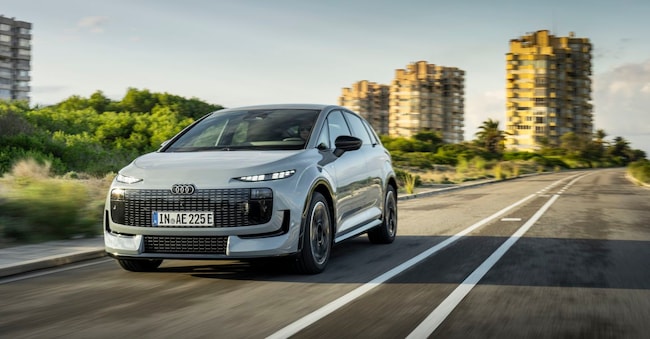
The reference to the first Audi A2 is clear, but this is not merely a nostalgic exercise. The new generation reinterprets the concept of a compact, aerodynamic car through clean surfaces, flowing lines and proportions that prioritise the efficient use of space. The front end is characterised by the so-called ‘black panel’, a black element that integrates the sensors for the driver assistance systems and the headlamps, whilst the slim daytime running lights help to define a distinctive lighting signature. Up to four different lighting configurations are available.

The profile is one of the car’s most distinctive features. The roof features a concave line that directly echoes the historic A2, whilst the rear section is defined by a spoiler that divides the rear window – another stylistic element inspired by the 1999 model. The short overhangs and generous wheelbase help to create balanced proportions, with a body design that seeks to reconcile the need for interior space with maximum aerodynamic efficiency.

Audi has also worked on the less obvious details that are nonetheless important for reducing aerodynamic drag. The air curtains, the small aerodynamic elements around the wheel arches, the aerodynamically shaped underbody, the rear diffuser and the specially designed wheels all help to improve aerodynamic efficiency. There is also an adaptive front air intake, which remains closed under normal driving conditions and opens when additional cooling is required. The result is a drag coefficient (Cx) of 0.24, the best among Audi’s compact models. This figure is not merely a technical statistic but has tangible implications for efficiency and range. The colour range comprises seven shades, including the new deep blue and pistachio green metallic finishes.

Motors and batteries: four versions, range of up to 643 km

The Audi A2 e-tron range comprises four engine variants, all with rear-wheel drive and a permanent-magnet synchronous motor. The range starts with the 125 kW version, equivalent to 170 cv and 350 Nm of torque, moving on to the 140 kW variant, equivalent to 190 cv, again with 350 Nm. At the heart of the range is the 170 kW version, or 231 cv, whilst at the top of the range is the 240 kW version, delivering 326 cv and 545 Nm of torque.

The batteries vary depending on the power output selected. The 125 and 140 kW versions use 52 and 61 kWh batteries respectively, both featuring LFP (lithium iron phosphate) technology. The two most powerful powertrain variants, on the other hand, feature an 84 kWh battery using NMC (nickel-manganese-cobalt) chemistry. The maximum claimed range is 643 km on the WLTP cycle for the 170 kW version, whilst the 240 kW version achieves 628 km. The entry-level variant is claimed to have a range of up to 421 km and the 140 kW version up to 515 km.

Loading...

The figures on energy consumption are particularly interesting: the 140 kW version, when combined with the optional efficiency package, can achieve 12.8 kWh/100 km, making the A2 e-tron the most efficient Audi ever. This result has been achieved by combining aerodynamics, advanced motors, power electronics featuring silicon carbide semiconductors and regenerative braking systems. DC charging reaches a maximum power of 183 kW, allowing the battery to go from 10% to 80% in under 30 minutes. Bidirectional charging is also provided: the Vehicle-to-Load function allows external devices to be powered, whilst the Vehicle-to-Home function will also be available following the launch, enabling the battery to be used as a domestic energy storage system.

Behind the wheel: well-balanced, stable and with good acceleration

My first experience of the new Audi A2 e-tron in Valencia gave the impression of a well-designed car, in which the work carried out on the architecture and weight distribution is reflected in its road holding. The car feels balanced and firmly planted on the road, with a good sense of stability even when you pick up the pace. Despite its compact dimensions, the cabin offers plenty of space and allows for comfortable travel even in the rear seats. This is precisely one of the most striking aspects: the A2 e-tron manages to offer a level of spaciousness that seems to belong to a higher class, without becoming cumbersome in everyday use.

During our test drive, we drove the 170 kW version – equivalent to 231 cv – paired with the 84 kWh battery. The throttle response is immediate and the acceleration is impressive, particularly when pulling away and in situations where power is needed quickly. The car does not feel excessively heavy or clumsy, but conveys a sense of control and composure. Its handling is that of a car designed for everyday use, without sacrificing a good dose of spirited performance when you decide to make the most of the electric motor’s power.

Initial feedback on fuel consumption was also positive; during our test drive, it remained in line with the manufacturer’s stated figures. This is an important point, particularly given that fuel efficiency is one of the model’s key selling points. The multimedia system and digital functions also presented no issues during our initial experience: interaction was smooth and the interface showed no particular glitches.

Copyright reserved ©
Loading...

Brand connect

Loading...

Newsletter

Notizie e approfondimenti sugli avvenimenti politici, economici e finanziari.

Iscriviti