
The facelifted Audi A3: how it drives and what it’s like
The German compact car has been given an interior makeover, with improvements to technology and quality. We test-drove the diesel Sportback and the 272 cavalli Allstreet plug-in hybrid

Key points
Thirty years of history, four generations and over 5.5 million units sold worldwide. The Audi A3 has been updated once again, with the focus on the interior and technology, whilst making no significant changes to the bodywork, which was already revised in 2024. This approach allows the German compact car to continue competing with the BMW 1 Series and Mercedes A-Class, whilst maintaining one of the most comprehensive line-ups in the segment. Alongside the traditional petrol and diesel versions are mild-hybrid and plug-in hybrid models, with power outputs of up to 272 cavalli. We test-drove the new facelifted A3, trying out the 2.0 TDI Sportback and the plug-in hybrid variant in the Allstreet trim. With the A1 and Q2 being phased out, the Audi A3 becomes the entry-level model in the ‘four rings’ range featuring a combustion engine.
Audi A3 facelift: exterior and dimensions
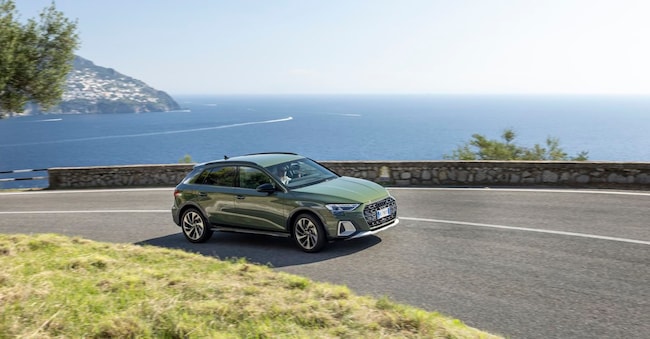
The new update does not introduce any substantial changes to the A3’s bodywork, which retains the proportions and styling features of the previous model. The Sportback is 4.35 metres long, 1.82 metres wide and 1.44 metres high, with a front end characterised by the large, frameless hexagonal grille and side air intakes. Also retained are the sculpted side panels and the rear end with LED light clusters and a sporty-styled bumper. Alongside the five-door model, the Allstreet continues to be offered, recognisable by its octagonal grille, enlarged wheel arches, underbody protection and roof rails. Compared to the Sportback, the ride height is raised by 30 millimetres thanks to a bespoke suspension set-up and tyres with a higher sidewall. The length remains unchanged, as does the width, whilst the height reaches 1.47 metres. The boot offers a capacity of 380 litres, expandable to 1,200 litres by folding down the rear seatbacks; this figure drops to 280 and 1,100 litres respectively on the plug-in models due to the presence of the battery. The range is completed by the Saloon version, and the S3 and RS3 will also be arriving in the coming months, the latter still powered by the 2.5-litre 5-cylinder engine producing 400 cavalli.
Audi A3 facelift, interior
The most significant differences compared with the past can be found in the cabin, where a completely redesigned dashboard makes its debut, echoing the layout of the latest Audi models. Perceived quality has also improved, with higher-quality materials and greater attention to detail – areas where the previous generation had raised some concerns in relation to the brand’s tradition. In front of the driver is an 11.9-inch digital instrument cluster, flanked by a 12.8-inch curved central screen. Both are fitted as standard from the entry-level trim upwards and feature a new graphical interface, with reorganised menus and more easily recognisable icons. The centre console has also been redesigned; the smartphone compartment now faces the driver and features wireless charging of up to 25 watts. The steering wheel once again features controls with a partially physical mechanism, a more practical solution than the previous fully touch-sensitive controls. There is also plenty of space on offer, especially considering the car’s external dimensions. The front seats offer a wide range of adjustment options, whilst the rear can comfortably accommodate two adults or children in car seats without any particular compromise. Even the boot, in the non-plug-in versions, offers sufficient capacity for both everyday use and travel. The A3 can therefore easily serve as a family car, even with children, provided you do not need to frequently transport particularly bulky items. The technology package also includes new driver-assistance systems, such as adaptive cruise control, lane-keeping assist and assisted lane change. Optional extras include automatic parking with memory for up to five manoeuvres and a system that allows you to control the car remotely via your smartphone.
Audi A3 facelift, engine options
The range continues to include petrol, diesel and hybrid powertrains. The range starts with the 116 cavalli 1.5 TFSI four-cylinder engine with a manual gearbox, alongside the 48-volt mild hybrid versions producing 116 and 160 cavalli, paired with the seven-speed S tronic automatic transmission. The electrified system contributes up to 12 cavalli and 50 Nm to the drive, whilst both mild-hybrid engines are already Euro 7-compliant. On the diesel front, the 2.0 TDI remains, available with 116 or 150 cavalli. Over the last ten years, internal combustion engines have been updated with solutions such as the Miller cycle for petrol engines, direct injection, plasma coatings, separate cooling circuits and a revised exhaust gas treatment system for diesel engines. According to the manufacturer, these improvements have helped to reduce fuel consumption by up to 22 per cent across the range of engines.
The plug-in range is more extensive, combining the 1.5 TFSI with an electric motor integrated into the six-speed automatic gearbox. System power outputs are 204 and 272 cavalli, the latter being exclusive to the Sportback. The 25.7 kWh battery, of which 19.7 kWh is usable, delivers a claimed range of up to 142 kilometres in the WLTP cycle for the Sportback and 139 kilometres for the Allstreet. Charging can be carried out using alternating current at up to 11 kW, with a full charge taking around two and a half hours, or using direct current at up to 50 kW – a decidedly rare option on the market – taking the battery from 10 per cent to 80 per cent in under 30 minutes.

