
Audi Q7: a test drive of the new large, luxury SUV, which makes its debut with turbo-diesel engines
The third generation of the Q7 stands out from its predecessor thanks to its styling, a host of new technologies – some of which are making their debut – an interior that can be configured in three different ways, and enhanced premium features.

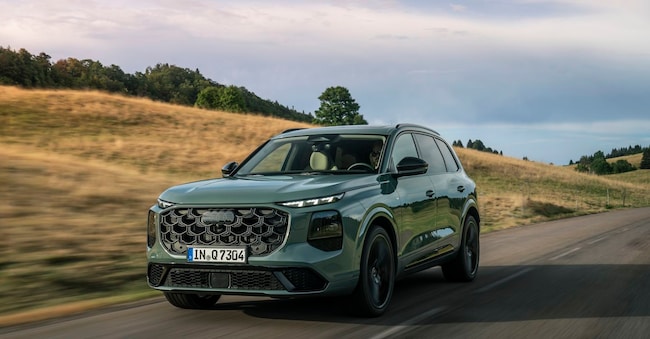
Having lost its title as Audi’s largest SUV following the arrival of the even more colossal Q9, the third-generation Q7 has undergone a radical transformation, retaining only its large dimensions as a link to its predecessors – in particular its length, which exceeds 5 metres. What’s more, in Europe it is taking a rather unconventional approach for the times, as it is making its debut with two mild-hybrid turbodiesel versions. This decision is inspired by the fact that, in this part of the world, large SUVs with a turbo-diesel engine under the bonnet remain popular because they offer long driving ranges. A mild-hybrid petrol version with a V6 engine and two plug-in hybrid variants are set to follow in due course.
Audi Q7: the PPC platform is the foundation of its technological evolution
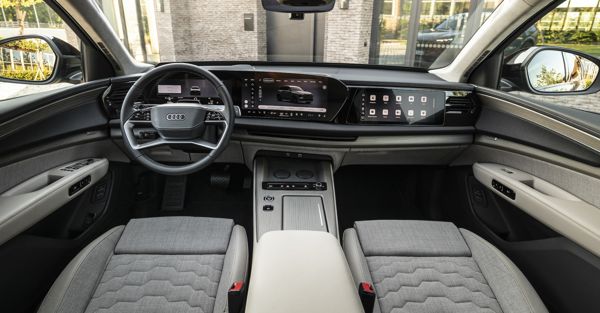
Like other recent large Audi models with internal combustion engines, the new Q7 is based on the Premium Platform Combustion architecture, which shares with the architecture used for electric models a sophisticated technological package, state-of-the-art ADAS features, an electronic architecture characterised by high computing speed that facilitates interaction between artificial intelligence and the voice assistant, and the latest release of the Android Automotive OS. The latter forms the basis of digitalisation thanks to five platforms that rapidly manage, for example, OTA updates and ChatGPT, and enable the addition of multiple displays in the cabin as well as enhancing Car-to-X interaction by managing the OLED 3.0 lighting units, which, in the event of danger, project clear signals onto the road surface to alert the driver and issue warnings by projecting, for example, the flashing of indicators onto the ground.
The PPC platform also incorporates 48 V mild-hybrid technology as part of the ‘Step Plus’ package. That is to say, it features a generator integrated into the drivetrain, comprising an electric motor, power electronics, a cooling system and an actuator for activation/deactivation, which boosts efficiency and assists driving by delivering up to 24 cavalli and, in this case, 370 Nm of torque, propelling the car electrically at low speeds and when manoeuvring, as well as recovering 25 kW of electricity during deceleration for the 1.7 kWh LFP battery. As for handling, either as standard or as an option depending on the trim level, the Q7 features adaptive air suspension in sport mode, which lowers the ride height by 30 millimetres compared to the standard setting, and rear-axle steering.
Audi Q7 unveiled with two twin-turbo V6 diesel engines
The first two new Q7s on sale are powered by specific variants of the 3-litre V6 turbodiesel engine, paired with the eight-speed Tiptronic automatic gearbox and quattro all-wheel drive: one delivers 245 cavalli and 500 Nm of torque, whilst the other produces 299 cavalli and 630 Nm. Both are characterised not only by Audi’s 48 V mild hybrid system but also by the sophisticated turbocharging system, as it comprises a traditional turbocharger and an electric compressor that reaches 90,000 revolutions per minute in 250 thousandths of a second, eliminating annoying turbo lag and thus ensuring a prompt response to the accelerator at low revs. The less powerful Q7 reaches 222 per hour and 100 per hour in 7.2 seconds, with an average fuel consumption of 7.8 l/100 km, whilst the other reaches 235 per hour and sprints from 0 to 100 in 6.0 seconds, with an average fuel consumption of 8 l/100 km.
Audi Q7: a muscular yet elegant design.
Aesthetically, the new Q7 reflects Audi’s current design language. In this case, with a length of 5.06 metres and a width of 2.01 metres – dimensions in line with those of the previous model range – and, above all, a height of 1.80 metres (an increase of 5 metres), it creates an imposing and muscular SUV, yet well-proportioned, thanks in part to a wheelbase of nearly 3 metres. The design is characterised by the oversized single-frame grille, flanked at the top by the position lights and at the sides by the main headlamps; together with the height and verticality of the front end, as well as the large air intakes in the bumper, this lends the Q7 an authoritative and high-tech appearance, the high flanks, reinforced by creases and muscular wheel arches, and the rear, defined by surfaces that gently round off the car’s silhouette.

