Test drive

Audi Q9: here’s the new giant SUV – what the flagship high-riding model is like and how it drives

The German brand’s new XXL-sized SUV combines impressive dimensions, luxury and advanced technology with mild-hybrid and plug-in hybrid powertrains; it is due to make its debut at Italian dealerships by the end of November

3' min read

Translated by AI
Versione italiana

3' min read

Translated by AI
Versione italiana

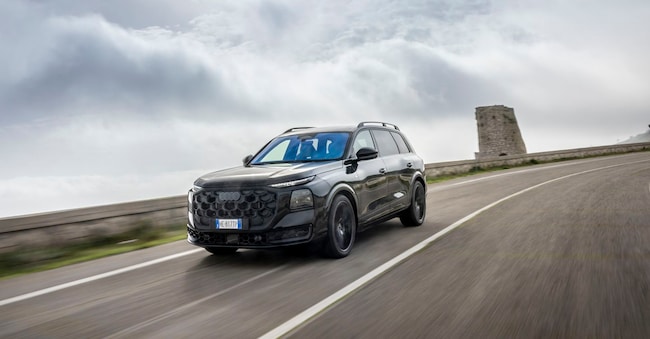
Audi is introducing the new Q9 to its SUV range – a flagship model that focuses on space, comfort and technological features to take the brand’s concept of luxury to the next level.

This model, the largest ever produced by the four rings, is aimed at those seeking a high-end SUV that combines spaciousness, interior quality and driving pleasure. At launch, it is available with two 3.0 V6 TDI mild-hybrid engines producing 245 and 299 cv, the latter being the star of our test drive along the Salento coast. The engine range will subsequently be expanded to include mild-hybrid petrol and plug-in hybrid variants. List prices start at 117,000 euros and go up to around 120,000 euros, whilst the car is expected to arrive in Italian showrooms by the end of November 2026.

Loading...

Dimensions and design of the Audi Q9

The Q9 is built on the PPC premium thermal platform, an architecture designed to ensure high structural rigidity and support advanced technical solutions.

At 5.31 metres in length, it is 25 centimetres longer than the Q7, whilst its wheelbase of 3.14 metres – 14 centimetres longer than its smaller sibling – helps to create a particularly spacious interior.

The proportions are those of an imposing SUV, but the design seeks to maintain a dynamic character: the front end is dominated by the large vertical single-frame grille, whilst the pronounced wheel arches evoke the Quattro tradition. The side profile is characterised by a horizontal waistline and an almost flat roof, a design choice that maximises interior space. At the rear, the continuous light strip and the curved OLED 3.0 light clusters stand out, marking a world first for the brand.

To emphasise its presence on the road, alloy wheels are available in sizes ranging from 20 to 23 inches.

Audi Q9, le immagini del nuovo maxi-suv

Photogallery15 foto

Interior and technology: a business-class cabin

The interior focuses on the quality of materials, attention to detail and digitalisation. The dashboard is dominated by the now familiar Audi Digital Stage, which combines the 12.3-inch digital instrument cluster, the 14.5-inch central OLED display and a dedicated screen for the front passenger, also measuring 12.3 inches. There is no shortage of Nappa leather surfaces, ash wood inlays and upholstery in refined materials, with the option to personalise the interior through the Audi exclusive programme.

The driver’s seat is raised, providing an excellent view of the vehicle’s surroundings. In addition, the cameras make it easier to manoeuvre in tight spaces.

The Q9 is available in six- or seven-seat configurations, whilst the boot has a maximum capacity of 2,308 litres. The interior features excellent soundproofing, with comfort and space taking centre stage.

Features include power-operated doors, a panoramic roof with adjustable transparency, a Bang & Olufsen sound system with 4D audio technology, and the latest generation of driver-assistance systems. The E3 1.2 electronic architecture also incorporates Android Automotive OS and an AI-powered voice assistant.

Loading...

Engines and road handling

At launch, the range will include a 3.0 V6 TDI 48-volt mild hybrid plus engine, available in two power outputs: 245 cv and 500 Nm, or 299 cv and 630 Nm. The system combines an electric powertrain generator, an electric compressor and a turbocharger, with the aim of improving response at low revs and reducing fuel consumption. A V6 petrol mild hybrid and two plug-in hybrid variants will also follow, with an electric range exceeding 80 kilometres in the WLTP cycle.

In terms of driving dynamics, the Q9 features the quattro permanent all-wheel drive system, an eight-speed Tiptronic automatic gearbox, adaptive air suspension and all-wheel steering. The latter allows the rear wheels to steer in the opposite direction to the front wheels at low speeds, improving manoeuvrability, and in the same direction as the front wheels as speed increases, enhancing stability. However, the ground clearance is noticeable, particularly given the car’s weight of 2,530 kg, and this s

This is also evident when accelerating from a standstill, as confirmed by the manufacturer’s stated 0–100 km/h time of 6.5 seconds.

Copyright reserved ©
Loading...

Brand connect

Loading...

Newsletter

Notizie e approfondimenti sugli avvenimenti politici, economici e finanziari.

Iscriviti