TEST DRIVE

Audi RS 5, the road test of the first plug-in hybrid sports car by RS

Extreme performance, rechargeable hybrid technology and available in both saloon and station versions.
by Giulia Paganoni

4' min read

Translated by AI
Versione italiana

4' min read

Translated by AI
Versione italiana

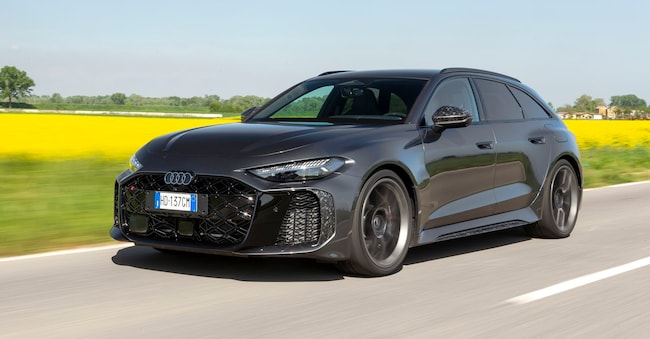
the new Audi RS 5 represents a historic turning point for Audi Sport, marking the brand's entry into the world of high-performance plug-in hybrids. Presented at Milan Design Week, the car embodies the evolution of Audi's philosophy, combining driving excitement, technological innovation and efficiency without compromising everyday usability. Available in saloon and station wagon versions, the Audi RS 5 is offered at a list price that starts at around 110 thousand euro and 113 thousand euro respectively with deliveries scheduled to start in June.

Audi RS5, le foto della nuova sportiva dei quattro anelli

Photogallery32 foto

Design and technological interiors

The Audi sport DNA of the new Audi RS 5 is confirmed in the design of the car, where the track widths are 93 mm wider at the front and 84 mm at the rear compared to the Audi RS 4 Avant. The quattro blisters at the wheel arches evoke all-wheel drive, while the front is dominated by the wide single frame with three-dimensional honeycomb structure. At the rear, the racing-derived extractor and the central outlets of the RS exhaust system stand out. The car's look boasts the standard black package, which can be made even sportier by opting for the carbon pack, also available in a matt camouflage version, which includes splitter, skirt inserts and the upper section of the extractor in composites.

Loading...

Inside the cabin there is a nice mix of sportiness and comfort: similar to the Audi A5, it is strongly characterised by the Audi Digital Stage. The digital stage consists of the 11.9-inch Audi virtual cockpit and the 14.5-inch display of the Mmi system as well as the dedicated passenger screen. Specifically, the Mmi and Audi virtual cockpit make use of a dedicated layout from which it is possible to display G-forces, temperature and pressure of individual tyres, lap times as well as detailed information on transmission, power and acceleration.

Hybrid powertrain: power and innovation

Based on Audi's Ppc platform, the RS 5's heart is a sophisticated hybrid powertrain consisting of a 510 hp twin-turbo V6 2.9 Tfsi engine and a 177 hp electric unit. Together, they reach a total power output of 639 hp and torque of 825 Nm, numbers that allow the RS 5 to sprint from 0 to 100 km/h in just 3.6 seconds and touch a top speed of 285 km/h. Compared to the previous RS 4, the performance leap is clear, thanks in part to technical improvements such as the Miller cycle, variable geometry turbochargers and a more efficient cooling system.

Quick shifts too, thanks to the eight-speed tiptronic automatic transmission.

According to the manufacturer, fuel consumption is between 3.9 and 4.4 l/100 km while CO2 emissions are 89/100 g/km.

Electrical Efficiency and Energy Management

In addition to the electric motor, the electric component consists of a 25.9 kWh battery (22 kWh net), which can be recharged in about 2.5 hours, allowing it to travel in either all-electric or hybrid mode. On one charge, the manufacturer claims a range of just over 84 kilometres.

As on other models in the range, Audi engineers opted not to adopt direct current charging, favouring charge recovery through a particularly advanced energy management system that includes functions such as Battery Hold and Battery Charge, as well as energy recovery during braking designed to keep the sporty driving experience intact.

Dynamic Torque Control, set-up and driving dynamics

Among the most significant innovations is Dynamic Torque Control, an electromechanical torque vectoring system capable of distributing torque between the rear wheels in just 15 milliseconds. This translates into greater agility, cornering precision and stability, as well as more effective management of oversteer. In support, the central self-locking differential, called upon to manage the distribution of torque between the axles up to a maximum of 70 per cent at the front and 85 per cent at the rear, features an unprecedented preload. This means that it is always partially locked for the benefit of rapid thrust transfer.

Dynamically, the RS 5 benefits from a 10 per cent stiffer body than the Audi A5, sports suspension with twin-valve shock absorbers and more direct steering.

Finally, the electro-hydraulic braking sees the electric motor act as an alternator taking care of the slight decelerations, using specific software so as not to excessively alter the sporty driving. On request, the RS braking system adopts carboceramic discs 440 mm in diameter at the front and 410 mm at the rear, 30 kg lighter than steel components.

Driving mode and boost function

For those who can't get enough of the 639 hp, there is the unprecedented boost, which can be activated in conjunction with any drive programme, thanks to which maximum power can be made available at the touch of a button on the steering wheel.

In addition to the traditional comfort, balanced and dynamic driving modes, there are the new ad hoc programmes: RS torque rear, aimed at markedly favouring oversteer; RS sport, which maximises performance and traction, especially on the track; and RS individual, dedicated to those who want to personalise the car like never before by configuring the steering and suspension settings, powertrain delivery, exhaust sound, Esc and quattro traction behaviour.

Despite the car's dynamic soul, it can also be a valuable ally in everyday life, offering good on-board comfort and roominess thanks to its 4.90 metre length, both in the saloon and avant-garde versions.

Copyright reserved ©
Loading...

Brand connect

Loading...

Newsletter

Notizie e approfondimenti sugli avvenimenti politici, economici e finanziari.

Iscriviti