

Back to school, backpack or trolley? How much should it weigh and the risk of scoliosis: here are some false myths and tips
Posture at school and being sedentary are the real enemies of girls and boys. Experts: 'For your back, just don't exceed 10% of your body weight'

4' min read
Key points
4' min read
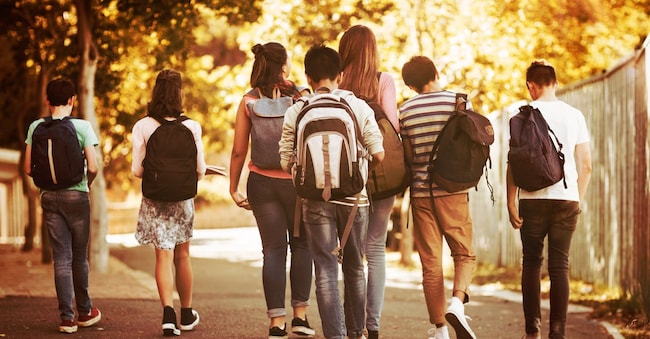
Backpack or trolley? The start of school is not far away and many families are faced with an often seemingly irresolvable doubt. If for children and teenagers it is a choice that concerns aesthetics, for mums and dads the dilemma is also linked to health: won't a heavy backpack give my daughter or son scoliosis? An orthopaedist and three kinesiologists, experts in human movement in relation to physical development, prevention and sport, have answered this question in an article in the latest issue of the journal of the Italian Society of Paediatrics (Il Pensiero Scientifico Editore). The verdict is as simple as it is clear: 'More important is the posture assumed in the classroom than the weight of the rucksack on the home-school-home journey'. Authoritative scientific citations and observational reflections support the statement.
The false myth of weight deforming
.The equation heavy backpack equals scoliosis is scientifically unfounded. The study's authors, Simone Cigni (Orthopaedist, ASST Santi Paolo e Carlo, Milan), Carmelo Giuffrida (Kinesiologist, Department of Biomedical and Biotechnological Sciences, University of Catania), Michele Perniola (Kinesiologist, Ministry of Education, Bologna), Rodolfo Lisi (Kinesiologist, Ministry of Education, Cassino - Frosinone) ask a direct and logical question: "If all children carry backpacks, why do only some develop developmental scoliosis?" The answer lies in the very nature of the spinal deformity, which cannot be caused by a temporary and symmetrical load such as a backpack. In fact, to scientifically prove a correlation, one would have to prove that the incidence of scoliosis in a school population is significantly higher than in a similar population in terms of age and gender that is not exposed to the backpack 'overload'. Such studies do not exist, and for a precise reason: the cause-effect link does not exist. The paradox is obvious to anyone observing the exit from a school: 'Children with backpacks - more or less heavy - are running or jumping, tuggling and pushing each other', as the researchers point out. In these moments, the spinal columns are subjected to mechanical loads that multiply enormously due to acceleration and deceleration, with possible musculotendinous injuries far more significant than simply carrying a backpack. The real enemy of spinal health is hidden between school desks. Hours and hours spent in often incorrect postures, in inappropriate chairs, with forced positions that young bodies are forced to maintain for most of the day. This is where the game for back health is played, not in the few minutes' journey from home to school. "It is the years straddling the developmental years that are the most delicate, from 10-11 to 15-16, especially for girls," explains Rodolfo Lisi. "At this stage, an asymmetry of the shoulders or chest should be checked by the paediatrician and then by a specialist.
The official guidelines: balance and common sense
Institutions have also addressed the issue in the past with a scientific approach. The joint note of the MIUR and the Ministry of Labour, Health and Social Policies (Nota Miur, prot. no. 5922 of 30/11/2009) entitled "Clarifications regarding the weight of school bags", refers to the recommendations of the Consiglio Superiore della Sanità. The document states that the weight of backpacks should not exceed a range between 10 and 15 per cent of body weight. A threshold that is also confirmed in the scientific literature: "A backpack weighing no more than 10 per cent of body weight is bearable for growing subjects," the experts point out, as it does not involve particularly heavy compensatory dynamic and muscular reactions.
Backpack or trolley: a (also) psychological choice
But then, how should one choose between a backpack and a trolley case? The experts' answer also takes into account the psychological aspects of development. "In early adolescence, the choice will fall exclusively on the young person," the researchers explain. If the peer group adopts the trolley, no problem: in such a delicate phase of life, 'conformity' represents an almost obligatory stage of growth and social acceptance. It is a different matter for younger children, where group membership is not yet so binding and the decision can be made by the parents, assessing the specific needs of their child. It is also important not to withhold a priori the use of the backpack from 'puny' children: it would mean depriving them of those stimuli necessary for the structuring of a healthy and resistant body.
The importance of physical activity
.A fundamental chapter is devoted to the role of physical exercise. Constantly practising physical activity means activating motor strategies and sensory mechanisms capable of recruiting more spinal muscle fibres. A trained body also bears the extra weight of the backpack better. 'Adequate physical training of the paravertebral muscles and abdominal wall means building a supportive muscular torso,' the authors emphasise. This is an important message for families: regular physical activity is the best prevention for back health, much more effective than excessive worries about backpack weight. 'Having emphasised the importance of doing sports and counteracting sedentariness, further assessments are to be made of individual sports and physical fitness. Beware,' explains Chinologist Lisi, 'of competitive tennis or other 'asymmetrical' sports for children with back problems. Some caution also on dance or artistic gymnastics. And even swimming, which is beneficial for many reasons, taking place in the absence of gravity cannot have a corrective effect'.

