Bankitalia

The impact of tariffs on world growth: Panetta's analysis and the risk for the US

In the US they are the highest in the post-World War II period. The risks of cryptocurrencies, the plan for the digital euro. Productivity, the gap between Europe and the US is widening. Action is needed on energy costs. Attractive jobs are needed for young people fleeing abroad. Training for immigrants

by Nicoletta Cottone

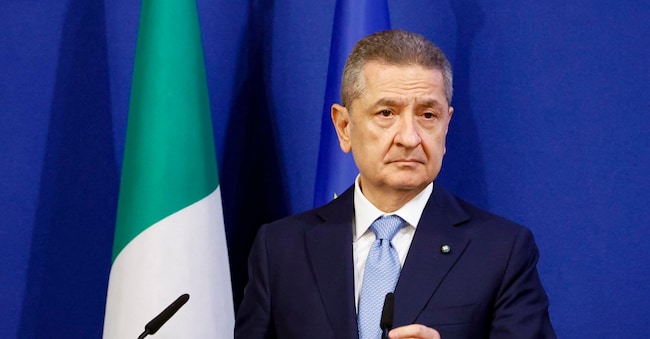
Il governatore Fabio Panetta durante la presentazione della Relazione annuale della Banca d'Italia a Palazzo Koch, Roma, 30 maggio 2025. ANSA/FABIO FRUSTACI

7' min read

7' min read

"The tightening of customs barriers could subtract almost one percentage point from world growth within a two-year period". And in the United States 'the estimated effect is about double'. This was said by Bank of Italy Governor Fabio Panetta in the Final Considerations, on the occasion of the presentation at Palazzo Koch of the Annual Report for 2024. The governor's speech starts from the trade disputes and ongoing conflicts that are undermining international confidence, recalling how in recent weeks the International Monetary Fund has lowered its forecasts for world growth for the next two years to less than 3 per cent, below the average of the past decades. Panetta points out that the tariffs 'could lead to lower labour demand and increased inflationary pressures, at a time when inflation expectations are already rising. They are also having a negative impact on household and business confidence, with possible repercussions on consumption and investment'.

Duties in the US are the highest in the post-World War II period

The announcement of high tariffs, the governor recalls, 'seems to be used as a negotiating lever to redefine international economic and political relations'. But the strategy, Panetta warns, 'may have effects that are difficult to predict and manage'. The duties currently in force in the United States, although lower than those announced at the beginning of April, remain the highest in the post-World War II period and are the cause of the significant increase in average duties worldwide.

Loading...

A European bond to finance public investments

.

In order to eliminate the fragmentation of the capital market along national lines, for Panetta 'it is crucial to introduce a European public bond, with a double objective: to finance the public component of investments and to provide a common, solid and credible reference for the entire financial system. According to our estimates, an integrated capital market, with a common European bond at its centre, would reduce financing costs for companies, triggering additional investment of EUR 150 billion a year and raising output by 1.5 per cent when fully operational. The effect on GDP could be up to three times greater if the new investments were earmarked for high-tech projects'.

Productivity and the lag in innovation

.

Over the past 30 years, the governor recalled, labour productivity in the European Union grew by 40 per cent, more than 25 percentage points less than in the United States. Since 2019, the gap has widened: productivity has increased by 2 per cent in Europe, compared to 10 per cent in the United States, where it has been driven mainly by advanced technology sectors. "This lag mainly reflects the difficulty of innovating," Panetta points out, recalling that, in relation to GDP, European companies invest half as much in research and development as those in the US. And most of the investments come from companies that have been active for decades, while the contribution of young and innovative companies that often choose to transfer their activities abroad is weak. On the artificial intelligence front, European patents are less than a fifth of those in the US.

Delays on NRP: 2025-26 interventions could raise GDP by 0.5%

Panetta recalled that Italy has so far received EUR 122 billion for the NRP, the National Recovery and Resilience Plan, and has utilised more than half of it. "The payment of the next instalments," the governor said, "will depend on the achievement of objectives related to the realisation of public works; in this regard, the data currently available suggest that there are delays. The use of NRP funds has supported the economy in recent years, Panetta recalled. "The interventions planned for 2025-26 could raise output by 0.5 per cent. In a phase of cyclical weakness,' Panetta stressed, 'it is essential to proceed with determination in their implementation.

Mergers serve to strengthen the banks

.

"The balance sheet data and market valuations" of Italian banks "confirm the strength of the system" which "as a whole" has a "solid capitalisation, higher than the European average", reiterated Bank of Italy governor Fabio Panetta in his final remarks. Mergers serve to create value for banks. The merger operations launched in recent months "must serve to strengthen" the banks "and must be well conceived and aimed solely at creating value". For Panetta, 'creating value means, first and foremost, offering businesses and families adequate financing in terms of quantity and cost', 'effective, transparent instruments for the use of savings at fair conditions', and 'qualified and innovative' services.

The risks of cryptocurrencies, from bitcoins to stablecoins

The governor spoke of the connections between the world of cryptocurrencies and the financial system, whose activities are intensifying. Indeed, "agreements between cryptocurrency operators and financial intermediaries are increasing, as are the initiatives undertaken by the latter. Some US-listed companies have purchased large quantities of Bitcoin, thus exposing their shares - and indirectly savers - to the volatility of this instrument. Exchange-traded funds that invest in Bitcoin have been operating for some time. These developments have implications on the risk front. On the one hand, cryptocurrencies, such as Bitcoin, lack an underlying asset; 'highly volatile instruments, traded mostly in unregulated, opaque environments. The increasing interconnection with the financial system makes it more difficult to contain the risks'. On the other hand, the so-called stablecoins: "these are instruments that aim to maintain a stable value with respect to underlying currencies or assets, but which nevertheless expose holders to risks linked to the solidity of the issuers and the variability of the value of the underlying. In the absence of appropriate rules, their suitability as means of payment is doubtful, to say the least'.

The Plan for the Digital Euro and Financial Education

"But it would be illusory to think that the evolution of cryptocurrencies can only be governed by bans or regulatory constraints. What is needed is a response that matches the technological transformation taking place, capable of meeting the demand for secure, efficient and accessible digital payment instruments, while preserving the role of central bank money. The digital euro project stems precisely from this need. At the same time, there is a need to strengthen the financial skills of citizens, so that they can orient themselves in the new digital universe and assess with awareness the opportunities and risks of the products and services available. The Bank of Italy is committed to both these fronts'.

Italy needs to take action on energy costs

.

The governor emphasised that despite the difficulties, Italian industry has dynamic and competitive companies, which invest in technology and research and position themselves in high-end segments. Solid foundations, which must, however, be strengthened. "In Italy, more than elsewhere in Europe, there is an urgent need to intervene on the cost of energy, following the guidelines already outlined: expanding the use of clean sources, incentivising long-term contracts and strengthening infrastructure and transmission networks. Adequate investments and a clear simplification of authorisation procedures for new plants are needed'

The central problem remains productivity

.

'The central problem remains productivity - in manufacturing as in the rest of the economy. The increases achieved so far are encouraging, but they are not enough to sustain the country's development. The low level of wages reflects this weakness: since the beginning of the century, in line with the stagnation in productivity, real wages have grown much less than in other major European countries. Until the pandemic, the increase had been as low as 6 per cent. The subsequent inflationary shock brought real wages back below those of 2000, despite the recovery that has been underway since last year. To ensure lasting wage growth, it is essential to boost productivity and growth through innovation, capital accumulation and decisive public action'.

Italy's growth has exceeded that of the euro area

.

Panetta recalled the long period of stagnation in the Italian economy, but emphasised that in the last five years, despite the pandemic and energy crises, 'the country has shown signs of renewed economic vitality. Growth has exceeded that of the euro area. GDP increased by about 6 per cent, driven by an increase of almost 10 per cent in the private sector. In addition to construction, a significant contribution came from services, which expanded in both traditional and advanced sectors. Employment increased by one million, reaching an all-time high of over 24 million; the unemployment rate dropped from 10 to 6 per cent. The Mezzogiorno grew slightly more than the national average.

Labour, greater integration of women and more childcare services

The governor spoke about the world of work, recalling the impact of the demographic winter on the growth potential of the Italian economy. According to ISTAT, by 2040 the number of people of working age will fall by about 5 million. "This could result in a contraction of output estimated at 11%, or 8% in per capita terms. An increase in labour market participation rates would mitigate this impact'. Panetta emphasised that a "significant contribution could come from greater inclusion of women, whose participation remains among the lowest in Europe, despite recent progress". Investment is needed in childcare services, in particular crèches, which can facilitate women's employment, which is still hindered by the lack of adequate facilities, as well as by an unbalanced distribution of family obligations.

Attractive occupations are needed for young people fleeing abroad

"However, even in the most favourable scenario, an increase in activity rates," the governor recalled, "can at best compensate for the decline in the active population. In order to expand the labour force, it is also necessary to create attractive jobs for the many Italians who leave the country in search of better prospects,' he said. And he recalled that in the last ten years 700,000 Italians have emigrated, a fifth of them young graduates.

Italy has the lowest share of immigrants with university degrees

.

Panetta said that regular immigration can make a significant contribution, especially in the construction and tourism sectors, which are experiencing a growing labour shortage. The contribution of immigration 'can extend to activities with greater added value, provided that we succeed in attracting qualified profiles'. And he pointed out that on this front Italy is lagging behind: among the main countries, it is the one with the lowest share of immigrants with university degrees. "Reducing this gap," he said, "also requires adapting the systems for recognising qualifications and skills to European standards. With such a sharp drop in the labour force in 2040, it is necessary to invest in appropriate training, including of immigrants.

Copyright reserved ©
Loading...

Brand connect

Loading...

Newsletter

Notizie e approfondimenti sugli avvenimenti politici, economici e finanziari.

Iscriviti