
Bankitalia, Panetta: 'Focus on human capital. A young German graduate earns 80% more than an Italian"
The Governor spoke at the inauguration of the academic year at the University of Messina: we need to start with young people (and greater female participation in the world of work) to restore momentum to an economy that has weakened and suffers from historical structural problems

Key points
- A tenth of young Italian graduates have moved abroad, mainly engineers and computer scientists
- The crux of demography: by 20250 (says Istat) Italy will lose 7 million people of working age
- The unknowns of the economy, from wages to prices
- "Income growth cannot, however, rest permanently on fiscal policy"
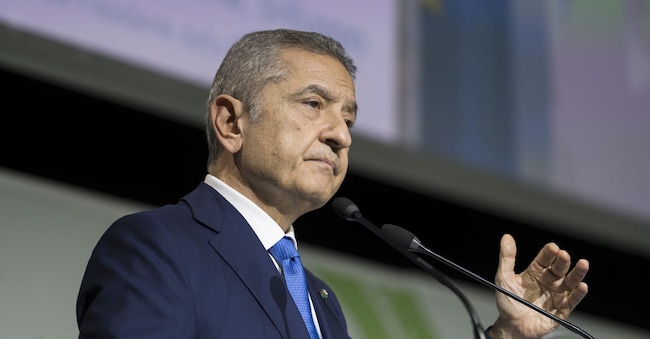
Italy reacts well to crises, we know. But then it loses ground in comparison with the rest of the industrialised countries: 'productivity has been stagnating for a quarter of a century; the capacity to innovate remains distant from the countries at the technological frontier. These brakes on growth translate into a persistently weak income and wage dynamic, which has for some time been limiting the choices and prospects of people, especially women and young people'. For the Governor of the Bank of Italy, Fabio Panetta, it is therefore necessary to start from young people (and from the increased participation of women in the world of work) to give new impetus to an economy that has weakened, and is suffering from historical structural problems: "We need development based on investment, innovation and productivity, capable of sustaining higher wages and better job prospects. The transformation of the world economy demands it. The demographic constraint of a country that is rapidly ageing and where there will be fewer and fewer young people entering the labour market makes it necessary'.
A tenth of young Italian graduates have moved abroad, mainly engineers and computer scientists
Panetta spoke at the opening of the academic year at the University of Messina, and so we start with young people. "The low performance of university education in Italy is driving an increasing number of young graduates to emigrate abroad, a phenomenon that also affects the north of the country. In recent years, around one tenth of young Italian university graduates have moved abroad, with higher incidences among engineers and computer scientists, professional figures for which Italian companies report a growing shortage,' says the governor. And he gives some emblematic figures: 'A young graduate in Germany earns on average 80 per cent more than an Italian peer, while the differential with respect to France is 30 per cent. These gaps have widened over the years. But salary differences are not the only determinant of the choice to leave Italy. Young graduates move in search of work environments where merit is fully recognised through stable contracts, jobs consistent with skills and more dynamic career paths'. To these motivations are often added preferences for social contexts considered more attractive, as well as natural curiosity towards worlds and lifestyles different from those of origin: 'This loss is not compensated for by the arrival of young foreigners with a similar level of qualification'. So one message is clear: 'Targeted support for families and education generates high economic and social returns'.
The node of demography: by 2050 (says Istat) Italy will lose 7 million people of working age
In light of demographic constraints, 'stable growth must be based on higher productivity. This requires investment in innovation and human capital, two areas in which the university plays a central role,' Panetta notes. And he recalls that according to the latest demographic projections, Italy will lose more than 7 million people of working age by 2050. Even assuming a further increase in labour market participation, Istat estimates a reduction in the labour force of over 3 million. "Without adequate productivity growth, the demographic imbalance will inevitably translate into a reduction in GDP and overall welfare. The demographic constraint is, therefore, crucial. It is a complex issue that must be addressed on several levels. First of all, it requires increasing labour force participation, particularly of women and young people - 'female employment and fertility are not contradictory. On the contrary, they can be mutually reinforcing, as shown by the experience of the countries with the highest rates of female labour market participation,' he specifies. 'Despite the progress made since the turn of the century, there remains much room for improvement. "It also requires a careful policy towards legal migration. It also requires managing the economic and social consequences of an ageing population. Finally, it calls into question the low birth rate which, as the President of the Republic recently reminded us, raises questions about the idea of society and economy that we want to build in the long term'.
The unknowns of the economy, from wages to prices
The governor then says it clearly (not for the first time): since 2000, hourly wages in Italy have remained almost static in real terms, compared to a growth of 21 per cent in Germany and 14 per cent in France. "This trend has been significantly affected by the inflationary shock following the energy crisis. Today, consumer prices in Italy are 20 per cent higher than in 2019. Nominal de facto wages have risen by 12, a reduction in real terms of 8 percentage points. In the other main European countries, however, the initial loss has been reabsorbed'. In Italy, however, Panetta acknowledges that tax policy and employment growth have compensated for the loss of household purchasing power. "Since 2021, tax cuts - mainly in favour of lower and middle incomes - have increased net wages by 5 percentage points, reducing the loss in real terms to 3 points. In parallel, the number of labour income earners has increased, particularly among the most fragile households; taking this effect and public transfers into account, real disposable household income has returned to pre-inflationary shock levels, offsetting the erosion of purchasing power and the tax drain."
"Income growth cannot, however, permanently rest on fiscal policy"
But things cannot always be this way: 'Looking ahead, however, income growth cannot permanently rely on fiscal policy. Budget margins are limited and public interventions can only provide temporary support in exceptional situations. Lasting wage increases require productivity to return to sustained growth and its benefits to be appropriately shared between capital and labour'. The experience of the recent past says that in the five-year period 2020-24, even with the support of fiscal policy, "the Italian economy grew at rates above those of the previous decade and in line with the euro area average. Employment is now at an all-time high and the labour market participation rate has increased significantly. The banking system, which only ten years ago was a vulnerability factor, is now on the whole solid, well capitalised and profitable'. And the most significant surprise came from the South: 'After the pandemic, the GDP of the southern regions grew by almost 8 per cent, over two points more than that of the Centre North. In per capita terms, the expansion exceeded 10 per cent, almost double that of the rest of the country. Employment increased by 6 per cent, more than twice the increase observed in the central and northern regions. These are important signs, which give hope for the possible resumption of the convergence process that was interrupted half a century ago'.


