
Panetta: 'Focus on young people. Yes to AI but focus on workers'
The Governor in his Final Considerations: the international situation that 'has been dramatically changed by the conflict in the Persian Gulf. The blockade of the Strait of Hormuz has caused supply shortages and sharp rises in the price of energy raw materials". In Italia, "targeted and temporary measures" are needed
Key points
The crisis of the world order triggered by the ongoing conflicts puts Italia in front of a very arduous but necessary challenge: to decisively increase the productivity of the economy, which despite having shown good resilience since 2019 now has very modest growth. Public policies must lower state debt in order to free up resources for social policies and development, and the weaknesses that have been holding back the Italian economy for decades must be addressed: "Poor innovation, low levels of human capital, energy dependence. The investment effort of recent years must be continued and made more effective, improving the quality of public action'.
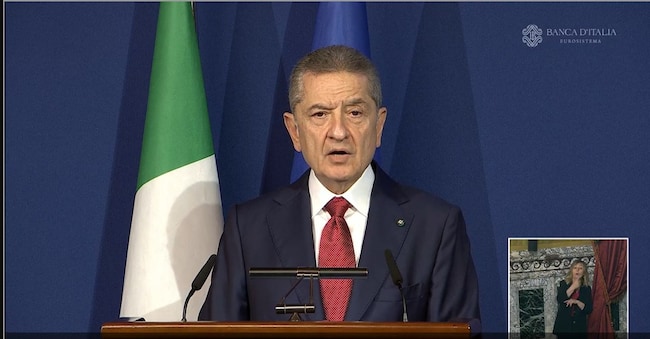
In his concluding remarks on 2026, the Governor of the Bank of Italy, Fabio Panetta, points the way to decisive innovation - starting with the extensive use of artificial intelligence - that first of all values young people and looks to the future: "Italia must look to the future with determination. It has important strengths: cutting-edge scientific knowledge, human resources to be enhanced, a production system with recognised excellence, a solid financial position of banks, companies and families. It is a valuable asset. For it to become a real asset, it must be directed towards growth, income and prosperity in the years to come'.
Italy has many strengths, we need to invest. Enhancing skills
Looking ahead,' Panetta writes, 'the issue of competitiveness is likely to become central again. "The presence of Italian exporters remains limited in Asian markets, which are destined to be the main drivers of global demand, while competition from China is increasing pressure even in technologically advanced manufacturing sectors. Italia retains significant strengths in mechanics, pharmaceuticals and quality production: only by investing and innovating will they be enhanced'. The ultimate criterion for success will be the ability to offer opportunities and a future to young people. "A country that innovates must know how to enhance skills, reward merit, retain and attract talent, and allow everyone to contribute according to their abilities. It is a question of efficiency and justice together'. In short, 'creating the conditions for the new generations to realise their aspirations and contribute to the progress of the country is not just an economic responsibility: it is the civil task of this time. Only in this way will Italia be able to cross an increasingly fragmented world without suffering its divisions, and transform the technological transition into a season of freedom, work and confidence in the future'. Themes that echo the key points of this year's Istat annual report.
Fostering the adoption of artificial intelligence, avoiding past mistakes in adopting innovations
However, recalls Panetta, for artificial intelligence to become a widespread lever of growth, its adoption in companies - including small and medium-sized ones - must be encouraged and investment in the training of people must be made. "The workers most exposed to change must be protected and accompanied in the retraining of skills, so that productivity gains translate not only into greater efficiency, but also into new job opportunities and wider participation in the fruits of innovation." So technology will be the decisive ground for this challenge. Artificial intelligence, robotics and other innovations are reshaping production processes, work organisation and the demand for skills. "Remaining on the sidelines of this transformation would mean accepting a retreat in the ability to grow, just when the ageing population makes it essential to increase the contribution of every worker and every company. We are still at an early stage'. For the Governor, 'there is therefore time to avoid a repeat of the experience of the 1990s. Back then, delays accumulated in the adoption of information and communication technologies, which then held back productivity for decades. Today, swift action is needed. The potential contribution is significant. Labour productivity could increase by 0.2 percentage points per year in a slow adoption scenario, and by more than 1 point in the case of rapid and pervasive diffusion'.
The international scenario: oil prices and inflation
Panetta analyses the international situation which 'has been dramatically changed by the conflict in the Persian Gulf. The blockade of the Strait of Hormuz - through which one-fifth of the world's oil and liquefied gas supplies routinely transit - has led to supply shortages and sharp increases in energy commodity prices. Oil prices rose in all regions, reflecting the integration of global production and distribution chains. In the more fragmented gas market, prices have followed different trajectories: they have risen in Europe and Asia, areas dependent on imports; they have remained stable in the US, where abundant domestic production and infrastructure constraints on exports mitigate the transmission of international tensions to domestic prices'. In Europe, "in the worst-case scenarios, a prolongation of the conflict and further damage to the Gulf's energy infrastructure could subtract a total of 1 percentage point from growth in 2026-27. Inflation could peak above 6 per cent and, if left unchecked, remain above target for a long time, as the energy shock is transmitted to an increasing number of sectors,' Panetta warns. Consumer prices and short-term inflation expectations are rising everywhere. Moreover, Panetta cites among the imbalances the persistence of large external debt and credit positions. The United States has a net debt position of 90 per cent of GDP, compared to credit positions in China, other Asian economies, and the euro area. The income generated by these positions - interest and dividends - tends to increase the imbalances over time.


