
Barilla Pesto turns 30: world leader with 38% of the market
The company has invested in the Rubbiano plant, specialising in sauces, over 150 million euros in 10 years

3' min read
3' min read
The world leader in pesto is in Parma. Its name is Barilla, it holds 37.8% of the global market in value terms and has been bringing this typically Italian condiment to the tables of half the world for exactly 30 years, exporting 80% of its production. All made in the Rubbiano plant, on the outskirts of the Emilian city, from where every year 84 thousand tonnes of sauces come out, obtained from over 55 thousand tonnes of Italian tomatoes and basil, supplied by 37 farmers who undertake to comply with a specification for sustainable cultivation.
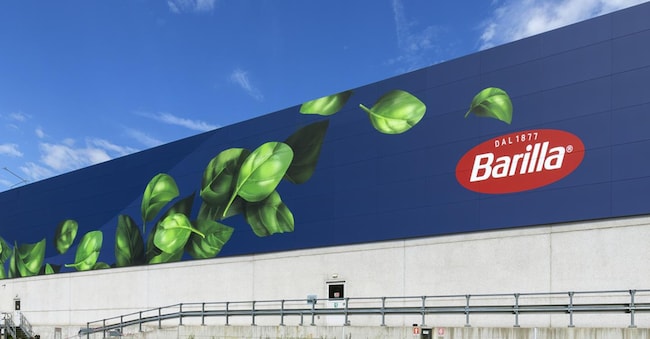
A factory, the largest in Europe for the production of sauces, on which the company has invested over 150 million euros in 10 years, and which now has a new look: on the façade stands an artistic mural of over 800 square metres, celebrating basil, the iconic ingredient of pesto. A work of art, created by Marianna Tomaselli, celebrating the birthday of a product that is one of the group's global best sellers. And one of the most successful Italian products in the world.
"Consumers are showing increasing interest in pesto because it is extremely in line with current trends, as it is tasty, easy to prepare and 'plant based'," explains Valentina Marchetti, global marketing director Pesto Barilla. The most important foreign markets are Germany and France, where Barilla is market leader, with 56% and 48% value share respectively. And where there is still much work to be done, because pesto is bought by less than 50% of families and because it is mainly used as a sauce for pasta, and only to a lesser extent in the preparation of bruschetta or as 'dipping', dipping crackers or breadsticks directly into the jar.
"Although its uses are still rather limited, in the focus groups we conducted in several European countries it emerged that pestos is considered a very versatile product and capable of stimulating creativity in the kitchen,' adds Marchetti, 'So we are studying a communication plan that will suggest alternative uses to consumers with the aim of widening the occasions of consumption of the product and, therefore, the frequency of purchase.
Another challenge for the company is to grow in the US market, where pesto has not yet expressed its full potential and where few people know it and how to use it. "Our role will be twofold: to grow the category, trying to get pesto into the habits of Americans, and to establish Barilla as the top of mind brand," says Marchetti.

