Eurogroup

ECB: Spain’s de Cos and the Netherlands’ Knot in the running to succeed Lagarde: who are the two contenders?

By the deadline for the submission of nominations, set for 5.00 pm today, the Eurogroup had received only the names of the two former governors of their respective national central banks, both of whom were widely expected

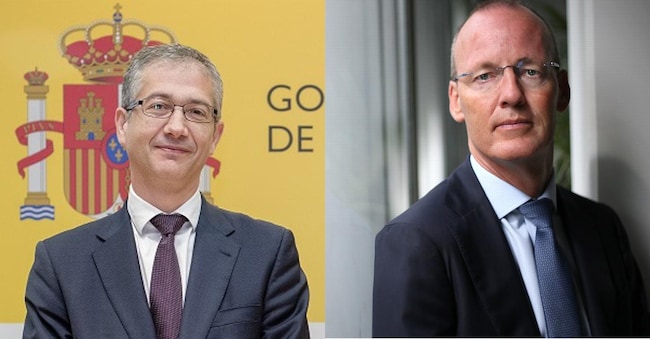
Pablo-Hernández-de-Cos e Klaas Knot

3' min read

Translated by AI
Versione italiana

3' min read

Translated by AI
Versione italiana

It is a two-horse race between the Spaniard Pablo Hernández de Cos and the Dutchman Klaas Knot to succeed Christine Lagarde as President of the European Central Bank.

By the deadline for the submission of nominations, set for 5.00 pm today, 6 November, the Eurogroup had received only the names of the two former governors of their respective national central banks, both of whom were widely expected. The Eurozone finance ministers will hold an initial discussion on the nominations at their meeting on Monday 9 November. Below is a profile of the two candidates.

Loading...
Bce, Lagarde lascia in anticipo: "Non posso più restare neutrale"

Pablo Hernández de Cos, Madrid’s dove

A native of Madrid, born in 1971, he is Spain’s candidate to succeed Christine Lagarde as head of the European Central Bank. He built his career at the Bank of Spain’s research centre, where he served as governor from 2018 to 2024, and championed greater transparency and a more public-friendly approach.

In mid-2025, he took over as head of the Bank for International Settlements (BIS) in Basel. Prior to that, he chaired the Basel Committee on Banking Supervision.

He is the first Spanish candidate for the presidency of the ECB. The forthcoming Spanish general election could prove to be a setback for his candidacy, but both the Socialists and the People’s Party have spoken out strongly in his favour.

De Cos has a reputation for favouring a more expansionary monetary policy, paying greater attention to the effects of monetary policy on economic growth. This moderate “dovish” stance aligns him more closely with the policies of southern European countries, which are calling for greater fiscal flexibility. His policy places greater emphasis on financial stability and the real economy.

De Cos has been described by the Spanish Minister for the Economy Carlos Cuerpo as combining an extraordinary knowledge of economic, fiscal and monetary policy with extensive expertise in the international banking sector and financial stability. As Governor of the Bank of Spain and Chair of the Basel Committee, he has earned ‘a reputation for technical rigour and the ability to bring teams together and build consensus’.

Klaas Knot, the falcon chosen by Amsterdam

Born in 1967, Klaas Knot is an economist and academic with a long career in financial regulation. For 14 years he headed the Dutch Central Bank and is known for having chaired the Financial Stability Board, an international body that monitors financial stability, as well as having served as a member of the Governing Council of the ECB.

He is the Netherlands’ official candidate to succeed Christine Lagarde as head of the European Central Bank following her announcement on 7 February 2027 that she intends to step down, almost nine months before the end of her term of office. 

Knot has a reputation as an uncompromising technocrat who takes a rigorous approach to risk management and systemic stability. A “hawk” who will most likely aim to maintain a tight monetary policy to counter inflationary pressures in European markets. Knot is also an advocate of a “frugal” economic policy characterised by strong fiscal discipline and low debt.  

Loading...

The appointment process, however, will not be straightforward, given that two further posts on the ECB’s Executive Board will need to be filled: that of Isabel Schnabel (German, who will step down on 3 January 2027 to join the International Monetary Fund) and that of Chief Economist Philip Lane (Irish, whose term expires at the end of May).

Knot’s chances hinge on the interplay of the three sets of negotiations between France and Germany regarding these three posts. An unwritten rule prevents any one country from having two representatives on the six-member executive committee.

If Germany were to retain the markets portfolio (currently held by Schnabel) and France were to secure the post of chief economist (currently held by Lane), the Dutchman’s chances would improve: this is the deal which, according to rumours, Paris is said to have in mind to support him.


Copyright reserved ©
Loading...

Brand connect

Loading...

Newsletter

Notizie e approfondimenti sugli avvenimenti politici, economici e finanziari.

Iscriviti