
Regional sovereignty

Beijing’s karst strategy to make its mark in the Maghreb’s energy sector

Morocco, Egypt and Algeria: European partners in renewables, solar power and gas. Chinese companies, however, operating outside the framework of the Belt and Road Initiative, supply specialised technology for these sectors: from inverters and storage systems to ICT. In future, who will own the operational data from the plants? Who will update the systems? What cybersecurity standards will be applied?

by Charlye Ghezzi

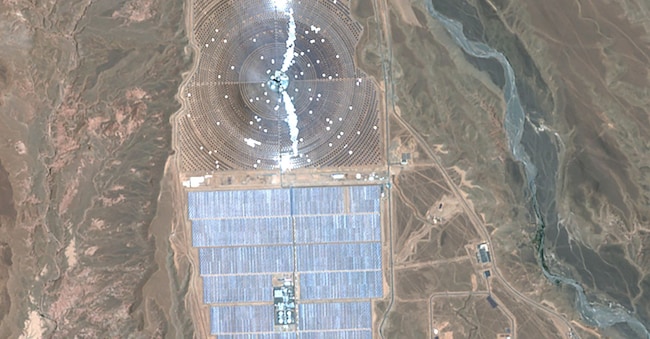
Immagine satellitare del complesso solare Noor Ouarzazate, in Marocco Science Photo Library via Reuter

9' min read

Translated by AI
Versione italiana

9' min read

Translated by AI
Versione italiana

A little-noticed strategy links the Ouarzazate desert to Algerian solar power stations, all the way to the industrial zones along the Suez Canal. It is a subtle thread, woven from construction sites, turbines, solar panels, batteries, EPC contracts, digital systems and economic diplomacy. This is China’s presence in North Africa’s energy infrastructure – a presence that does not take the traditional form of the Belt and Road Initiative, with its ports, roads and railways, but rather the quieter face of the energy transition. Morocco, Algeria and Egypt are not three identical cases. On the contrary, they represent three different models. Morocco is using renewables and the green industry to strengthen its position between Europe and Africa. Algeria remains, first and foremost, a gas powerhouse, but it knows that the Sahara’s sunshine cannot remain merely a potential resource. Egypt, rather than being ‘Maghrebi’ in the strict geographical sense, belongs to the vast North African and Middle Eastern energy belt: a country that aims to become a regional hub for electricity, gas, hydrogen and green manufacturing. In all three cases, China is stepping in where energy ceases to be merely a matter of fuels and becomes industrial infrastructure.

Rabat

In Morocco, the most striking symbol is the Noor solar complex, near Ouarzazate. Set amidst a landscape that seems tailor-made to remind us just how much the sun can be both a resource and a challenge, China’s involvement has taken a very tangible form: construction, engineering and the ability to deliver. PowerChina presents the Noor concentrated solar power project as one of its flagship overseas projects, comprising two phases with an installed capacity of 350 megawatts. According to the company’s documentation, construction began in 2015 and the plant became operational in 2018. The company also claims an annual output of over one billion kilowatt-hours and a reduction in emissions of 522,000 tonnes of CO₂. The technical figures matter, but what they represent matters even more. Noor is not just a power station. It is a showcase. It signals that Morocco wants to play a leading role in the energy transition, not merely as an importer of technology, but as a platform capable of attracting capital, businesses and expertise. It is also a signal to Europe: on the other side of the Strait of Gibraltar lies not just an emerging market, but an industrial system seeking to integrate itself into the value chains of decarbonisation.

Loading...

This Moroccan ambition is also evident in the wind sector. In January 2024, the Moroccan ministry responsible for investment announced the launch of the Aeolon project in Nador: a factory producing wind turbine blades, presented as the Chinese manufacturer’s first international facility. This is an important detail, as it shifts the focus from electricity generation to manufacturing. It is no longer simply a matter of building renewable energy plants in Morocco, but of producing components for the renewable energy sector within the country. Morocco has a stated target: to increase the share of renewables to 52 per cent of installed electricity capacity by 2030. This figure is often cited, but its significance must be carefully considered. Installed capacity does not automatically equate to actual production. A megawatt of solar or wind power does not operate in the same way as a megawatt of gas or coal-fired power, as it depends on the sun, the wind, the grid, storage systems and demand management. This is why Morocco’s energy transition cannot stop at solar panels or wind turbines. It requires grids, batteries, control systems, maintenance and operational expertise. And it is precisely here that China’s involvement becomes most significant: not just concrete and steel, but power electronics, energy storage and digital management. In economic diplomacy between Rabat and Beijing, renewables feature as a priority sector. The Morocco–China Joint Economic and Technical Commission has expressed an interest in encouraging Chinese operators in sectors such as the automotive, textile, agri-food, aerospace and renewable energy industries. It is a broad list, but not a random one: it brings together export-oriented industry, logistics, clean energy and global value chains. In other words, Morocco is seeking to transform its geographical position into an industrial one.

Algiers

Algeria is starting from a different point. Here, the focus remains on gas. Its reserves, its export network and its role in the European and Mediterranean markets mean that Algeria cannot be understood solely through the lens of the green transition. Its economic security is still tied to hydrocarbons. But it is precisely this strength that creates a dilemma: how can it defend its role as an energy supplier without falling behind in the new era of renewables? The Ministry of Energy and Renewable Energy speaks of a programme to achieve 15,000 megawatts of renewable capacity by 2035. The first phase, comprising 3,200 megawatts of solar power, is reported to have already begun and is set to come online from 2026. Here too, China appears not merely as a financier, but as a builder and provider of implementation capacity. In March 2024, PowerChina announced the signing of contracts with Sonelgaz-EnR for two photovoltaic projects in Algeria, with capacities of 220 and 150 megawatts respectively, to be carried out under an EPC model – that is, engineering, procurement and construction.

This approach warrants some explanation. An EPC contract is the way in which a government or a utility tells a company: design the plant for me, source the materials, build it and hand it over to me in working order. It is a powerful operational shortcut, especially when a country wants to speed things up. But it also has a strategic implication: whoever controls the design, supply and construction aspects gets very close to the heart of the infrastructure. For Algeria, solar power does not replace gas in the short term. It complements it. It serves to free up more gas for export, reduce domestic consumption of fossil fuels and pave the way for a possible future hydrogen economy. In official Algerian documents, the transition is described without abandoning the role of gas. It is a realistic stance: for Algiers, gas is not a relic of the past, but a current geopolitical lever. Solar power is a second lever, still under development. The delicate issue is that Algeria’s energy modernisation requires not only infrastructure but also the grid, regulation, data management, forecasting capabilities and operational security. The more the electricity system integrates variable solar power, the more it needs digital tools. And the more a grid becomes digital, the greater its surface area of vulnerability. Here, the term ‘cyber’ must be used with caution. Available public sources allow us to discuss energy digitalisation, technological solutions and smart systems; they do not, at least based on publicly available evidence, allow us to assert the existence of specific Chinese cyber assistance targeting Algeria’s energy supply chains.

Cairo

Egypt takes this dynamic to a whole new level. In recent years, the country has already built a powerful narrative: to become a regional energy hub. Gas from the Eastern Mediterranean, terminals, interconnections, renewables, green hydrogen, special economic zones. The Suez Canal is not just a maritime route; it is also an industrial platform where the government is seeking to attract manufacturing, logistics and technologies linked to the energy transition.

The best-known example of renewable energy in Egypt is Benban, the large solar park near Aswan. The International Finance Corporation has presented it as a key project for unlocking Egypt’s energy potential, comprising 32 plants with a projected capacity of 1,650 megawatts. Benban is not strictly speaking a ‘Chinese’ project as a whole: it involves a variety of developers, financiers and international institutions. But it illustrates the terrain on which Chinese companies operate: large volumes, infrastructure, solar technology and delivery capacity. In the most recent agreements, the new element is energy storage. In January 2026, Scatec announced a power purchase agreement with the Egyptian Electricity Transmission Company for 1.95 gigawatts of solar power and 3.9 gigawatt-hours of battery storage. In the same context, official and corporate sources highlight the role of Sungrow, a Chinese group specialising in inverters and storage systems, within the projects’ technology chain. This is a crucial point: the future of Egypt’s renewables sector depends not only on how much solar power is installed, but on how much of it can be made stable, programmable and usable even when the sun goes down. An electricity grid is like a large orchestra. Power stations produce different ‘instruments’: some play constantly, whilst others come on and off depending on the wind and sunlight. Batteries and digital systems are the conductor trying to prevent the music from going out of tune. If the conductor is technologically dependent on external suppliers, that dependence is not necessarily an immediate problem, but it becomes a strategic variable. This is why Egypt is talking about industrial localisation. The energy transition is presented not only as a climate agenda, but as an economic policy: foreign direct investment, employment, local production and exports. In 2025, the Egyptian Ministry of Planning and International Cooperation reaffirmed the target of 42 per cent renewables by 2030 in its nationally determined contributions. It also linked the clean energy transition to the ability to attract investment and low-cost financing. In other words: green energy as industrial policy.

Gas

As regards gas, China’s presence in the three countries appears to be more selective and less dominant than in the renewable energy and electricity sectors. In Algeria, the gas sector remains under state control and is characterised by long-standing partnerships with European and international players. In Egypt, the Eastern Mediterranean gas sector is dominated by European and regional players, as well as major Western companies. In Morocco, gas is primarily a matter of energy security and import infrastructure, with projects that have also been subject to suspensions and adjustments. Based on the open-source primary sources consulted, China does not appear to be the dominant player in North African gas projects. However, it can establish a presence in ancillary areas of the supply chain: construction, equipment, technical services, digitalisation, components and control systems.

It is precisely this ‘indirect’ presence that is often underestimated. You do not always need to own a deposit to exert influence over an energy supply chain. Sometimes it is enough to build the power station, supply the inverter, install the storage system, manage maintenance, train technicians and become part of the operational protocols. Energy in the 21st century is not just about molecules and megawatts. It is also about data.

The Huawei case

In this regard, Huawei is the most prominent example. The company’s public documentation describes Huawei Digital Power as a provider of solutions for smart photovoltaics, energy storage, data centres, critical power and digital energy infrastructure. In Egypt, the Ministry of Petroleum and Mineral Resources recorded a meeting in April 2025 between Minister Karim Badawi and Charles Yang, an executive at Huawei Digital Power, aimed at strengthening cooperation in digitalisation, renewables and hydrogen. This is diplomatic language, not a detailed operational contract. But it highlights the point where energy meets ICT. This is where the most sensitive issue arises. Energy infrastructure is critical infrastructure. If it becomes more efficient thanks to sensors, platforms, software and remote management systems, it also becomes more exposed to cyber risks, vendor lock-in, proprietary updates and supply chains that are difficult to control. This does not mean that every Chinese technology is automatically a risk. That would be a political conclusion, not an analytical one. It does, however, mean that North African governments must treat the digitalisation of the energy sector as a matter of technical sovereignty.

Future moves

The overall picture is therefore less straightforward than a simple dichotomy between China and the West. Morocco works with Europe, the Gulf states, China and multilateral institutions. Algeria is in dialogue with the European Union on gas and energy, but is also opening up renewable energy projects to Chinese companies. Egypt combines the World Bank, European investors, Gulf companies, Chinese firms and special economic zones. China does not replace everyone else: it fills the gaps, steps in where industrial capacity is needed, offers competitive prices and brings technology to sectors where it has a global advantage. The real issue, then, is not ‘China yes’ or ‘China no’. It is how much local control remains along the supply chain. Who owns the operational data for the plants? Who can update the systems? Who trains the staff? What proportion of components is produced locally? What cybersecurity standards are applied? For Morocco, Algeria and Egypt, the Chinese presence is both an opportunity and a test of strategic maturity. An opportunity, because it allows power stations, factories, storage systems and digital infrastructure to be built more quickly. A test of maturity, because it forces a distinction to be made between useful investment and opaque dependence. A solar panel may seem neutral. A battery may seem like just a battery. Management software may seem like a technical detail. But taken together, they form a country’s energy architecture. North Africa is no longer merely Europe’s energy backwater or a hydrocarbon extraction zone. It is becoming a laboratory where gas, solar power, green industry and digital technology intersect. In this laboratory, China has realised that those who build the infrastructure for the energy transition do not merely sell machinery. It is helping to shape the practical rules of the future. The question that remains unanswered does not concern Beijing alone. It concerns Rabat, Algiers and Cairo. Will they be able to use the competition between powers to strengthen their own autonomy? In the desert, the sun shines abundantly. Sovereignty, however, must be planned with greater care.

Charkye Ghezzi is a geopolitical analyst and a specialist in technology and government security

Copyright reserved ©
Loading...

Brand connect

Loading...

Newsletter

Notizie e approfondimenti sugli avvenimenti politici, economici e finanziari.

Iscriviti