
Belgium, Poland and Romania gear up to shoot down Russian drones
Warsaw and Bucharest introduce the Merops system, already announced at the end of September. Urgent Security Council in Belgium

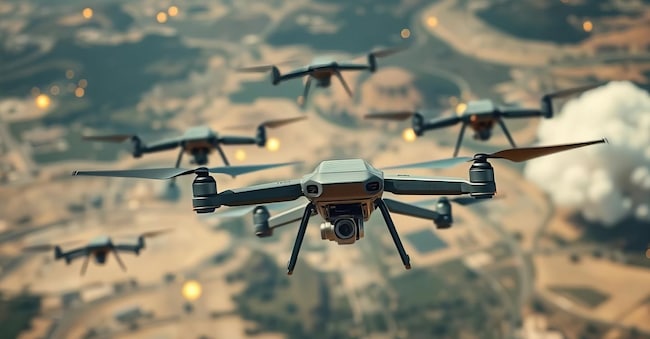
The National Security Council convened on an emergency basis in Belgium, a new defence system just deployed in Poland and Romania, soon to be deployed in Denmark: almost two months after drone incursions into European skies have become increasingly common, producing alerts and air traffic blocks, the response of EU and NATO countries must take into account costs and strategic issues.
Warsaw and Bucharest are today introducing the Merops system, announced back in late September. It is an electro-optical surveillance system small enough to be carried in a medium-sized pickup truck, capable of identifying and eventually shooting down hostile drones, while also employing artificial intelligence devices in the event of interference to satellite and electronic communications. 'It's a system capable of targeting and even shooting down drones, at a low cost,' Colonel Mark McLellan, NATO Allied Land Command's number two operations officer, told Associated Press. 'It's a lot cheaper than scrambling F-35s and shooting down drones with a missile.
On 9 September, at around 11.30 p.m., between 19 and 23 Russian drones had violated Polish airspace, leading to the reaction of the Polish Air Force and the air force of other NATO countries, which shot down some of the aircraft.
Poland had called it one of the most serious incidents since the collapse of the Soviet Union and had invoked Article 4 of the Atlantic Treaty, which provides for consultations between the alliance countries in the event of obvious threats. Only four days later, other Russian drones had entered Romania's airspace, highlighting a structural weakness of NATO's entire eastern flank: to what extent is it functional to spend millions on deploying military jets against drones costing a few thousand Euros?
The Russian incursions underlined the need for new means of defence, in a military context to which the conflict in Ukraine is bringing constant changes: several European conglomerates are developing systems similar to Merops - a joint US-Turkish production - including anti-drone missiles, while several many EU political leaders and senior military officers are calling for the creation of an Eastern Flank Deterrence Line, i.e. a zone of layered defences along NATO's eastern flank.

