

Bengasi meets PAM: universities and collaboration ahead of the elections
The President of the Parliamentary Assembly of the Mediterranean, Giulio Centemero, is in Cyrenaica to sign two memoranda on strategic partnership. He also held a meeting with Balqasim Haftar, Director-General of the Libyan Fund for Development and Reconstruction and son of the commander of the LNA.

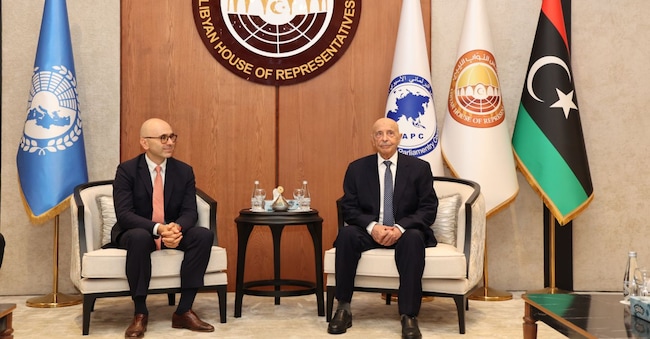
Things are hotting up in the Benghazi area. Haftar’s camp meets with the Parliamentary Assembly of the Mediterranean, reflecting the growing cooperation with the authorities in the east. Topics on the agenda: reconstruction, training and the ongoing electoral process. On Wednesday 22 July, a high-level delegation from the Parliamentary Assembly of the Mediterranean, led by its President Giulio Centemero, took part in a series of meetings in Benghazi. The highlight of the day was the signing, at the headquarters of the Libyan House of Representatives, of two memoranda of understanding: the first between the PAM and the Afro-Asian Parliamentary Council, formalising a strategic partnership; the second between the Office of the Libyan House of Representatives and the Assembly’s Secretary-General, a first step towards parliamentary cooperation set to strengthen over the years. In a statement released to Il Sole 24 Ore, Centemero said that the first memorandum “opens a new phase of collaboration on strategic issues such as training, skills development, investment, infrastructure and support for growth”.
These meetings highlight the growing interest on the part of a parliamentary cooperation platform in strengthening ties with Cyrenaica. The agenda covered other topics, starting with the meeting between Centemero and Balqasim Haftar, Director-General of the Libyan Fund for Development and Reconstruction and son of LNA commander Khalifa Haftar. In a statement posted on social media, the Fund described the meeting as a sign of the “growing significance of the results achieved in the Mediterranean region”, as well as an opportunity to strengthen relations with other countries in the region – a view shared by Centemero, who explained that the meeting represented ‘an opportunity to consolidate economic relations with a strategic partner, fostering an environment of greater stability and shared development’. Some plans for further cooperation have already been finalised: Haftar invited the PAM to attend the official opening of the University of Benghazi, scheduled for September; this invitation has been officially accepted, and a parliamentary delegation including representatives from the Assembly’s Academic Platform will attend.
The purpose of the trip can be summarised as follows: ‘Stability in the Mediterranean is not achieved through diplomacy alone, but also by creating opportunities for collaboration between parliaments, universities, businesses and financial institutions. This is the direction we intend to pursue,’ added Centemero.
The Parliamentary Assembly of the Mediterranean represents 43 countries across the European Union and the southern and eastern shores of the Mediterranean, and is currently chaired by Italia for the two-year period 2025–26. The missions taking place over the last few days signal a shift in approach: from formal and institutional support for the Government of National Unity in Tripoli to a more diplomatic and comprehensive approach to the Libyan issue, which has recently returned to the forefront of the agenda in several countries, starting with the United States. An indication of this had already emerged in Luanda in early July, where American, Italian and Libyan envoys – from both the east and west of the country – had gathered simultaneously; Added to this is the request, also made on Wednesday by the US State Department, for $41 million to reopen an embassy in Benghazi. These are signs confirming a growing international interest in a road map for reconciliation between the two parallel governments. Such an outcome would be particularly beneficial to Italy: a more stable and centralised Libyan government would, in fact, bring benefits both in terms of economic and energy cooperation and in terms of support for the ‘preventive containment’ operations targeting migration flows, which are still ongoing.

