
Best companies to work for: Lamborghini tops the list
According to the Randstad employer brand, salary rises up the list of workers' priorities. Randstad CEO Ceresa: 'Choice influenced by economic uncertainty and inflation'

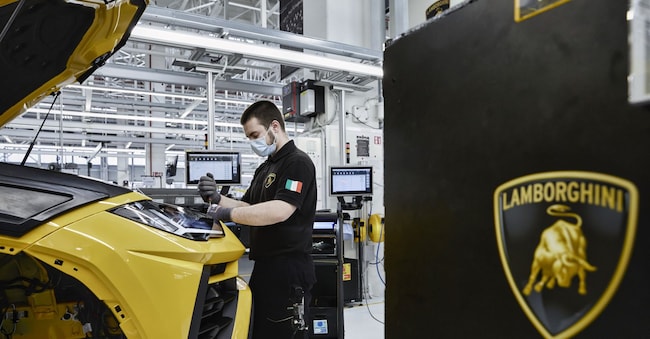
In the dreams of Italian workers there is Automobili Lamborghini, not only because of the supercars and the suv Urus that stand out for their brilliant colours and power, but also because the Sant'Agata Bolognese-based company has been experimenting for some years now with a work organisation based on flexibility, short week and sustainability, is also the ideal employer, according to the Randstad employer brand research 2026 ranking. Douglas Arrighi Pereira, Chief People, Culture and Organisation Officer of Automobili Lamborghini, explains that the result is the fruit of work done "to create the conditions for everyone to express their potential, contributing to an agile, motivated organisation capable of facing the challenges of the future. We know that this path requires constant commitment and the ability to evolve. Being recognised as an ideal employer in Italia reinforces our responsibility to continue to operate with consistency, attention to people and a sense of shared responsibility'.
The other first-timers
In fact, in the Randstad employer brand of 2026 it ranks first overall with 79.8% preference. In their respective sectors, Ferrero stands out as the most attractive employer in the consumer goods sector, Mondadori Group in media, IEO - European Institute of Oncology in healthcare, Brembo in automotive components, Leonardo in aeronautics, Sanofi in pharmaceuticals, ABB in electronics, IBM in ICT.
Wage at the centre
The results emerge from Randstad's annual survey which this year involved 171,000 respondents and 6,400 companies in 34 countries around the world. In Italia, 7,170 people, employed and non-employed, aged between 18 and 64, were interviewed on the attractiveness of the top 150 employers in the market, through an independent survey conducted by the Kantar Institute. In his reading of the results, Marco Ceresa, group ceo of Ranstad, notes that "in Italia the choice of the ideal employer is driven by a mix of closely related factors. This year wages emerged as the top driver, certainly influenced by economic uncertainty and inflation, but closely followed by work atmosphere, work life balance, job security and career opportunities. Italians evaluate potential employers 'holistically', without limiting themselves to a single dominant element. However, the analysis shows that companies achieve results that can still be improved on some of the most relevant factors. This is a clear signal to organisations: they need to take a closer look at their employer branding in order to define stronger talent attraction and retention strategies'.
Among the results emerging from the survey, the most notable is the fact that in 2026 retribution has become the most important factor in deciding which company to work for, indicated by 59% of Italians. More important therefore than the enjoyable working atmosphere (57%) and the work life balance (56%), to return to the top of preferences after 10 years in which 'soft' elements took first place for workers. The impact of inflation eroding purchasing power and putting salary back at the centre of Italian workers' choices can certainly be seen in this response. Taking the litmus test, one can clearly see that it is precisely the salary that becomes the first cause of resignation for Italians, indicated by 44%, followed by the lack of growth opportunities (33%) and the desire to improve work-life balance (33%). The response of employers to this issue, however, is weak especially when it comes to salary and career opportunities. In Italia 22% of workers intend to change jobs within the next six months, while 12% have already done so, slightly down from 2025, in a trend towards greater stability. Depending on the generation surveyed, the response varies greatly: more than a quarter of Generation Z workers plan to leave their current job within six months (26%), compared to just 9% of Baby Boomers.
Aviation industry the most sought-after
In the ranking of sectors to work in, the differences are increasingly small, a sign of the strong competition between employers in attracting talent not only in their own sector, but across the board. According to the research, the most sought-after sector in which to work for Italians is the aviation industry, with 77% of preferences, followed by ICT, with 75.9%. Then come automotive (75.7%), electronics (75.58%), media (75.55%), health (75.45%), pharmaceutical (75,42%), consumer goods (75.22%), automotive components (74.90%) and metals industry (74.9%).

