Space

Betelgeuse is not alone: the red giant’s companion star has been discovered

A team of astronomers from the Paris Observatory has used the VLT to capture an image of Betelgeuse’s stellar companion: a historic breakthrough that explains the mysterious fluctuations in brightness of Orion’s supergiant

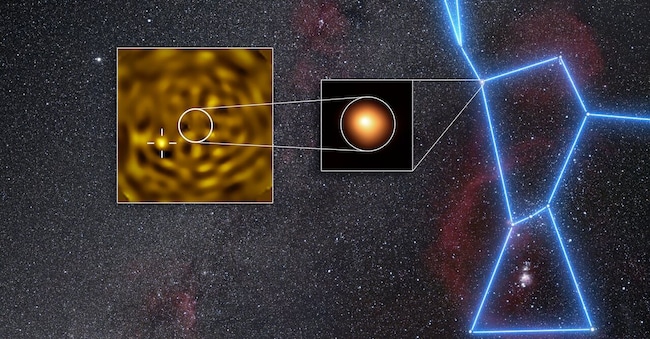
Nell’immagine a destra lo schema geometrico della costellazione, in blu, in centro l’immagine della stella Betelgeuse e infine a sinistra si vede l’immagine elaborata che contiene la stella compagna della principale.“ ESO/M. Montargès et al. Background: N. Rissinger (skysurvey.org)

3' min read

Translated by AI
Versione italiana

3' min read

Translated by AI
Versione italiana

For almost a century, Betelgeuse has been the subject of astronomers’ scrutiny. Now, at last, one of its most fascinating aspects seems to have been clarified: Orion’s famous red giant is thought to have a companion, which is much fainter and smaller.

The discovery was made by a French research team, which used ESO’s Very Large Telescope, situated in the Chilean Andes, in the Atacama Desert. This is an important finding, because Betelgeuse is no ordinary star: it is one of the best-known stars in the winter sky, easily recognisable to the naked eye due to its reddish-orange colour and its position high in the constellation of Orion.

Loading...

In Western tradition, Orion was the great hunter carrying a sword and the skin of a lion he had just slain. The star marking his right shoulder is none other than Betelgeuse, which has always been a subject of interest for at least two reasons: its variable brightness and its status as a red supergiant, destined sooner or later – in astronomical terms, so perhaps tomorrow or in 10,000 years’ time – to end its evolution as a supernova.

Betelgeuse is located approximately 650 light-years from us and has been observed for over a century in the hope of confirming the hypothesis of the existence of a stellar companion. For a long time, this was the most convincing explanation for the star’s variations in brightness: a faint companion passing close by is a more plausible hypothesis, at least from an observational point of view, than a cloud of gas orbiting the red giant.

In recent years, the theory that Betelgeuse B is a binary star has been supported by increasingly strong evidence. Now, thanks to an image obtained in collaboration with the French team, the evidence appears much more compelling.

“This is the conclusion of a century-long research project,” said Miguel Montargès, head of the team at the Paris Observatory. “We have shown that Betelgeuse is not a solitary star; it is accompanied by a faint stellar companion. I jumped out of my chair when I saw the processed images.”

This new evidence follows two studies published in 2024, which indicated that December of that year would be the moment when the companion star would be at its greatest apparent distance from Betelgeuse A. Acting on this prediction, the team trained their instruments on the system.

“To be honest, I didn’t think we’d have the sensitivity needed to detect Betelgeuse B as planned,” said Montargès. “As it’s more massive than expected, we can now see it!”

The analysis suggests that the companion has a mass approximately two or three times that of the Sun, and is therefore more massive than previously thought. It is therefore not a minor object, but a star in its own right, albeit much fainter than its famous neighbour.

Cina, lo straordinario cielo stellato che attira gli appassionati di astronomia

This result was made possible by the VLT’s SPHERE instrument, equipped with a coronagraph, which, using a sort of disc, blocks the light from Betelgeuse and allows us to make out what would otherwise remain hidden. This technique was developed primarily for the observation of exoplanets, but in this case it has also proved invaluable for identifying a stellar companion.

Loading...

“It is remarkable to see how SPHERE and the advanced post-processing techniques, originally developed for the search for exoplanets, are proving just as effective in detecting a companion around a massive, evolved star such as Betelgeuse,” explained Anthony Boccaletti, an astronomer at the Paris Observatory and a member of the team.

However, there is still something to be verified. Further observations will be needed to definitively confirm the presence of Betelgeuse B and, above all, to understand whether and how its presence influences the future evolution of the red supergiant. Betelgeuse, in fact, is a star nearing the end of its cosmic life and continues to surprise astronomers with its erratic behaviour.

It will take about another year of observations to get a definitive answer. But the picture that is emerging is becoming increasingly clear: Betelgeuse, one of the most iconic stars of the winter sky, may not be alone.

Copyright reserved ©
Loading...

Brand connect

Loading...

Newsletter

Notizie e approfondimenti sugli avvenimenti politici, economici e finanziari.

Iscriviti