
First exomoon discovered: a world 73 light-years away that defies our definitions
An international team, with significant Italian involvement from INAF, has, for the first time, identified a gaseous object the size of Jupiter orbiting a brown dwarf

In a few days’ time, here on planet Earth, there will be a full moon once again. On 29 July, our splendid celestial companion will be on display in all its radiant beauty. Those lucky enough to be at the seaside or in the mountains – or at least somewhere far enough away from artificial lights – will particularly enjoy it and will see, once again, just how much light our moon casts upon the Earth, naturally by reflecting the light it receives from the Sun.
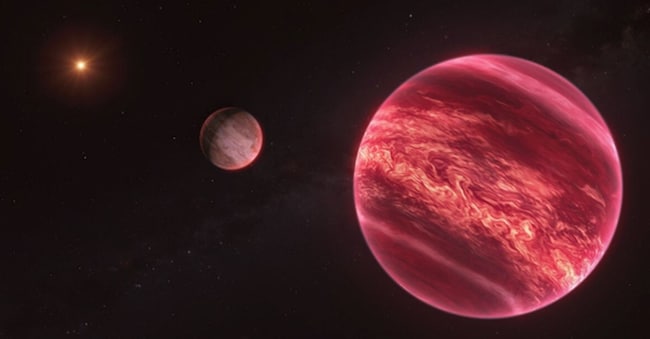
But a discovery announced by the major European telescopes in Chile and published in *Nature* takes us much further afield: to CD-35 2722, a system 73 light-years away from us, where a research team – with significant Italian involvement from INAF, the National Institute for Astrophysics – may have identified the first exomoon ever observed.
Astronomers use this term to refer to a moon that does not orbit a planet in our solar system, but rather an exoplanet – that is, a world which itself orbits another star. The details of this discovery still need to be confirmed, but it is already highly significant as it opens a window onto planetary systems about which little is currently known.
So now we might well ask ourselves: what, then, will we see on CD-35 2722? The designation we have just introduced is used by astrophysicists to refer to a solar and planetary system not too far from us – in fact, it is just 73 light-years away – and it is already known.
The system is rather unusual: at its centre is a very young M-type star, between 50 and 200 million years old; orbiting this star is a brown dwarf, and now, thanks to the valuable research published in the journal *Nature*, we know that there is also a ‘moon’. This would be the first discovery of an exomoon, which orbits a planet that, in turn, orbits a star – much as we orbit the Sun.


