Stories

Sunlight at night for 5,000 euros an hour: the business of mirror satellites that banish the darkness

The Californian start-up Reflect Orbital has been given the go-ahead to test orbiting mirrors capable of reflecting sunlight onto Earth at night. It promises round-the-clock solar power and on-demand lighting, but scientists and environmentalists are sounding the alarm: without international regulations, there is a risk of orbital chaos and disruption to circadian rhythms.

4' min read

Translated by AI
Versione italiana

4' min read

Translated by AI
Versione italiana

Charles V, Holy Roman Emperor in the sixteenth century, became famous for the well-known phrase attributed to him: ‘The sun never sets on my empire’, given that he held territories in various parts of the world and, when the sun set in Europe, it rose over his lands in Central and South America.

Before long, any one of us may be able to play at being Charles V for a few minutes at a reasonable cost, given that the US FCC, the Federal Communications Commission, has given the green light to an innovative trial by a rapidly growing start-up: Reflect Orbital, based in Hawthorne, California.

Loading...

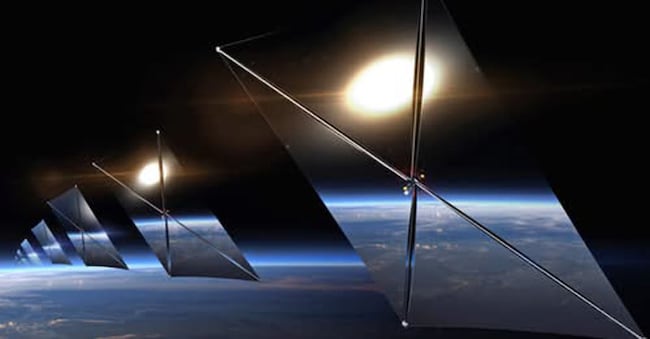
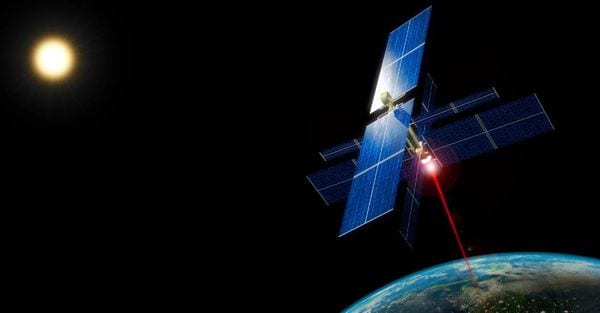
The plan is as follows: to place a satellite – with the unusual name Eärendil 1, inspired by Tolkien – into orbit at an altitude of around 640 kilometres. It will carry an 18-metre mirror which will reflect sunlight from space back onto Earth, to places where it is already night-time. According to the entrepreneurs, this on-demand light will make it possible to power solar farms at night – and thus 24 hours a day – as well as to illuminate towns or parks for events, and to light up areas affected by serious accidents or disasters.

As is customary at this stage, the start-up has already announced that, if all goes well, a constellation of thousands of mirror satellites – up to 50,000 – will be sent into space, into low Earth orbit. They will vary in size, with the largest measuring more than 50 metres in diameter. According to the promoters, the light reflected by these satellites will be equivalent to that of 100 full moons.

Although it focuses on circular and even limited areas – with a minimum of 5 kilometres – the lighting intensity can be increased, depending on how many satellites the customer wishes to direct towards the area for their purposes. Costs: a minimum of 5,000 euros for one hour, with subscriptions starting at 1,000 hours. We might therefore be able to afford one hour on the off chance; what we would use it for remains to be seen.
Reflect Orbital’s website and presentation are quite clear: we know it will cause problems for some people, they say quite honestly, but think of the benefits. You don’t need ground-based infrastructure, do you; it’s easy to set up, isn’t it; in agriculture, it extends the growing seasons – perhaps true, but it’s not clear whether that’s desirable; it will be possible to work 24 hours a day, particularly in the construction sector, and some people may well have objections to that. They also promise to leave some areas free for those who still wish to gaze at or study the sky.

This highlights a first, extremely serious problem. The international situation – which nobody seems willing to change at the moment – is incredible: today, I can secure funding to occupy the skies in a quasi-military manner; all I need is a licence from my national authority – in this case, the US – and then anyone can go and floodlight an area of land on the other side of the world, for whatever purpose.

What’s more, a monopoly on space is looming, because there aren’t that many satellites left: orbits are like roads where, if we put too many cars and lorries on them, sooner or later they’ll collide. But in space, the knock-on effects are disastrous, as the fragments of satellites resulting from collisions do not come to a halt as they do on Earth – because there is no friction in space – and become deadly projectiles.

Cina, lo straordinario cielo stellato che attira gli appassionati di astronomia

The plans for these constellations – almost all of which are American – do not require a general agreement or the adoption of common rules. With radio frequencies – another limited common resource – it was immediately realised that there would be total chaos if no agreement were reached and an international body were not set up straight away to grant licences for the use of clearly defined frequencies, in accordance with agreed rules. And so, fortunately, the ITU – the International Telecommunication Union – was established.

Space is a tricky area, given that the US national regulatory body, the aforementioned FCC, does not believe it is appropriate to apply regulations already adopted on Earth – such as environmental regulations – to space. As far as the FCC is concerned, the sky is not a natural environment to be treated with care, but is available to whoever takes it.

Loading...

At first glance, it all may seem very appealing and promising, and it is indeed innovative, but let’s consider the objections that have already been raised: by American astronomers themselves, by airline pilots, by those who study circadian rhythms, the internal biological clock that regulates the body’s functions in cycles of approximately 24 hours and the light and dark cycles of humans, animals and plants. And this is only the beginning. Consider the waste of public money – not only on scientific equipment costing billions, to begin with, but also on remedying the damage to the Earth’s environment, including human health, agriculture and wildlife. Even Roohi Dalal, director of public policy at Reflect Orbital, has admitted as much.

The point is not to demonise this project or others, but to find a common approach to managing the problems that may arise from space technologies, as was done with radio and television frequencies.

It is not the first time, however, that someone has considered reflecting sunlight onto the Earth at night. In 1993, a Russian satellite fitted with a mirror approximately 25 metres in diameter briefly reflected a narrow beam of sunlight onto our planet, as part of an experiment aimed at extending daylight hours in Arctic Siberia. However, the Russians abandoned the project about ten years later, partly due to its cost and complexity, and it was not pursued further.

Copyright reserved ©
Loading...

Brand connect

Loading...

Newsletter

Notizie e approfondimenti sugli avvenimenti politici, economici e finanziari.

Iscriviti