
Bills decree in the Cdm. Final touches: work is under way for bonuses over 115 euro
League leader Matteo Salvini raises his voice against the financial world by asking for a 'sacrifice' even for the measure that is expected to be approved on Wednesday at Palazzo Chigi

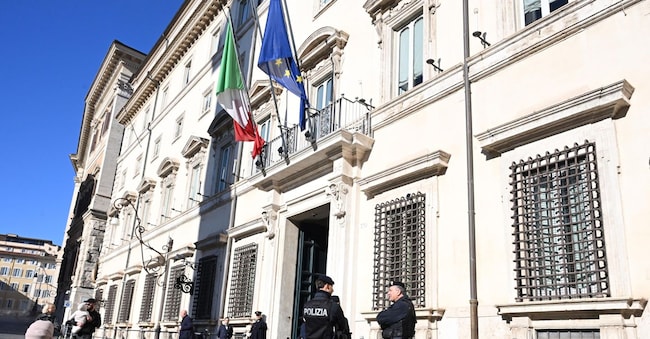
The decree law on electricity bills, which will cut electricity costs for families and businesses, is among the measures on the agenda of the Council of Ministers meeting on Wednesday afternoon, 18 February, around 4pm. The electricity bonus for families with an Isee up to 10,000 euro (or 20,000 euro for those with at least four children) could increase even further, compared to the 115 euro envisaged in the draft. A few minutes before the start of the Council of Ministers, the technicians at Mase and Palazzo Chigi are working on raising the contribution further, up to 125 euro.
Vice-Premier Matteo Salvini meanwhile relaunches his idea of making banks pay a contribution to lower their bills. 'The 2025 profits of the main Italian banks have just come out, which are close to EUR 30 billion,' he said. 'I think it will be a duty to ask the banks, which are making incredible profits thanks to the Italians and thanks to the government, for a further contribution, why not, also for the bills.
Ets Node
Salvini's idea is applauded by Codacons and Assoutenti, which are calling for the contribution to be extended to insurance companies, pharmaceutical companies and e-commerce and logistics companies. In Italia, electricity costs 30 per cent more than the European average, due to the high proportion of gas in the energy mix. Prime Minister Giorgia Meloni had announced a bill-cutting decree-law at her press conference at the beginning of the year. But the Italian state, in order not to weigh down its public debt, does not have the money to lower prices, as Germany is doing. So the Mase technicians have had to resort to 'creative' measures such as the one to reduce the difference in the cost of gas between the European Ttf exchange and the Italian Psv exchange (3 euros per megawatt hour) by providing in the decree for the sale of the 'little treasure' of gas stored by Gse and Snam during the 2022 energy crisis. The draft decree envisages spreading incentives for solar energy over a longer period of time, and cutting support for bioenergy. But above all, it would remove charges on gas transport and European ETS emissions taxation from producers of electricity with methane, and charge them instead to bills. A measure that would lower the price of electricity, which is linked to the price of gas, producing greater savings than the increase in the bills themselves. The European Union, however, might consider the shift of Ets state aid, and reject it.
The other measures
Other measures envisaged by the decree are a 90 euro bonus for families with an Isee up to 25,000 euro, a public guarantee for long contracts for the supply of electricity from renewable sources, and simplifications for the installation of new clean source plants. In these hours Mase technicians are verifying, with simulations, the effectiveness of the regulations. The most intricate knot is the displacement of the Ets. But there is also the question of the agreement that the Lombardy Region has made with Edison and A2A, to renew their hydroelectric concessions in exchange for 15% of electricity at reduced prices for energy-intensive companies. The bill decree, they denounce from Milan, would cut the companies' profit margins and blow up the agreement. In general, energy companies see the measure as smoke in their eyes, because it would reduce their earnings. But on the other side, small companies complain that the decree only favours large energy-intensive industries, and gives nothing to them. Angelo Bonelli of Avs speaks of a 'bloodletting decree for Italian families'. It foresees 'a 4 billion euro discount upstream to gas energy producers, who are reimbursed ETS quotas', which will be recovered by 'increasing the charges in the tariff, which are paid by citizens'.

