Road test of the Munich tourer

Bmw R 1300 Rt, the road test: even more comfort, but sporty character

Like the rest of the boxer family, revolutionised motorbike: on the Apennine roads the new variable set-up allows a more agile and dynamic ride without sacrificing the attitude to long journeys

by Emiliano Sgambato

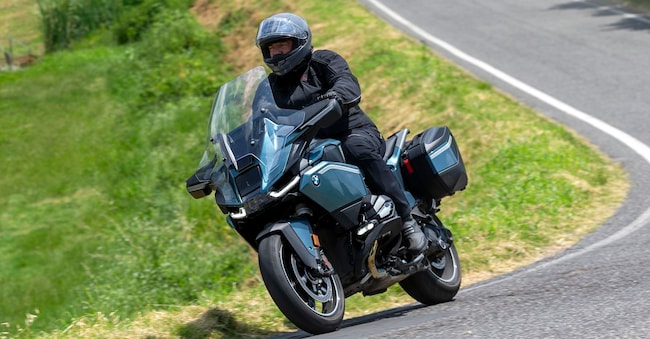
Un momento della nostra prova della nuova R 1300 Rt di Bmw Motorrad, nella versione Style Option 719

5' min read

5' min read

For fans of the RT or even those who have simply had the opportunity to ride the big boxer as a touring version in the past, it is certainly no surprise to hear that the flagship boxer does not do badly in the bends at all, offering a lot more fun than it might seem at first glance, as well as comfort on long journeys. But the latest version of the German tourer, which we tested for a day in the curves of the Apennines, has raised the bar in terms of sportiness, without neglecting the continuous improvements also in terms of comfort.

Usually, dynamism takes away some of the attitude to travelling and vice versa. How did BMW improve both aspects? It has exploited more than in the past the possibility of changing not only the type of engine delivery, but also the dynamic chassis set-up when switching from one riding mode to another. The rest is done by the elasticity and power of the new 1300 boxer, which debuted on the Gs (and has also arrived on the even sportier Rs and on the R), the revised overall concept of the bike, and the automatic transmission.

Loading...

Still more comfort...

.

On first contact, what strikes you is a motorbike that is more streamlined and aggressive in shape, but with attention to every detail. An example? Among the many optional extras available on the new Bmw R 130o Rt is the heatable version of the pillion grab rail, as well as the heated backrest of the topcase and, of course, the rider's seats and grips. Often it is the details that make the difference, and make you realise what the vocation of a motorbike is. And the latest generation of the historic tourer has certainly not lost its flair for long journeys and comfort.

Nuova BMW R 1300 RT, più comfort e più sportività

Photogallery19 foto

Also making its absolute debut is the introduction of the dynamic flaps: these are two side 'panels' that can be set to two positions with the use of one hand while riding. The two positions let through more or less air depending on whether the rider wants more coolness or more protection. The same function is performed by the more classic large windshield, which is electrically adjustable and available in three sizes. Elements that make it clear that the Rt is not a bike that "doesn't make you feel the wind on your face" as some people think; it's certainly not a naked bike, but it is a bike that allows you to adjust the degree of protection according to the rider's wishes, the weather and the road conditions.

Speaking of travelling, then, the integrated side cases are missable, now also with variable volume (27 to 34 litres, optional), with central locking, Usb socket and interior lighting. The large top case is optional, but few will give it up. And again, note the presence of a refined and powerful audio system (we had no trouble hearing the other RTs ahead of us on the highway).

The large 10.25-inch digital display can be divided into two parts: from here, for example, you can follow the navigation set on your mobile phone (to be stored in a ventilated compartment with USB socket, which in our opinion could still be improved in terms of location and capacity).

... but with a (nice) extra dash of sportsmanship

.

Comfort is therefore guaranteed (and the list of optional extras would still be long), but the real novelty of the Rt, as we said, is to be found in its increased sporting character: an element that is characterising the entire 1300 boxer range after its debut on the Gs a year and a half ago.

You can already guess it at first glance, observing the work done by the designers to give a grittier character to the fairing, now more angular (but joined with soft lines) and less massive. And one could imagine this, knowing by now the qualities of the Munich-based manufacturer's completely revamped twin-cylinder engine, endowed with an elongation unknown to its predecessors and capable of delivering 145 horsepower at 7,750 rpm, with a maximum torque of 149 Nm at 6,500 rpm. 

Further confirmation comes when one looks at the work done on the chassis (combined with electronics): from the 'evo' generation of the telelever-paralever damping system, the stiffer chassis and Dsa active suspension, to the new weight distribution, with the gearbox shifted under the engine, which lowers the centre of gravity for the benefit of stability and agility, already promoted on the Gs..

Added to these new features is the Dynamic Chassis Adaption (Dca). Basically it is the possibility of changing set-up depending on the riding mode: "One characterised by a more open steering head angle and chassis geometry designed to maximise stability and ride fluidity," explain BMW, "the other with stiffer damping settings, greater spring stiffness and higher ground clearance. That is, the bike rises 3 cm at the rear while loading the front end more in Dynamic riding mode (the others are Road, Eco, Rain, and the customisable Dynamic Pro).

The surprise is between the bends...

.

The result can be felt when the curves start to come in fast: thebike is agile, nimble and safe on the front end in spite of its 181 kg.  

The automatic transmission responds well to stresses in 'manual' mode and is also quite supportive in automatic mode, although in some situations we didn't like some of the shifts that were too early in the more driven sections, at least for our riding style. But for a touring bike, the Asa, often ridden in a more 'relaxed' manner, is an option that we think it would be absurd to give up.

The excellent work of the automatic adaptive suspension softens the roughness of the asphalt without making the bike lose directionality: again a great advantage to give more confidence when riding given the Rt's size.

The riding position is less 'sitting' than before, although it remains quite 'upright' (the soul is still that of a mileage grinder) and obviously not loaded on the wrists. Vibrations are practically absent, bearing in mind that we are still talking about a 1300 cc twin-cylinder engine.

The saddle (available from 78 to 86 cm and adjustable) is rather soft in the taller version and narrows at the front, linking up with a fuel tank (24 litres for a declared consumption of 4.9 l/100 km) that is less constricting on the knees than in the past: a solution that gives taller riders more freedom and helps manoeuvring from a standstill.

... but everything is ready for the motorway

.

We didn't test it on the motorway, but all indications are that the Rt doesn't disappoint on one of its chosen terrains: front and rear radar with adaptive cruise and anti-collision system, automatic transmission (with a slightly longer gear ratio than on the Gs) and considerable aerodynamic protection should allow even greater peace of mind on long transfers. At BMW they guarantee that the adaptive headlamp function is also much improved.

"With the new Bmw R 1300 Rt, we have taken the iconic touring bike from Bmw Motorrad to a whole new level. It is lighter in design, more accessible and more dynamic than ever before. With its completely revamped engine, chassis and aerodynamics, it offers a riding experience that meets the highest standards in this segment in terms of dynamics, comfort and touring ability," summarised Harald Spagl, project manager of the Rt.

The price of the Rt starts at 24,300 euros, but with BMW packages and the long list of accessories it is easy to go well over 30,000 euros.

Copyright reserved ©
Loading...

Brand connect

Loading...

Newsletter

Notizie e approfondimenti sugli avvenimenti politici, economici e finanziari.

Iscriviti