
Border controls: double the queues at the airport with the new non-Schengen system
Increased inconvenience for passengers up to four hours in a queue. The measures for the Olympics: which airports are affected

Key points
The coming year will bring novelties for travellers at border controls: goodbye to stamps in passports from April with the introduction of biometric controls. The system is being tested, but those who are travelling abroad these days will find the surprise of long queues at airport controls on their return.
The new digital entry/exit system (EES) operating in most parts of the continent is forcing all non-EU citizens, including Britons, to register personal data when entering EU countries for even short stays. At the moment, these checks are carried out on 10 per cent of passengers, but from 10 January this will rise to 35 per cent and be fully operational by 10 April.
Strongly increasing control times already at an early stage
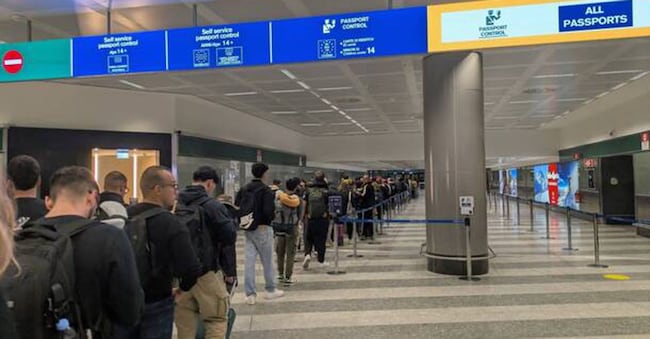
Since the introduction of the EES, the new system of controls has led to a significant increase in waiting times at borders, up to a doubling at both manual stations and eGates, even though passenger volumes are still very limited. A situation that is occurring at all Italian airports, but not only. ACI Europe itself, the association grouping European airports, has raised the alarm: without corrective measures, the inconveniences are bound to increase, especially when the summer period approaches and the system is fully operational.
Code already today at critical levels
Waiting times of more than two and a half hours have already been recorded at some major national airports, even in low season and with a still low number of EES registrations. Simulations on expected traffic flows in 2026 indicate that, as the share of passengers subject to registration increases from the current 10 per cent to 35 per cent from January and beyond, waiting times at border controls could exceed four hours during peak periods.
Measures in view of the Winter Olympics in Milan-Cortina
In the light of these criticalities and in view of the next Olympic deadline from 6 February to 22 February, the airports involved, i.e. Milan Malpensa, Milan Linate, Venice and Verona, have been granted the suspension of formalities linked to the Entry/Exit system for the period of the event and only for operators, delegations, athletes and the 'Olympic family' in general. A decision that starts from the numbers since the peak in the week before the opening ceremony is expected to see the arrival at Malpensa alone of over 15,500 operators and athletes and over 150,000 spectators. During the days of the event, Malpensa will handle up to 4 thousand oversized bags, concentrated in the peak days when the athletes and delegations arrive.


