

It would be beneficial for Ankara if the EU were to reopen the CED dossier
The summit scheduled for 7 and 8 July in Turkey risks being reduced to yet another public relations exercise. The Alliance is creaking under Trump’s blows, but without the US it has no legs. The idea of European national rearmament clashes with fiscal disparities. Whilst the 1952 Treaty on the European Defence Community would complement a leaner NATO and the need to consolidate the Old Continent’s defence industries

Key points
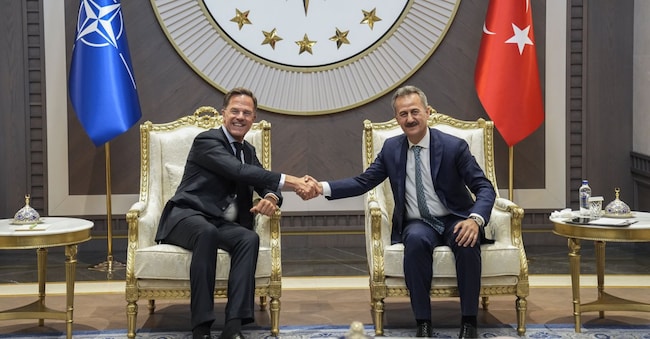
The NATO summit in Ankara, Turkey, scheduled for tomorrow and the day after, risks being reduced to yet another public relations exercise. A group photo of the heads of state and government of the 32 member countries of the Atlantic Alliance and a brief final communiqué will not be enough to conceal the deep crisis in transatlantic relations. NATO is a defensive alliance of a confederal nature, in which one country – the United States of America – acts as the majority shareholder. Under the NATO founding treaty, signed in Washington in 1949, the member states (including Italia, which was a founding member) undertook to ensure mutual defence in the event of enemy threats: a commitment enshrined in the famous Article 5 of the NATO Treaty.
Credibility
However, the credibility of the Atlantic Alliance’s collective defence system rests on two essential factors: the firmness of the commitment to intervene in defence of an ally, and the operational capabilities to do so where necessary. In fact, historically, only the US has possessed both the resolve and the operational capabilities to revitalise NATO. Under the Trump presidency, however, the US has called into question its commitment to protecting its allies and has substantially reduced its military presence in Europe, with a clear indication that further cuts are imminent.
The moves
In this context, what can Europeans do? So far, the prevailing strategy has been to turn a blind eye, in the hope that this will keep the US engaged in Europe. However, this strategy – pioneered by NATO Secretary-General Mark Rutte – has not enhanced the Atlantic Alliance’s credibility in the eyes of its enemies. On the contrary, the continuous Russian drone attacks on the eastern borders show that Russia is attempting to test the resolve of the Atlantic Alliance. A second strategy – short-sightedly promoted by the President of the European Commission, Ursula von der Leyen – is that of national rearmament. Indeed, since 2025, as a result of the suspension of European fiscal rules and the establishment of a EU fund (SAFE) to finance national rearmament, various European states have dramatically increased their defence spending. However, the varying fiscal capacities of European states are leading to asymmetric rearmament. Furthermore, due to the ongoing fragmentation of the EU defence industry market, the increase in spending does not actually correspond to an increase in European military capabilities.
The paradigm shift
To take European defence to the next level, it would therefore be advisable to revisit the merits of the 1952 Treaty establishing the European Defence Community (EDC). This treaty, adopted at the dawn of the Cold War, provided for the merger of the armed forces of the participating European countries into a single European defence force, integrated into NATO, thereby creating a genuine European pillar within the Atlantic Alliance. At the same time, in addition to operational capabilities, the EDC established supranational institutions with the democratic legitimacy and the necessary speed to decide on the use of force. Finally, the EDC tackled head-on the problem of fragmentation within the European defence industry by centralising authority over the procurement and production of military equipment. The EDC Treaty never came into force, but as many as four out of six states (Belgium, the Netherlands, Germany and Luxembourg) had ratified it in the 1950s, and today a number of bills have been tabled in the Italian Parliament providing for the treaty’s approval in Italia (leaving France as the only country that has neither ratified nor revived the treaty). At a time when transatlantic relations are in a state of deep crisis, if Europe wishes to take its defence seriously, it should return to the principles of the EDC. And Italia, from its position as an unlikely political bridge-builder with the Trump administration, could prove – if it were to ratify the EDC – to be a key player in the reconstruction of a genuine European defence framework within NATO.
Federico Fabbrini is a full professor of European law at Dublin City University and a Fellow at Harvard

