Germany

Automotive, cuts also at Bosch: 5,500 jobs. The crisis worsens

The works council and IG Metall union expressed firm opposition. 'We will organise our resistance at all levels'

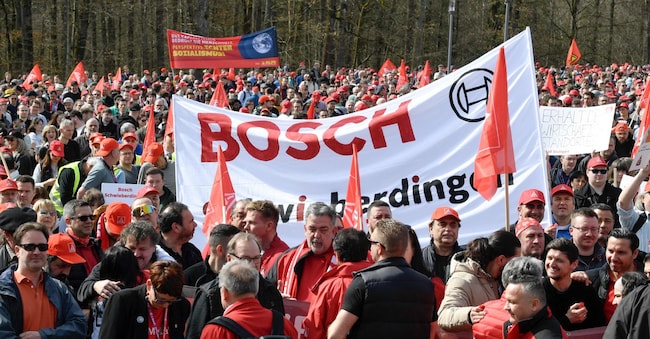
Dipendenti  Bosch protestano contro i piani di taglio di migliaia di posti di lavoro presso la sede centrale dell’azienda a Gerlingen, vicino a Stoccarda. (Foto di THOMAS KIENZLE / AFP)

3' min read

3' min read

Robert Bosch, the world's leading supplier of components for automobiles, has announced plans to cut up to 5,500 jobs (3,800 in Germany), signalling further critical issues for the German automotive sector, already under pressure from price competition from Chinese manufacturers and falling demand.

The Cross-Domain Computing Solutions division, responsible among other things for driver assistance and automation systems, is the hardest hit: 3,500 jobs will be lost by the end of 2027, about half of them in Germany.

Loading...

But there are also planned cuts in the electromobility area, where around 750 posts will be deleted by 2032. Consequences are also expected for the division producing steering systems for cars and trucks: between 2027 and 2030 up to 1,300 posts, i.e. more than a third of the staff. The employees of the world's leading component maker number just under 430,000 on a global scale.

The 10,000-strong plan at the beginning of the year

.

The Bosch works council and the metalworkers' union IG Metall declared firm opposition. 'We will organise our resistance against these cuts, at every level,' said Frank Sell, vice-president of the works council. Earlier this year, Bosch had already outlined a broader restructuring effort that envisaged a reductionof up to 10,000 jobs over the course of the decade. The plan was aimed at addressing the challenges of the automotive sector and adapting to changing market conditions. Which have since deteriorated. The latest job cuts focus on specific divisions.

The supplier, which is headquartered in Gerlingen, near Stuttgart, also justifies the savings plans by the lower than expected demand for cars, especially electric cars (-26.6 per cent sales in Germany this year). 'Global vehicle production will stagnate at around 93 million units in 2024, if not decrease slightly compared to the previous year,' the company said. At best, the forecast is, there could be a slight recovery in 2025. Moody's sees it not before the second half. According to Bosch, a giant that in 2023 recorded revenues of EUR 91 billion (+8%) and Ebit of EUR 4.8 billion, there remains, however, considerable overcapacity in the sector.

Robert Bosch is not listed, but operates as a limited liability company. Around 94% of its shares are held by the Robert Bosch Stiftung, a foundation. The company operates in four business sectors: Mobility, Industrial Technology, Consumer Goods and Energy and Building Technology.

The Manufacturers' Front: Volkswagen and Mercedes-Benz in the Storm

The downturn in the sector in Germany does not only affect Bosch but all the big players in the components industry and, of course, also car manufacturers. Giants like Volkswagen and Mercedes-Benz are facing similar difficulties. Volkswagen is in the midst of dramatic negotiations with the trade unions over possible plant closures in Germany and a 10 per cent pay cut for 120,000 employees in the country, who belong to the core brand groups (VW, Skoda, Seat, Cupra, Commercial Vehicles). The Wolfsburg group, which also achieved a good sales result in October, is aiming to regain competitiveness and profitability. Mercedes, on Thursday, announced severe austerity measures after a drastic drop in profits in the third quarter. 'We will reduce our costs by several billion euros a year in the coming years,' a group spokesman told the German news agency Dpa yesterday.

The troubles of the other German component manufacturers

.

Among component manufacturers, Schaeffler announced a fortnight ago thousands of redundancies in Europe, after a drop of almost half in operating profit in the third quarter, attributable to the weakness of the industry sector and the decline in demand for electric cars. Schaeffler plans to cut about 4,700 jobs in Europe, including 2,800 in Germany, with a net reduction of 3,700 jobs after some relocations. The reorganisation, which includes the integration of Vitesco, will affect ten locations in Germany and five more in Europe, two of which will be closed by 2029.

But also Continental, another large German multinational, recently announced plans to reduce up to 30,000 jobs in the coming years, to refocus on digital and electrical technologies. Similarly, ZF Friedrichshafen has announced that it will reduce its workforce by up to 15 thousand over the next few years, due to declining demand for traditional components.

Copyright reserved ©
Loading...

Brand connect

Loading...

Newsletter

Notizie e approfondimenti sugli avvenimenti politici, economici e finanziari.

Iscriviti