
Bosch will design the brain of humanoids in Milan
Bosch Sensortec, based in Lombardy, will manufacture MEMS sensors for industrial and service robots. The centre employs over 70 researchers from all over the world
by Lello Naso
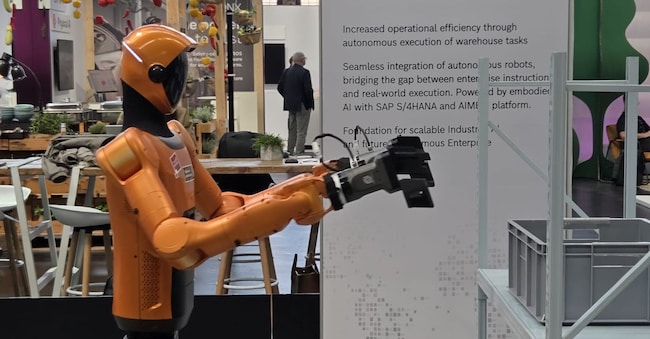
By 2030, the market for humanoid sensors will be worth €20 billion. Growth is expected to be 4% per year – steady and progressive. These figures will reshape the landscape and competition within a highly technology-driven industrial sector, where the search for new solutions will be crucial. Bosch, the global automation giant (€91 billion in turnover, 230 plants and 413,000 employees worldwide), is focusing on Milan for the design and development of MEMS, the sensors crucial to the development of humanoids. At the Lombardy-based research centre, Bosch Sensortec, led by Riccardo Campagna, which started just over ten years ago with twelve researchers and has now grown to over seventy engineers and technicians from all over the world, solutions are being developed to enable humanoids to see, hear, touch and perceive tactile sensations. MEMS store and process the data collected by humanoids and transmit it to the limbs to carry out the tasks for which they are intended: on production lines, in private homes, in hospitals, in care homes and in all the places where they will be used. If humanoids are made in the perfect image and likeness of human beings, MEMS are the brain, the nerve centre of the man-machine. Robots must have highly developed tactile sensitivity to interact safely and precisely with their environment, be it a factory or a home. It is a tiny technology that is essential for giving robots refined tactile sensitivity. MEMS, micro-electromechanical systems, are the key element that allows humanoids to handle objects with the necessary delicacy and to react to physical contact. Thanks to these sensors, a robot can precisely adjust the force with which it grasps a sturdy or delicate object, a work tool or an IV syringe.
“Humans have four million sensory receptors for touch. If we were to build robots with that number of sensors, given current global sensor production, we would barely manage to create 12,500 robots in four years,” explained Stefan Hartung, president of Bosch board of management, in Berlin for the group’s innovation convention. A figure that highlights the potential of automation and robotics and the key role that companies in the sector can play. “This market,” added Hartung, “is worth one billion euros in annual turnover for Bosch alone.”
Bosch Sensortec, the centre in Milan, will be at the forefront alongside the multinational’s other two development centres, Sunnyvale, in California, and Singapore. Reutengen and Dresden, in Germany, are the production sites. Bosch Sensortec has already produced over 23 billion MEMS. “Europe,” explained Hartung, “has a huge opportunity for growth in an industrial segment—that of robotic automation—where it boasts specific expertise in both machinery and products. We also hope that a serious commitment to this path will strengthen Europe’s position as a cutting-edge technology hub.”
The Milan research centre will play a pivotal role within the Bosch organisation. Established in 2015, the design laboratory has, in just a few years, made a significant contribution to innovation and the implementation of strategic projects. The laboratory is a veritable melting pot of scientific expertise and nationalities. The environment is multicultural, with English as the official language. There is a constant exchange of experience and expertise with other research centres in Europe, Asia and the United States. The team at the Italian design centre has an overview of the business and oversees all stages of the design process, from the customer’s request to the final product and its application. MEMS, in fact, are designed for use by companies specialising in the production of robots and humanoids, as well as smartphones and other digital devices. The prospects for development, including for the Milan centre, are potentially enormous. “Every new technology,” explained Bosch’s global head of innovation, Tanja Rueckert, “has significant implications for development and employment across the entire supply chain.”


