

Brain tumour: team surgery saves language, movement and memory
Today it is possible to operate with the brain 'in operation': direct and continuous mapping makes it possible to intervene in areas inaccessible just a few years ago
by Lorenzo Bello*
Key points
In recent years, brain tumour surgery has undergone a profound evolution, which goes far beyond the improvement of surgical techniques. Today, treating these diseases means building a complex system in which clinical expertise, neuroscience, advanced technology and hospital organisation work in an integrated manner, with a clear objective: to increase survival without compromising quality of life.
Multidisciplinary Planning
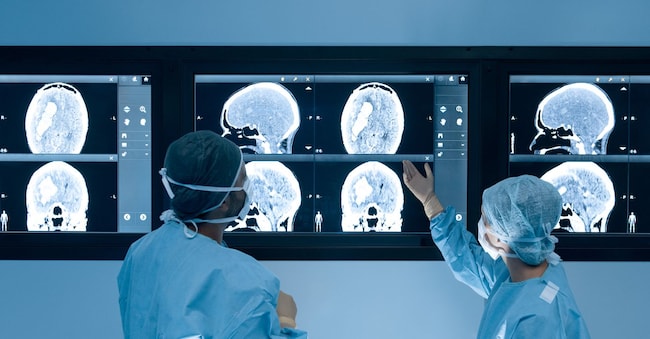
Modern cancer neurosurgery can no longer be thought of as the act of a single specialist, but as the result of collective work. Every operation is the result of multidisciplinary planning involving neurosurgeons, neuropsychologists, neurophysiologists, neuroradiologists, anaesthetists, physicists and engineers. Today, this structured collaboration takes place at the Irccs Galeazzi Sant'Ambrogio - thanks to the Oncological Neurosurgery team. Here, complex tumours are operated on while preserving fundamental functions such as speech, movement and cognitive abilities.
A decisive role is played by the application of advanced neuroscience associated with technology. The combined use of neuropsychology, neurophysiology and intraoperative functional mapping associated with advanced recording and monitoring techniques now makes it possible to operate with the brain 'in operation'. In many cases, the patient remains briefly awake during surgery, allowing direct and continuous mapping of his or her functions, especially higher cognitive functions. This real-time dialogue with the brain makes it possible to operate even in areas considered inaccessible just a few years ago.
Extremely accurate checks
This is the context of the so-called supratentorial resection, a surgical strategy that aims to remove not only the tumour mass visible to imaging methods, but also the surrounding areas potentially infiltrated by neoplastic cells. An approach that can only be adopted if supported by a very thorough knowledge of the brain's functional organisation and extremely accurate intraoperative control. Clinical results show that this strategy can result in a significant improvement in long-term survival, without an increase in neurological sequelae.
The link between clinical and basic research
Fundamental to this approach is the link between clinical and basic research. Ongoing collaboration with neuroscience laboratories makes it possible to rapidly transfer discoveries on the functioning of brain circuits into everyday surgical practice. A 'translational' model that not only produces benefits in the field of oncology, but also opens up new perspectives in neurological rehabilitation.

