The interview

Brera becomes more accessible: Meta AI Glasses are coming for blind and visually impaired people

Maxine Williams (Meta): “For those who cannot see, it’s not just a gadget: it’s independence. And people with disabilities use AI far more than others.”

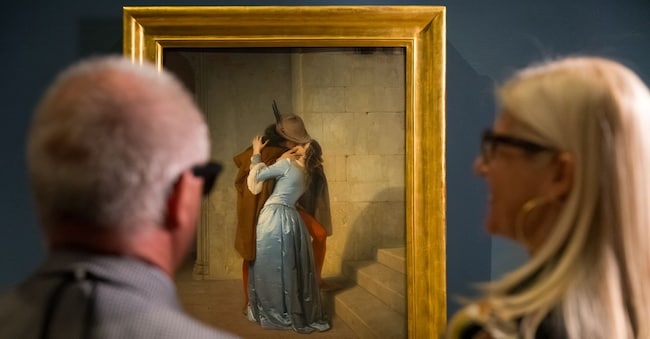
Il bacio di Francesco Hayez, realizzato nel 1859, custodito nella Pinacoteca di Brera a Milano

6' min read

Translated by AI
Versione italiana

6' min read

Translated by AI
Versione italiana

Microphones, earpieces, cameras and AI built into glasses can enhance our senses. For people with disabilities, they make all the difference. The art at the Pinacoteca di Brera is now more accessible: glasses from Meta and EssilorLuxottica will be available, by booking, to provide information on the artworks, including for those who are blind or visually impaired. It will also be possible to speak to the AI to obtain further information, or to connect with ‘Be My Eyes’, an organisation with millions of sighted volunteers worldwide that can provide assistance. In Italia, around one million people are blind or visually impaired. Moderate or severe visual impairments affect a total of 18.6 per cent of the population.

The project, launched today in Brera, is a pilot scheme run by Meta, the Pinacoteca di Brera and EssilorLuxottica, in collaboration with the National Association for the Visually Impaired (ANS), the Italian Union of the Blind and Partially Sighted (UICI) and the Fondazione Istituto dei Ciechi in Milan. The initiative is launching with 10 pairs of Meta AI glasses, which can be reserved by emailing educazione@pinacotecadibrera.org.

Loading...

“The glasses use content created by Brera and ANS with Descrivedendo: descriptions of the artworks, art history and the artist’s biography. But they do so in a natural way: as you move from one artwork to another, the AI in the glasses recognises what’s in front of you and starts describing it, at your own pace, depending on where you want to go and how you want to experience the art,” says Maxine Williams, Global Head of Accessibility and Engagement at Meta, in this interview with *Il Sole 24 Ore*. The idea is to do this without having to rely on someone else to describe the artworks to you and without needing to hold another device in your hand. People who are blind or visually impaired often have hands full: one hand is on the cane, or holding the guide dog, or is used to orientate themselves with their body. Being able to live without having to give up the use of your hands may seem like a small thing, but it significantly changes the way you go about your day, your activities – everything.”

The manager, who was born in Trinidad and Tobago and trained as a lawyer, taught and worked in the media before joining a law firm, where she led its diversity initiatives, before moving to Meta. We meet her in Milan, where she has just arrived from the United States to launch the initiative.

What makes this experience possible: the glasses or artificial intelligence?

Both. The hardware enables a hands-free experience. The glasses are worn just like a normal pair of spectacles; the camera is at the front and captures what the wearer sees. When the wearer turns their head towards a work of art, the glasses recognise the image and play the corresponding audio description. Previously at Brera, this information was accessible via a mobile phone and headphones, following a pre-set route. Then there is the software – that is, the AI – which transmits the information created by Brera but also, if you wish, additional context.

The models are improving, but they’re not perfect yet. How do you ensure that AI doesn’t give misleading instructions? I’m not so much thinking of Brera as I am of using it on the road, in real life.

With more training, the models become more accurate: the more feedback they receive, the better they get. You’re right, it’s a constant process of improvement. Fortunately, it’s not the only thing people have to rely on: it’s one of the tools they have at their disposal to find out information.

What sort of feedback do you receive?

In the first version of the Ray-Ban Meta, there was an option to request a description: ‘What’s in front of me?’. For a blind or visually impaired person, this is essential: when I walk into a room, tell me where I am and what’s in front of me. And the AI would describe the room. The feedback we received whilst working with blind and visually impaired people was that this wasn’t enough: it wasn’t detailed enough. Now you can get detailed descriptions: the AI no longer just tells you that you’re in a room with three people; it tells you that the room is green, that there are six sofas, how many people are there, what’s on the right and what’s on the left. And it’s an option you can switch on or off: if you don’t want the details, you won’t get them.

Glasses can already help with reading text and recognising objects. But can they safely guide a blind person along the street, or is that still a goal for the future?

I don’t think anyone would ever argue that, for their own personal safety, they should rely on just one aid. Glasses – and the AI in them – are designed as an additional aid. They will not replace the white cane or the guide dog, which people have been using for a long time to get about safely. Can they tell you that there’s a low railing in front of you and that you’d bump your head if you carried on walking? Of course, and that’s an extra bit of help. But I wouldn’t say it’s something people should rely on 100 per cent for their own safety.

Have you carried out any research into how people with disabilities use glasses?

Yes, we carry out what are known as co-design projects, in which we design and develop the product together with the users. This year alone, I believe, we’ve carried them out in five countries, involving people who are blind or partially sighted, as well as those who are deaf, have physical disabilities or suffer from memory loss. And we’ve found that people with disabilities use the AI in the glasses far more than people without disabilities.

What is the main limitation that users report today: accuracy, response speed or battery life?

In all three of these categories, there have been improvements even compared to just six months ago. Battery life was a frequent complaint, because if you’re blind, you want to wear the glasses all the time. It’s not a gimmick, it’s not a gadget. We’ve improved the battery life significantly, but people would like it to work 24 hours a day, and we haven’t quite got there yet. The latency isn’t zero, but it’s become really very good: the response feels almost instantaneous. And whilst the accuracy isn’t 100 per cent either, it’s improving. People want 24-hour battery life, zero latency and 100 per cent accuracy. All these aspects are improving, but they’re not perfect yet.

Loading...

People who wear glasses can see better, but those around them are filmed. How do you manage privacy?

Glasses don’t just help you make sense of your surroundings; they give the wearer a level of privacy they didn’t have before. I’m thinking, for example, of medical reports. Recently, a blind woman told me: ‘Imagine taking a pregnancy test and having to ask someone else to tell you the result. Now, thanks to the glasses, she can do it herself. Then there’s the issue you raise, namely filming other people. Mobile phones are constantly filming and taking photos, and you don’t know it, because there’s no way of telling when someone’s pointing one at you. The glasses, like a mobile phone, can record, but we’ve built in specific privacy features: a flashing LED light indicates when a photo is being taken or a video is being recorded. And if you try to cover it, they stop working. Recently, I was trying to read a text and had brought it so close to the lens that the glasses thought I was trying to cover it. I hadn’t even touched it, yet they told me: ‘Power off, it won’t work’.

Looking ahead to the next five years, what everyday activities do you think these glasses will enable blind people to do?

In workshops and co-design sessions, I often hear people say that the glasses help them build self-confidence. I didn’t expect this, and we’ll learn from them exactly what it means in practice. I’ve been working in the tech sector for 13 years and I’ve never heard such overwhelmingly positive feedback about a product as I have about these glasses, and about how they radically change the way people can live their lives. I think we tend to forget just how large the population with disabilities is. They’re seen as a minority, people on the margins. But 16 per cent of the world’s population has a disability. In some countries, such as the United States, it’s one in four adults. And if we live long enough, 100 per cent of us will have a disability.

Do you think that solving the problems faced by people with disabilities will become the main purpose of glasses?

I’d say not: it’s a more inclusive interpretation. We’re getting closer to being able to serve everyone. Technology is often designed in a way that doesn’t meet the needs of those on the margins. With these glasses, right from the start, we’ve consciously thought about these people. When we think about what a disability is, we tend to think of a permanent disability, but we all experience situational disabilities too. When the light dims, even though I’m neither blind nor visually impaired, I might need assistance. When I’m in a noisy place, I can’t hear very well. The Ray-Ban Meta glasses we use at Brera are designed for blind and visually impaired people, who receive information in audio form. But we also have models with displays, which can compensate for a deaf person by showing them what they cannot hear. Designing this feature has meant that I, too, can read my speeches on the lens: there’s a little bump on the glasses, because once you have the technology for transcription, what else can you use it for? Designing for a deaf person has created a better product for everyone. And I can tell you that every politician I know who’s heard about them has contacted me saying they want to try them out.

Copyright reserved ©
Loading...

Brand connect

Loading...

Newsletter

Notizie e approfondimenti sugli avvenimenti politici, economici e finanziari.

Iscriviti