Defence

Gcap Fighter, Marrone (Iai): 'Germany in the team with Italia, UK and Japan? It's a stop to the Paris-Berlin axis'

According to the head of the Defence, Security and Space programme of IAI, the International Affairs Institute, Germany's entry would sanction the end of the Fcas, the programme to develop the sixth-generation fighter aircraft resulting from the collaboration between Berlin, Paris and Madrid

by Andrea Carli

Difesa, Italia verso il caccia di sesta generazione

5' min read

Translated by AI
Versione italiana

5' min read

Translated by AI
Versione italiana

Germany is said to have sounded out Italia's willingness to let it join the Gcap project, the sixth-generation fighter jet it is developing with the UK and Japan. The opportunity, as reported by Il Corriere della Sera, was allegedly provided by the vertice between Italia and Germany at Villa Pamphili in Rome on 23 January. On that very occasion, with reference to the current relationship between Italia and Germany, German Chancellor Friedrich Merz spoke of two nations 'never so close'.

A proximity that at this point would also be on the defence topic, mostly on what is considered a particularly strategic project. Gcap, an acronym for 'Global Combat Air Programme', is in fact an international collaboration programme that currently involves Italia, the United Kingdom and Japan with the shared ambition of developing a new-generation air system by 2035. The future combat air system, defined as the 'system of systems', will operate in the five domains, air, land, sea, space and cyber, according to a star structure in which the next-generation fighter will be the 'core platform' connected with other peripheral 'systems', piloted and unmanned.

Loading...

Germany's possible entry would therefore not be a detail, as confirmed by Alessandro Marrone, head of the 'Defence, Security and Space' programme at IAI, the Istituto Affari Internazionali.

 Do you think Italia will accept the German proposal?

Italy should do it: a possible entry of Germany would bring public investment and private technological-industrial capabilities that would make the programme more solid and sustainable. It would also reduce fragmentation in Europe over combat aircraft, bringing together as many as four of the seven G7 countries in the Gcap. Of course, German participation also brings greater competition for the Italian industries involved in the programme, which will therefore have to innovate and run more.
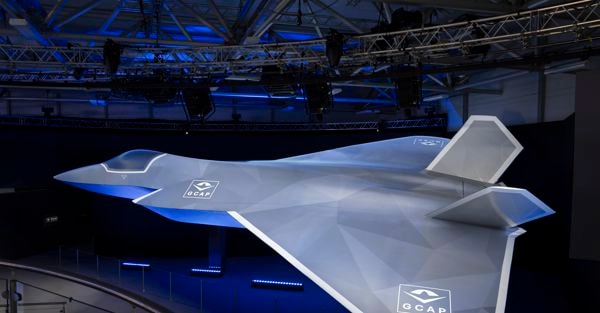
Un prototipo di Gcap, il caccia di sesta generazione (F'boro 2024)

In recent months, there has been talk of Saudi Arabia's involvement in the project, but as things stand, Ryad remains outside. How come?'

There are various difficulties related both to the regional framework in the Middle East and to the perceptions of Saudi Arabia in the democratic countries that are part of the Gcap.

At present, are there any other suitors besides Germany?

There are no other candidates with the geographical, historical, political, military and industrial proximity that Germany has with the UK and Italia, just think of the previous joint Tornado and Eurofighter programmes.

If Italia says yes, will it require the green light from the other two partners, the UK and Japan? 

Yes, it is explicitly provided for in the international agreement signed to launch the Gcap.

Do you think the conditions are in place for the other two partner countries to also give the green light?

Yes, because Germany brings a domestic market and government investment that makes the Gcap more sustainable in terms of sharing non-recurring costs, especially research and development, and this also affects London and Tokyo.

What consequences could Germany's entry into the Gcap have on the Fcas initiative, (Future Combat Air System), the programme to develop the sixth-generation fighter aircraft resulting from the collaboration between Germany, France and Spain?

That would be the end of the Fcas. An end for which, however, much of the responsibility would fall on France, which has demanded too much in terms of technological and industrial leadership in the face of a Germany accustomed to a co-leadership role with the United Kingdom and Italia on the Eurofighter. A Germany that has increased its weight in defence in recent years compared to when Macron and Merkel launched the Fcas.

Could Germany's entry into the Gcap also convince Spain to join the joint venture that is developing the sixth-generation fighter?

If Germany leaves France, Spain faces the following fork in the road: return to work with Italia, the UK and Germany on the Gcap as successfully done in the Eurofighter, or accept an absolutely secondary role in a predominantly French programme.

If Germany were to enter the Gcap project, what kind of advantages could this solution provide for the development of the project? Recently, a debate developed in parliament on the increased costs associated with the development of the Gcap. For this year, the German Ministry of Defence can count on investments in excess of EUR 108 billion. In the following years, the figure will grow to EUR 152 billion for 2029 alone, i.e. three times as much as was invested in 2023. In 2029, the NATO target of 3.5 per cent of GDP in military expenditure could already be met. Part of these resources could flow into the sixth-generation fighter project?

Definitely. The growth of the German defence budget is so robust that it is able to invest heavily in all sectors, from land to space or aeronautics, and the German aviation industry is well able to absorb some of this investment channelled into the Gcap.

Could the German move, i.e. the decision to enter the Gcap, definitively blow up the possibility of a collaboration with the Swedes on the Gripen, produced by Saab, in which there is also interest from Canada? Or is it too early to tell?  

If Germany joins the Gcap, while it has already committed to buying a few dozen F35, it will not collaborate with Sweden on the next fighter. So it becomes more difficult for Stockholm to pursue an exclusively national project based on the Gripen, when three of Europe's four biggest military and industrial powers are converging on another programme.

If Germany were to join the Gcap, the project could gain a leg up in the competition, in prospect, with the F-47, the highly advanced sixth-generation fighter to be developed by Boeing for the NGAD (Next Generation Air Dominance) programme, intended to replace the F-22 Raptor and ensure American air supremacy by integrating artificial intelligence, advanced stealth technology and the ability to operate alongside swarms of autonomous drones?

Certainly in this scenario, the Gcap would gain the weight of German engineers, skilled workers, laboratories and production capabilities. The sixth generation is a huge technological challenge for everyone, but American requirements are not necessarily the same as those of the Gcap countries, and in Europe a fair balance can be found between military requirements and technological feasibility.

What kind of difficulties on the operational level could arise if Germany were to join the Gcap? States are always a bit reluctant to share complex software.

There are two kinds of difficulties. On the one hand, adapting the governance of the Gcap to a strong partner like Germany, while maintaining effectiveness, efficiency and timeliness in decision-making. On the other hand, revising the industrial division of labour to make room for the German ones as well. Doing both within a reasonable timeframe is not easy, but it is possible, and above all worthwhile in order to systemise public investments and German private production capacities with those of the other Gcap countries.

Would a possible marriage on the sixth-generation fighter between Germany, Italia, the United Kingdom and Japan mark a halt in the process towards an axis between Paris and Berlin on defence? What kind of solutions would France have once the rift with the Germans on this project is consummated?

It would certainly be a setback, adding to the stalemate over the new generation Franco-German tank but on a much higher order. At that point, France would continue to make the next generation of fighters as it did with its predecessors, i.e. on a national basis, but would bear the high costs and high risks of making the leap from the fourth generation to the sixth on its own without having participated in the fifth as Italia and the United Kingdom did with the F35.

Copyright reserved ©
Loading...

Brand connect

Loading...

Newsletter

Notizie e approfondimenti sugli avvenimenti politici, economici e finanziari.

Iscriviti