Extraordinary transactions

M&;A, traditional guarantees collapse and risks shift to insurance

The legal and contractual risk of transactions is progressively transferred from the parties to the policies and contracts are increasingly standardised even in the middle market


by Monica D'Ascenzo

4' min read

Translated by AI
Versione italiana

4' min read

Translated by AI
Versione italiana

The M&A market in 2025 is changing profoundly, with insurance playing an increasingly central role. According to the new 2026 Deal Terms Study published by SRS Acquiom, the US middle market is undergoing a structural transformation: the legal and contractual risk of M&A transactions is progressively being transferred from the parties to Representations & Warranties Insurance (RWI) policies, profoundly changing the market for extraordinary transactions for unlisted companies.

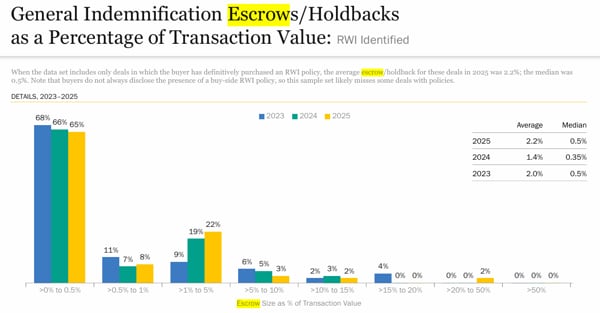
The phenomenon emerges clearly from the data on escrow (the share of the price temporarily retained as post-closing security), liability cap (the upper limit to the damages that the seller can be obliged to indemnify) and persistence of representations and warranties (the period during which the seller's warranties remain valid after closing), which show an increasingly standardised, liquid and seller-friendly market. In particular, the most emblematic figure concerns the escrow post-closing. In 2025 transactions with identified RWI, the median escrow falls to 0.5% of the transaction value, compared to 10% in transactions without insurance coverage.
Loading...

In practice, buyers retain a smaller and smaller share of the amount paid as security for possible future disputes, relying on insurance companies rather than the seller's assets to cover the risk.
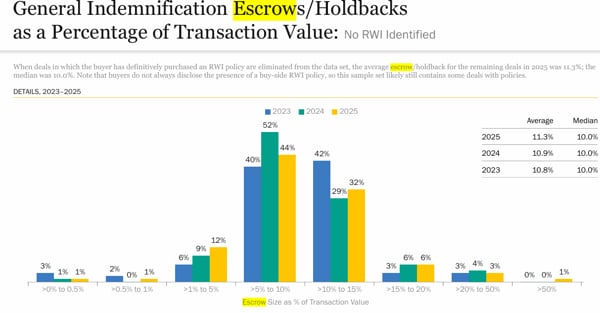
In transactions without insurance, the amount retained was in 2025 in 44% of cases between 5 and 10% and in 32% of cases between 10 and 15%. The percentage of transactions without insurance that had an escrow below 0.5% was negligible (1%). This demonstrates how the risk, in the presence of insurance, is minimised for the seller.

Reduced liability limits

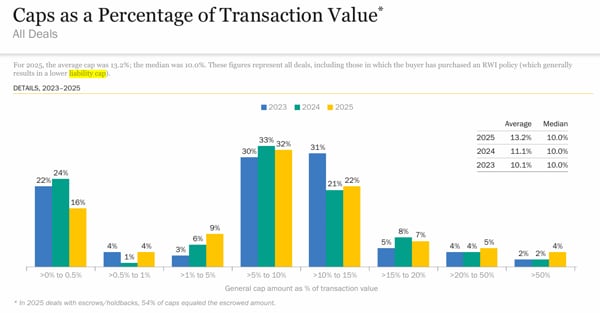
The same dynamic emerges from liability caps (liability cap). In deals with insurance coverage (Rwi), the median seller liability cap stops at 0.5% of the transaction value in 2025, while in deals without Rwi the figure rises to 10%. This is a radical change from the traditional structure of US middle-market M&A deals, historically characterised by long periods of seller liability, consistent escrow and high residual seller exposure after deal closing.
Indeed, the study shows that 32% of 2025 deals are now structured in a 'no survival' mode for the general representations of the seller. In other words, an increasing share of sellers obtain an almost immediate clean exit, drastically limiting their liabilities after the deal closes. Particularly for private equity operators and M&A advisors, the trend has significant implications: on the one hand, the speed of deal execution increases and the so-called negotiation friction is reduced; on the other hand, the risk is 'financialised', i.e. it is redistributed towards the specialised insurance market.

Standardised contracts

The report also highlights how many clauses traditionally considered to be subject to intense negotiation are converging towards increasingly homogeneous market standards. The mmaterial adverse change clauses (material adverse event, change or circumstance that materially affects the target company, its business, financial condition or prospects), for example, appear in 95% of 2025 deals, either as stand-alone (stand-alone) or indirectly (back-door).

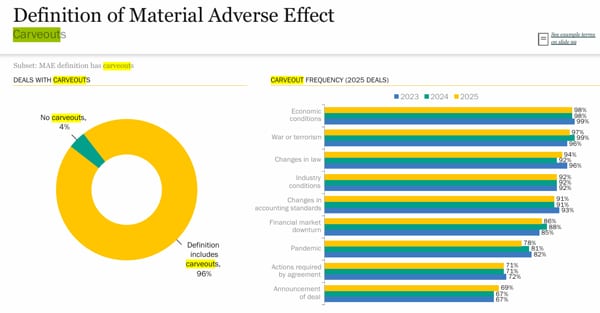
Exclusions (carveouts) included in the definition of material adverse effect, that is, clauses specifying which adverse events are not considered material enough to constitute an MAE for contractual purposes, are present in 96% of deals. Also materiality scraps (mechanisms that neutralise materiality thresholds for indemnity purposes) remain widespread: they are included in 83% of 2025 deals.

M&A documentation is becoming increasingly standardised and modelled on insurance parameters and underwriting requirements. As a consequence, there is less work for both legal advisors and financial advisors during negotiations.

Cyber & privacy

One of the most interesting aspects, however, concerns cyber and privacy, areas that have become central to due diligence in recent years. Data protection declarations and guarantees are now almost universal, present in 98% of 2025 transactions. More surprising, according to the analysts who compiled the report, is the figure for declarations by which a party attests to the robustness of its IT and cybersecurity systems, the absence of significant breaches or attacks, and compliance with applicable data and IT security standards and regulations. The latter dropped from 95 per cent of deals in 2024 to 78 per cent of deals in 2025, against a backdrop of increasing sophistication of cyber attacks and their frequency. The figure may indicate that cyber risk is increasingly being managed outside of traditional contracts (share purchase agreements), through dedicated technical diligence and specialised insurance contracts, rather than through extensive contractual guidance.

The report also portrays a market that is still strongly protective of buyers on some key issues. Representations and warranties of regulatory compliance (compliance with laws representations) are present in 99% of deals. no-shop/no-talk clauses, whereby the seller undertakes, respectively, not to solicit offers from third parties and not to engage in negotiations or discussions with other potential buyers during the exclusivity period with the buyer, appear in 91% of deals.

On the indemnity obligation side, the most frequent exclusions from the liability caps continue to relate to fraud, tax, capitalisation and due diligence on the relevant authority/approval.In parallel, the market confirms the increasing centrality of insurance cover in the economic structure of transactions. In 2025, 44% of all deals will no longer have a general guarantee mechanism through escrow or retained indemnity, up from 41% in 2024 and 33% in 2023. For private equity funds, the benefit is clear: greater certainty of execution, faster distributions to their investors and less tied-up capital post-closing. The overall result is an increasingly 'institutionalised' middle market, where private deals begin to resemble public markets in terms of speed, liquidity and risk transfer.

Copyright reserved ©
Loading...

Brand connect

Loading...

Newsletter

Notizie e approfondimenti sugli avvenimenti politici, economici e finanziari.

Iscriviti