Success Stories

From Mi Ami to Poplar and Red Valley, music festivals generate belonging

The three events have now carved out a significant place for themselves on the national and international scene

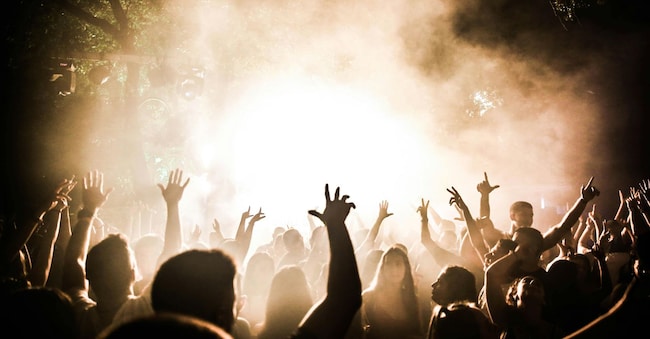
by Camilla Curcio

Credits: Maorattias (Pexels)

8' min read

Translated by AI
Versione italiana

8' min read

Translated by AI
Versione italiana

There are those who describe them as a great cathartic and collective rito, helping to rediscover a sense of community and to break away from the monotony of routine or the screen of a phone. And those, on the other hand, who celebrate them as launching pads for artists who, passing from their stages and to the sound of their own tracks, have made it to the top of the charts or into the ears of an ever-widening audience. The dimension of the music festivals that, especially in the summer season, dot the billboards of Italian cities, seems to be that of a suspended time, where connoisseurs and laymen, youngsters and adults alike forget responsibilities and commitments to indulge in a moment of healthy and joyful lightness.

Mi Ami Festival, Italy's indie presidium

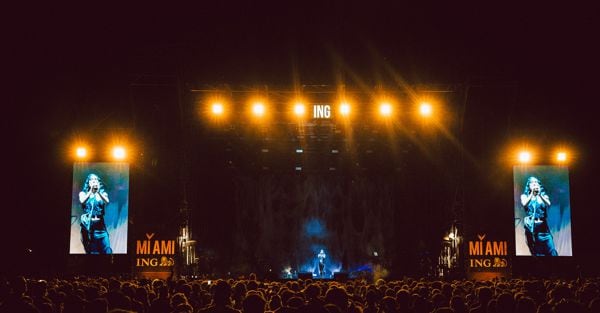
Joy and lightness have, for twenty years now, been the leitmotif of Mi Ami, a cult event at the end of May for Milan (and not only) and a virtuous example of an event that, not letting itself be overtaken by fashions, has never lost the magic of its beginnings.

Loading...

"Mi Ami was born in 2005 as a small festival, with a small budget and the idea of having independent and unknown artists play to support them and make this new music known," says Stefano Bottura, co-founder and director of Mi Ami. "From the beginning to today, the impact of the event on the Italian music scene has certainly changed: we have helped create a a large audience, we have raised the quality both in production - increasing the number of stages from two to five in the last edition, for example - and in the selection of artists, and there has been a real effort to achieve the initial vision and objective: to create an international music festival, such as there are few in Italia, starting from an unusual content, namely Italian music. In 2005 no one listened to it, now everyone listens to just that. We went, therefore, almost in the opposite direction. And now we have started to introduce a breath of Europe, inviting also international names to broaden our gaze and feed this discourse made of continuous research, fire and energy'.

Frah Quintale e Coez, live insieme a sorpresa al MI AMI Festival

And it is this dedication that has transformed Mi Ami into a transgenerational evergreen: "The festival has never wanted to be a product to sell tickets or push sponsors and, without rushing the stages and with organic growth, it has turned into a valuable project for the country's cultural scene and a key junction for the music industry," Bottura notes. "With a precise role: to be a catalyst of energies, create human value, to be a moment of discovery of the new, to give a showcase to outstanding musicians who may have made contact with a record company that had seen them perform with us, and to give the audience a unique sense of unity and belonging. Because our community knows that the festival is a magical moment, you never return home the same as you left".

The facts speak for themselves: from 2005 to the present day, there have been many groups, singer-songwriters and song-writers who, starting from Mi Ami or treading the boards, have gone on to become some of the most iconic names on record rosters. With professional trajectories that continue to reap extraordinary results: "Among those that come to mind is certainly Calcutta, who went on to become a giant in his genre. Or Cosmo and Brunori Sas'.

Credits: Luca Secchi

Mi Ami's soul is made up of fantasy, originality but also bits of identity cemented by the link with the territory and Milan. A relationship that seems, however, a bit peculiar. As Bottura clarifies, 'having the Idroscalo as its location, and therefore moving in an area not really located in the municipality of Milan, in twenty years the festival has never received municipal funding nor economic aid from the institutions. As for transport, for example, this year we paid Atm to extend the service on Friday and Saturday on the blue line. And in 2020 we planted more than 200 trees in the Vettabbia Park. Let's say that, in general, our relationship with the city is a little bit monodational: us towards the city, less the city towards us. And that's a pity because Mi Ami is an enormous resource: with a total audience of around 30,000 and an average of 100/200 euros in theoretical induced revenue, the impact on the territory settles b>between 3 and 6 million. Making a conservative estimate - so that in the first editions there were fewer spectators and less revenue - and counting one and a half million in induced revenue per edition, over 20 editions we arrive at an average of 30 million".

Credits: Kimberley Ross (@kimmika)

Not only that: the capital of Lombardy has also become a location where organisational costs - e.g. those of hosting artists - have risen considerably. "On the other hand, however, we were born here, this is where we thought and imagined everything, we couldn't see it anywhere else and we deserve our work to be recognised.

Because in addition to music, Mi Ami is also a valuable source of stimulation: 'When everything ends, people know that they have seen something they will carry with them for a long time, that they have had a strong experience,' says Bottura, 'and that they have accumulated a lot of inspiration: a lot of people, after the festival, have decided to start playing an instrument or found a band. Or even to replicate, on a smaller scale, an event similar to ours'.

Poplar, virtuous ecosystem in evolution

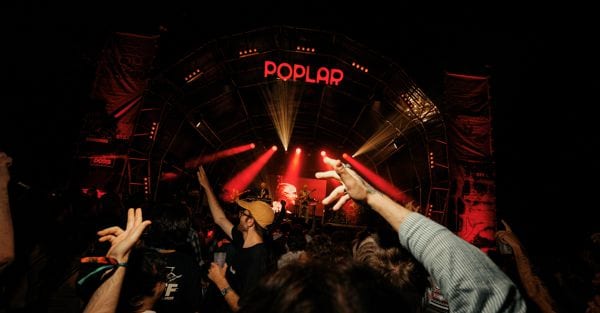
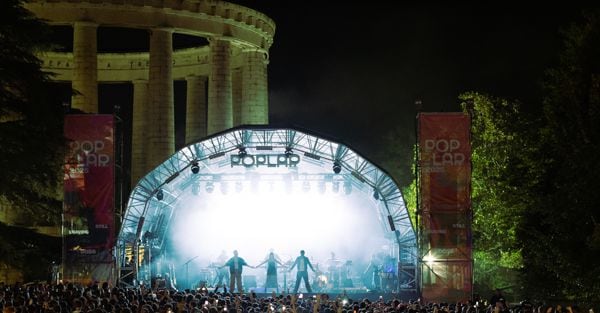
The feeling of being part of a multitude that vibrates and breathes on the wave of the same notes is also a key element of Poplar, a non-profit festival conceived in 2017 in Trento by a group of university students to implement the cultural offer available to young people: "It was born a bit like a party among friends, from the synergy between two student associations, Udu Trento and UNITiN, as something done by students and for students, a free concert in the park," Chiara Pasquali, project manager of Poplar, explains. "Today it is a living laboratory of people and skills, which has generated horizontal growth that is reflected throughout the city".

Credits: Benwksi

The success of the first edition, the good feedback from the community and the push from the territory to get involved were the trigger for years of co-design and innovation: from a one-day festival to a four-day one, from the Parco delle Albere to the Doss Trento - after a series of intermediate stages, including a special formula in the Covid period so as not to lose 'the presence of participation and activism of the event' -, an entrance ticket has been introduced (with restricted entry for security reasons and a lower price than the average festival ticket), the programme has been enriched and today approximately 350 volunteers are working behind the three stages.

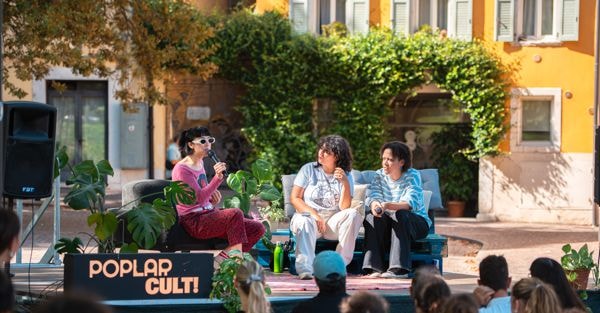
Not only: the main event - from 10 to 13 September - was flanked by the talks of Poplar Cult and Poplar Utopia, a spin-off celebrating the union of music and art in the spaces of the Mart in Rovereto. "This second project in particular has positioned the festival in a range of contemporary art enthusiasts, thus helping us to reach segments other than the usual ones and winning over those who perhaps attend music events but prefer museum-based events," Pasquali emphasises. "The three pieces are part of one body, organs that work independently but are strongly connected.

Credits: Eyes of Eccel

What makes Poplar unique is a line up that does not flatten itself on the mainstream, engaging a heterogeneous target audience ranging from the very young to families: "It is 70, 80% of the festival's identity," explains Luca Bocchio Ramazio, artistic director. "We work on it seamlessly from one year to the next, with curating done 100% by us, without intermediaries and in direct contact with the artists. At the beginning we only pushed the national repertoire, then we made our way to the international multi-genre festivals'. The inspiration is to foreign festivals where the 'local' component is slightly outnumbered by the foreign one. And to pillars of the scene such as the Primavera Sound, the End of the road and Into the great wide open.

'These are all events that live thanks to a very loyal community, which returns year after year,' Bocchio Ramazio continues. "Our idea is precisely to move along this path, cultivating a parterre of spectators who return from edition to edition blindly. We can already see this with subscriptions for the September festival, which are growing year on year over the number of single ticket buyers. And then, for the future, we will deseasonalise the offer, consolidating the initiatives we have launched so far and creating different curatorial lines throughout the year, without extinguishing contact with the public".

Credits: j_alexx

As with Mi Ami (and perhaps even more so), Poplar's identity is inseparably linked to the territory. "Trentino gave us the opportunity to experiment, giving us a space that in other places with many more stimuli and activities we would not have had," Pasquali echoes. "We have strong ties with local administrations and have always received cooperation in return. I don't think there would have been Poplar without Trento. On the other hand, what has the festival given the city? Well, certainly significant economic spin-offs: it fills Trento, fills hotels, campsites and restaurants. But not only: it trains and continues to train professionals and cultural operators, it becomes a reference model for many other events and a training ground for those who, thanks to their work as volunteers for example, have then discovered a passion that they have turned into a real career'.

Red Valley Festival, transversality rewards

Transversal is the right adjective for the Red Valley Festival (13-15 August), born in Arbatax in 2015 and at home in Olbia since 2022, where it has partly fuelled tourist flows and produced an average revenue for the city of around 14 million, consolidating itself among the country's top festivals. "It all started from Edm music, in the first edition Steve Aoki and Deorro played. That was the matrix, until, in 2019, there was a turn towards pop with Salmo," explains Luca Usai, event manager of the festival.

"Today, Red Valley is a cross-genre festival, alternating pop, urban, electronic and dance with the right balance and looking around, between the charts, the market, trends, kermesse like Sanremo and more off-beat choices, to bring to the stage the best of the moment. Not only big names such as Annalisa or Achille Lauro, but also international voices, historical names that sell out even if they are not present on the scene very much, and artists that are perhaps not so strong in terms of tickets, such as the Black Eyed Peas, but that in the live dimension work well and entertain those who pay the ticket".

Edizione da record del Red Valley con 118.175 presenze e 50 artisti

Breaking away from the tradition of multi-stage festivals, Red Valley concentrates the performances on a single, large stage, alternating shows (and musical genres) that are often at odds with each other. A strategy that, although initially giving the organisers some doubts, has since proved successful. Attracting, as Usai confirms, an audience ranging 'from 16 to 21 year olds up to 40 and 50 year olds', with '70% of participants coming from the peninsula and around 30% from Sardinia'.

Considering the location, the impact on the territory evidently involves tourist flows. "Red Valley could only be made in Olbia and exist at that particular time of year," Usai points out. "It is not the main reason why tourists come here, but it is definitely an element that completes the offer: people choose the island to holiday regardless, but they are motivated by the fact that they have the opportunity to see, for four days and with just one ticket, so many artists at the same time. And then there is the return on the supply chain: the hotels register more bookings, the supermarkets work more, the local operators with whom we collaborate experience a higher than normal amount of work'.

The festival's projection into the future rhymes with work in progress. "In recent years we have tried to optimise the experience as much as possible, preserving the essence and changing small things from time to time," Usai closes. "Today, perhaps something more incisive is needed. Perhaps working on the format or reasoning, for example, on logistics, thinking about a 360 degree stage, reducing the artists' slots to make them perform more or lengthening the times of individual concerts. In general, the track remains to keep Red Valley at the centre, without shifting the focus too much to just the names that alternate in the line up'.

Copyright reserved ©
Loading...

Brand connect

Loading...

Newsletter

Notizie e approfondimenti sugli avvenimenti politici, economici e finanziari.

Iscriviti