News

From Wizz Air to Easyjet, why slots at Milan Linate are so coveted

At the airport there is a limit on the number of flights, a ceiling set by Enac: there can be no more than 18 aircraft movements per hour, i.e. no more than 18 landings or take-offs per hour
by Gianni Dragoni

Milano - Aeroporto di Linate

4' min read

4' min read

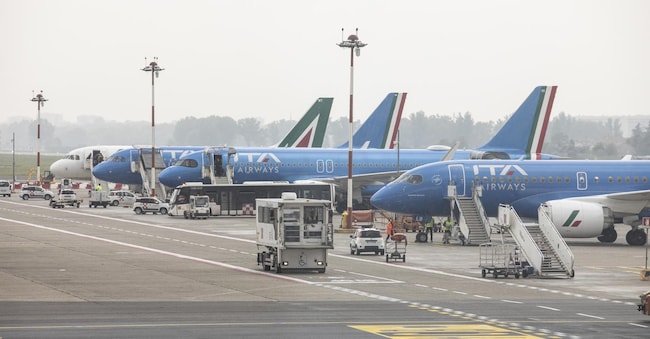
Imagine a congested city where it is forbidden to build new buildings in the historic centre. But many people want to have an office or dwelling right in the historic centre. Obviously, property prices, both for rent and purchase, would skyrocket. This is exactly the situation at Linate airport, Europe's most convenient city airport, just 7 kilometres from the centre of Milan.

The ceiling of 18 movements per hour

.

At the airport there is a limit on the number of flights, a ceiling set by Enac: there can be no more than 18 aircraft movements per hour, i.e. no more than 18 landings or take-offs every hour. Considering that Linate is open from 6:30 a.m. until 11:30 p.m. or midnight, in total a maximum of between 306 and 316 landings or take-offs per day is allowed. That is 153 to 158 aircraft arrivals and as many aircraft departures per day.

Loading...

Saturated Airport

.

The airport is saturated. The hourly landing and take-off spaces, which in aviation jargon are called slots, it would be like saying hourly slots, are very valuable because there is much more demand from companies to make new flights than the supply of available space. Linate had 9.36 million passengers in 2023. The airport is preferred for business traffic flights because of its proximity to the city, which is the main centre of economic life in Italy. Average flight prices from Linate are higher than at other airports and therefore flights are more profitable for companies.

The Ita-Lufthansa operation

.

This explains why there is an ongoing battle over slots at Linate in the game being played before the EU Commission to approve the sale of Ita Airways to Lufthansa. Initially 41% of the capital would be transferred, through a capital increase reserved for the Germans who would pay 325 million euros. But the operation would only be the first step towards the transfer of the majority of the capital of the former Alitalia to the German carrier, a path already carved out in the contract.

The slot rule

.

Slots are not owned by the companies. They are allocated by Assoclearance, the agency that 'coordinates' the airport, and are kept unless a company stops using them. According to the 'use it or lose it' principle, it is enough to use them 80% for each season, which lasts six months. This rule was suspended during Covid because flights were reduced.

Alitalia's legacy

.

The old Alitalia has always had control of the majority of slots at Linate, although over time flights have been reduced and not all slots are used regularly. Thus Ita, which inherited Alitalia's business, holds about 60% of the slots, the hourly slots at the city airport. The Lufthansa group together with its subsidiaries has about 6% of the slots. Therefore, the concentration between the two groups would result in 66% of the slots being held by one entity.

The EU asked for sacrifices

.

Too many, according to the European Antitrust Authority. This is why the EU Commission's Directorate General for Competition has demanded, as one of the conditions for approving the agreement, that there should be a 'renunciation' of a conspicuous share of the slots of the Ita-Lufthansa hub. The extent of the required cut has not been detailed, but this is the heaviest sacrifice imposed by Brussels.

Proposed waiver of 11 slot pairs

.

Lufthansa as buyer, together with the Ministry of the Economy as seller, has put on the negotiating table a reduction of 11 slot pairs at Ita, entitling 11 landings and the same number of take-offs, i.e. 22 aircraft movements, corresponding to 11 daily frequencies from Milan airport. Is it a lot or is it little?

Proposed waiver of 7% of movements

.

Based on the permitted aircraft movements at Linate, 22 aircraft movements per day are equivalent to 7.1% of the maximum permitted movements. Giving up these slots does not automatically mean reducing flights: because Ita has more slots than it actually uses. But if the slots that are released are to be used by other carriers, since the airport is saturated, current flights would have to be reduced to make room for new flights. The question will therefore have to be clarified by also seeing what slot times Ita and Lufthansa would give up.

To whom the slots go

.

What would happen to the slots that Ita would vacate? It is up to the body that coordinates slots, Assoclearance, to reallocate them to other companies that request them. International rules state that in a 'coordinated' airport, i.e. subject to traffic restrictions as Linate is, half of the freed slots must go to new entrant carriers (a rule created to favour competition) and half must go to those who have requested them, according to a waiting list.

The suitors

.

A suitor for Ita's slots is the Hungarian low-cost Wizz Air. As is the British easyJet. Ryanair, on the other hand, has said it is not interested.

Agreements with easyJet and Volotea

In recent days, Ita and Lufthansa have signed preliminary agreements with easyJet and the Spanish company Volotea to allow the two low-cost carriers to start short-haul connections between Milan Linate, Rome Fiumicino and central Europe in order to bring back competition on routes where the Italian-German marriage would give an overwhelming advantage to Ita-Lufthansa. This is another chapter in the demands made by the EU on Ita and Lufthansa. Which is intertwined with the question of slots at Linate. The matter is now on the table of the EU antitrust authority, which has the final say.

Copyright reserved ©
  • Gianni Dragoni

    Gianni DragoniCaporedattore, inviato

    Luogo: Roma

    Lingue parlate: italiano, inglese, francese

    Argomenti: economia, finanza, industria aerospazio, difesa, industria ferroviaria, trasporto aereo, grandi aziende pubbliche, privatizzazioni, bilanci società di calcio, stipendi manager, governance società quotate, conflitti d'interesse

Loading...

Brand connect

Loading...

Newsletter

Notizie e approfondimenti sugli avvenimenti politici, economici e finanziari.

Iscriviti