
The Campiello Prize: why Marcello Fois’s *L’immensa distrazione* won
Literature, understood as a form of memory that restores order to the past and establishes connections in the Sardinian author’s novel

When memory ceases to be a sentimental repository of lost things, it serves to put the past in order, of course, but above all to establish connections between what has happened, what might have happened and what, in the meantime, we have come to understand. It is a narrative faculty even before it is a sentimental one.
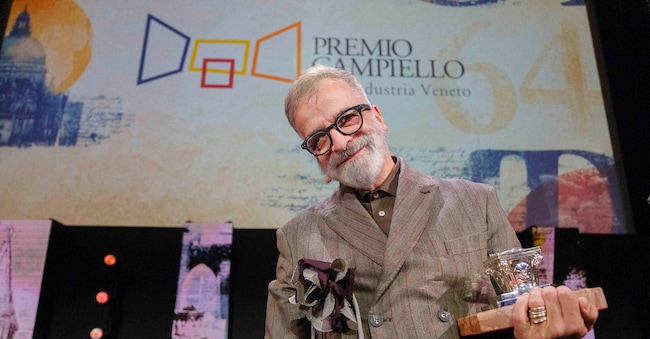
Marcello Fois has built one of the most interesting central themes of L’immensa distrazione, the novel published by Einaudi with which he won the 64th edition of the Campiello Prize. The prize, awarded at the Lido di Venezia rather than at the Teatro La Fenice as is customary (the theatre being closed for stage restoration), marks the culmination of a journey that the writer – originally from Nuoro but long since adopted by Bologna – reflects upon with the calm of someone who has finally gained some distance from himself. ‘I’ve been a perpetually debutant actor,’ he explains. ‘Now,’ he suggests, ‘the time has come to recognise myself in the craft of writing.’
The novel – dedicated to the photographer Daniela Zedda and the writer Michela Murgia (to whom Fois also dedicated his victory) – begins with a paradox of great narrative elegance. Ettore Manfredini, the protagonist, wakes up to find that he is dead. From that moment on, his life unfolds before him like a story that can finally be read. The man who went from being extremely poor to extremely rich, his business, his family, his country and his books: different layers that intersect to form a single story. Death, from this perspective, becomes a necessary distance from which to see, an extreme condition of memory. Fois speaks of writing as a ‘small experience of death’.
‘Every book, in fact, contains the lives we have chosen and those we have left out. Writing means becoming aware of the possibilities we have discarded, the phrases that have stuck in our throats, the occasions that only in hindsight take on their true meaning.’ Literature often arises ‘precisely in that twilight zone where lived experience ceases to be mere chronicle and becomes material for interpretation’, he explains. Hence the writer’s emphasis on education. ‘The more words we have, the less we’ll be taken in by the words of others. Words serve to name the world, and thus to distinguish it. They serve to establish connections, to recognise nuances, to escape the laziness of ready-made formulas. In this view, school takes on an essential task: that of providing individuals with the tools for understanding, not merely a quantity of information.’
Fois emphasises a crucial distinction: information and education belong to different realms. He recalls Rita Levi Montalcini and that stern remark addressed to a generation of parents: ‘You are very well-informed but poorly educated’. Education consists of the ability to make connections. It is the mental act that transforms a series of facts into an intelligible structure. ‘Complexity,’ he observes, ‘demands precisely this exercise. Its simplification, on the other hand, creates the illusion that everything can be isolated from the rest.’ Literature, then, ‘takes on a cognitive function’.

