Mind the Economy/Justice 169

Can a right exist if no one recognises it?

The paradox of human rights: if no law recognises them, can they still exist?

8' min read

Translated by AI
Versione italiana

8' min read

Translated by AI
Versione italiana

President Trump has just signed into law a bill prohibiting Muslims from publicly practising their faith. Places of worship will be closed, gatherings banned, and the publication of religious texts penalised. The law has been passed, and its provisions will soon come into force. The measure has, naturally, sparked huge controversy and fierce protests. Are the human rights of that religious minority being violated? It is hard to disagree. Even though the law no longer recognises it, the right to religious freedom continues to exist. Precisely because that right is being violated, it perhaps manifests itself with even greater force. Or does it? Or, when a law no longer recognises that right, does that right lose its meaning and can its observance therefore no longer be demanded? The answer to this question is less obvious than it seems. If no law recognises that right, no court protects it, no authority is obliged to respect it and no citizen can exercise it without being punished, in what sense can we say that that right exists?

Fortunately, Trump has not enacted any such law. It was merely an exercise in imagination. But that does not mean the question raised by this example should seem any less concrete or pressing to us. It is a problem that becomes clear when we adopt the perspective that John Searle develops in his theory of institutions. In recent weeks we have seen that much of the social reality in which we live consists of facts that would not exist without institutions. Being a homeowner, the chairman of a company, a citizen of a state, or a university professor means occupying a position to which a community attributes certain powers. Searle calls these ‘deontic powers’: rights, obligations, authorisations, permissions and responsibilities. The power of a homeowner to prevent others from entering their home, that of a judge to deliver a judgement, or that of a voter to cast a vote do not derive from the physical characteristics of the people involved. They depend on the status that institutions recognise in them.

Loading...

So far, the mechanism is relatively clear. But when it comes to the issue of human rights, something seems to go awry. A property owner’s right depends on the institution of property. The abolition of private property by law would render that right null and void. But when it comes to human rights, things seem different. Human rights seem to survive even the abolition of the institutions that recognise them. Their origin does not lie in being Italian, French or Iranian citizens, nor in being rich or poor, men or women, believers or non-believers. Their origin lies simply in our being human.

Unrecognised rights

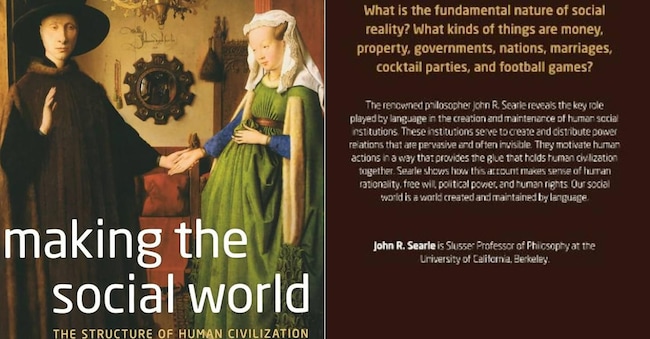
Searle is fully aware of this difficulty. In *i* *Making the Social World* (Oxford University Press, 2010), he observes that we normally have rights and duties by virtue of the position we occupy within a particular institution. But at a certain point in history, he writes almost with amazement, someone had ‘the brilliant idea’ that there were rights held solely by virtue of being human. Humanity itself became, so to speak, a status to which specific deontic powers could be attached. The difficulty this raises is by no means trivial. If rights are deontic powers that exist by virtue of collective recognition, how can a right exist even when, for example, it is not recognised by the society that denies it? This is Jeremy Bentham’s old objection to natural rights. Real rights, Bentham argued, are the offspring of real laws. To speak of rights that predate laws is to ascribe existence to something that does not yet possess any social force. Many years later, Alasdair MacIntyre would radicalise this objection, going so far as to compare belief in natural rights to belief in witches and unicorns. Searle takes this scepticism seriously. He does not counter by saying that human rights are simply ‘found in nature’. On the contrary, he concedes a fundamental point to his critics: we do not discover a human right in the same way that we discover photosynthesis or a chemical element. Rights, too, are realities dependent on human intentionality.

And this is precisely where the problem becomes interesting. We can say, for example, that the universal right to freedom of speech would not have existed as a social institution until someone had formulated and recognised it. But we can also say that a human being living before the Enlightenment would nevertheless have possessed it. The two statements appear to contradict one another. In the first case, the right arises historically; in the second, it seems to possess a validity that predates its actual recognition.

Searle attempts to resolve the contradiction by distinguishing between two levels. On the one hand, there is the actual functioning of a right as a deontic power. For a right to operate socially, it must be recognised: someone must be obliged to respect it, some practice must make it enforceable, and some institution must treat it as valid. On the other hand, there is the basis of status. In the case of human rights, the relevant condition is not being a property owner, a taxpayer or a citizen, but simply belonging to the human species. Condition X is satisfied by the mere fact of being human, and from this condition derives, according to our normative conception, the entitlement to status Y as the holder of certain rights.

This helps us to understand a phrase we use all the time without really realising the paradox it contains: ‘his rights were denied’. If rights were merely what institutions actually grant, this phrase would make no sense. The moment a government abolishes a right, that right would simply cease to exist. We could no longer say that it had been violated. We would simply have to say that it no longer exists. Yet we instinctively distinguish between the institutional recognition of a right and the entitlement a person has to that recognition.

When applied to the subject of justice, this is a crucial distinction. It enables us, in fact, to avoid two opposing errors. The first is to think that every right must derive from some mysterious natural property inherent in human beings. The second is to conclude that, since rights are social constructs, they are valid only when a positive legal system decides to recognise them. Searle’s perspective seeks to strike a balance: rights require institutions to become effective powers, but we can formulate normative criteria on the basis of which certain people are entitled to those rights even when institutions deny them.

The Law and Its Other Side

Here, social ontology finally meets political philosophy. Explaining how a right comes into being does not yet amount to saying which rights we ought to have. Searle’s theory can explain the structure of a right, but it does not automatically derive a complete catalogue of just rights from its ontology. And this is important, because otherwise we would risk confusing two different questions: ‘What does it mean to have a right?’ and ‘Which rights is it right to recognise?’. The first question, however, has a powerful implication for the second. For Searle, a right is never a property that floats in a vacuum. It is always a right vis-à-vis someone. If X has a right vis-à-vis Y, then Y is subject to a corresponding obligation. One person’s right and the other’s duty constitute two sides of the same deontic relationship. If I have the right to walk on a beach, someone has the duty not to prevent me from doing so. If I have the right to freely express my opinions, others – and in particular those in political power – have the obligation not to prevent me from doing so. From this simple logical structure follows a consequence that we are all too easily inclined to forget. If there are universal human rights, there must also be universal human obligations. Searle notes how natural it is to speak of the former and how much stranger the latter expression sounds. Yet we cannot have the one without the other. A right that imposes no obligation on anyone resembles a wish rather than a true right. It is at this point that Searle’s theory becomes particularly demanding. Before proclaiming a new right, we should always be able to answer at least three questions: What precise obligation does it impose? Upon whom? Why should that person be subject to that obligation?

The cost of rights

This distinction becomes clear when we compare freedom of expression with the right to housing. If we say that a person has a right to freedom of speech, it is relatively easy to identify the corresponding obligation. No one must prevent them from expressing themselves. If, on the other hand, we maintain that every human being has a universal right to adequate housing, the relationship becomes more complex. Who is obliged to provide it? The state to which they belong? All other citizens? The wealthiest states? And through what forms of taxation and redistribution? The same applies to the right to education or healthcare, for example.

Loading...

Searle uses this argument to express strong scepticism towards many so-called positive rights and goes so far as to judge certain formulations of the Universal Declaration of Human Rights extremely harshly. His position is debatable, and one need not agree with it. A social right can be perfectly intelligible when political institutions determine, with sufficient clarity, upon whom the corresponding obligation falls and according to which procedures it must be fulfilled. But Searle’s objection retains all its methodological force. Merely calling something a ‘right’ is not enough to turn it into a right. The structure of obligations that the word entails must be made explicit.

This slightly shifts the way we think about justice. We are used to conceiving of it primarily from the perspective of the claimant: what rights the person has, what assets are due to them, what freedoms must be guaranteed to them. Searle’s ontology, on the other hand, compels us to look simultaneously at the other side of the relationship. Whenever a right arises, there is also someone from whom we expect something: not to interfere, to protect, to recognise, to provide, to fund and to guarantee. Perhaps this is precisely the most interesting point. Human rights are not merely attributes of individuals. They are a particular way of organising relationships between individuals. To say that every human being possesses a certain freedom is simultaneously to say that everyone else – and above all the institutions endowed with greater power – must behave towards them in a certain way.

The language of rights thus accomplishes something extraordinary. It takes a biological characteristic – being a member of the human species – and transforms it into the basis of a network of entitlements and obligations that can even be invoked against the state in which that person lives. The fragility of this construct does not make it any less real or concrete. But it reminds us that rights do not survive simply because they are written into nature. They become socially effective when we manage to build institutions through which asserting that a person possesses that right also means, in practical terms, being able to assert that someone else has a duty to respect that same right.

Copyright reserved ©
Loading...

Brand connect

Loading...

Newsletter

Notizie e approfondimenti sugli avvenimenti politici, economici e finanziari.

Iscriviti