

Cancer cell GPS in the new centre of excellence at Pascale in Mercogliano
Thanks to state-of-the-art instrumentation, it is possible to map the geographical interaction of neoplastic cells with the immune system so as to make therapy increasingly effective and accessible to a growing number of patients

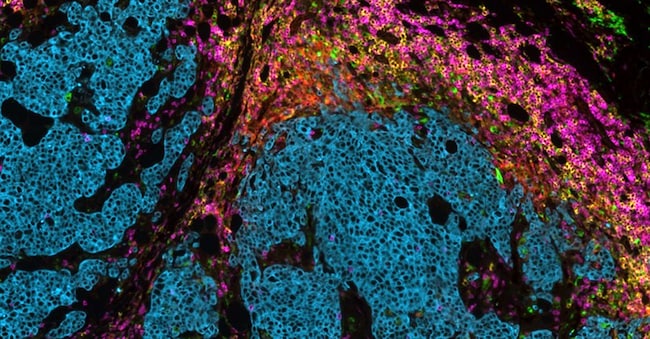
The vital map of a tumour may appear on the screen of microscopes as a brightly coloured abstract work, almost like Van Gogh's 'Starry Night'. In reality, what we observe is an extraordinarily precise representation of the tumour microenvironment, a true GPS map of the cells. It is the most advanced frontier of precision medicine: spatial biology.
The Mercogliano workshop
This is what happens every day in Mercogliano, in the province of Avellino, where the first laboratory in Southern Italy dedicated exclusively to research in immunoncology has been inaugurated. Here, in fact, studies converge that range from the analysis of the microbiome to the genetic profiling of patients through so-called gene signatures, to the identification of new molecular biomarkers. However, the most advanced line of research we are exploring concerns spatial biology, a revolutionary discipline that makes it possible to study the tumour microenvironment with surgical precision.
Traditional genomics analyses tissues as if they were a 'smoothie' of cells. Spatial biology, on the other hand, makes it possible to keep the architecture of the tumour intact, preserving its topographical context. Thanks to state-of-the-art instrumentation, we can therefore map not only the presence of tumour cells, but also their geographical interaction with the immune system.
This approach makes it possible to study the mechanisms of resistance to therapies much more accurately and to work on increasingly personalised treatments. The aim is to make immunotherapy increasingly effective and accessible to a growing number of patients.
An ecosystem of innovation
The Mercogliano laboratory is not just a new technological facility. It is an ecosystem of innovation involving the entire research team of the Pascale Institute, with researchers engaged in the development of advanced immunoncology projects. In this context, the Mercogliano centre represents a strategic point because the Institute's main technological platforms have been centralised here.

