
Carbone: ‘A unique ecosystem linking the tax authorities and professionals’
De Nuccio: Accountants are also at the forefront of cooperative compliance. Sisto: Moving forward on liability limits for statutory auditors. Leo: Tax Code to be finalised by the end of the parliamentary term
by Marco Mobili and Giovanni Parente
Key points
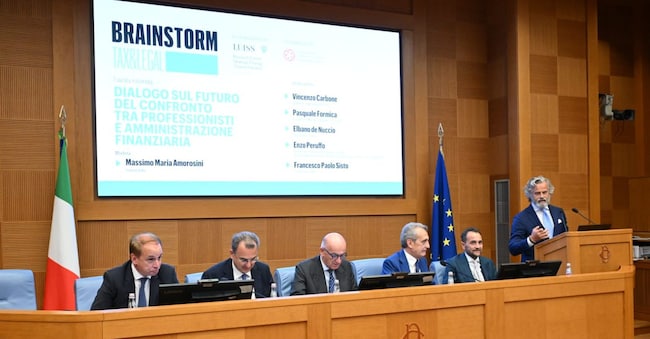
The role of professionals is ‘crucial’. Together with the tax authorities, there is a single ‘ecosystem’, and the evolution of these relationships is set to be shaped by the new tools now in use. Starting with cooperative compliance. This is the message that Vincenzo Carbone , Director of Revenue , conveyed during the closing panel of the ‘Brainstorm Tax&Legal 2026’, organised by Fortune Italia under the patronage of the Luiss ‘Franco Fontana’ Research Centre for Strategic Change and the National Council of Chartered Accountants.
Increasing collaboration
The path we have embarked upon is one of ever-greater mutual cooperation. And there is one concept that encapsulates the very essence of this approach: cooperative compliance. Cooperative compliance is a ‘framework to be treated with the utmost care and the utmost respect’, said Carbone. And the president of the association of chartered accountants , Elbano de Nuccio , emphasised, amongst other things, that the profession is at the forefront of efforts to ensure that the new approach between the tax authorities and taxpayers delivers the expected results.
Artificial intelligence
Another key area is artificial intelligence. Enzo Peruffo, Vice-Rector for Teaching at Luiss, emphasised the indispensable role of the human element in its management. Carbone once again emphasised that the use of AI within the Agency is always and consistently governed by the men and women who work there: ‘We have principles to uphold and must ensure the proper functioning and impartiality of the administration, as laid down in Article 97 of the Constitution. Artificial intelligence helps us to compile, more quickly, a set of data at our disposal. Data which, I reiterate, is used in accordance with constitutional principles.”
The regulated use of new technologies, including in customs
In one of the previous panel discussions, Roberto Alesse , director of the Customs and Monopolies Agency (ADM) , had struck a similar note: ‘Digitalisation and innovative risk management tools facilitate checks whilst also providing reassurance for operators who comply with the rules.’
Tax justice
New technologies are also proving helpful in the area of services. The director of the department, Fiorenzo Sirianni, spoke about the evolution of tax justice. The President of the Tax Justice Council (CPGT), Carolina Lussana, emphasised the importance of the role of professional judges, particularly in terms of legal certainty.


